How Much Does AI Agent Development Cost in 2026?
Listen to this articleTap play to start listening

An Overview: How Much Does AI Agent Development Cost in 2026?
What Is An AI Agent?
An AI agent is an automated software program which understands a goal, analyzes information, makes decisions, and takes action with little human involvement. While a chatbot just provides answers to customers’ questions, an AI agent is capable of interacting with various programs, accessing company data, following work processes, and performing several tasks to reach the set goal.
When a customer support AI agent can comprehend the customer’s request, access the account data, get the status of an order using the API, respond adequately to the request, and open a ticket for human help if necessary.
What AI agent development involves?
The process of developing AI agents involves more than one area of both software and artificial intelligence development. These may include choosing an AI model, planning the instructions for the agent, integration with business data, creation of functionality to invoke tools, creation of workflow capabilities, development of user interface, and integration with business systems.
The agent may also need memory capabilities, retrieval capabilities, authentication mechanisms, monitoring capabilities, security measures, and evaluation facilities. Therefore, AI agent development costs involve much more than just the cost of the AI model. It also encompasses the effort needed to implement business value from the AI capability.
What businesses should consider before estimating a budget?
Before assessing development costs, it is important to establish:
* The problem that the agent needs to solve
* The user group it will be dealing with Its autonomy level
* The information that the agent will need
* The systems and tools it needs to integrate with
* The security and compliance controls needed
* The estimated volume of its use
* How its performance will be evaluated
A defined scope will lead to a more accurate cost assessment than specifying the technology used initially.
Average AI Agent Development Cost in 2026
AI agent cost estimation should go beyond the cost of the AI model alone. Other elements included in the total budget could be Product Planning, Application Development, Data Preparation, Integration, Infrastructure, Security, Testing, Deployment, and Operations.
Why There Is No Single Cost
Each artificial intelligence system is developed for its own unique purpose, from assistants to more elaborate enterprise-level systems. The architecture for an artificial intelligence agent which can answer questions based on a limited set of knowledge will be disparate from an artificial intelligence agent which can use multiple enterprise applications.
The architecture, autonomy, number of users, environment, integration, and security concerns may differ in each case, resulting in a varying degree of development required. Thus, an average figure cannot be used in order to assess the true requirements for the project.
Business Requirements
The business goal must become the basis for the budget estimation of the AI agent. Businesses should understand what kind of task they wish to automate with the AI solution, who will interact with the agent, what systems will be used by it, and how much decision-making should be done by the AI.
In case of an internal assistant, security access to the company’s data might be essential, while customer-oriented agents should have integrations with customer accounts, support systems, and means of communication. Such well-defined requirements will help understand what kind of technology and features are required.
AI Agent Development Cost by Complexity
AI agent development costs vary depending on the complexity of the agent, the number of tasks it handles, and the level of autonomy required. Simple agents generally require less development effort, while multi-step, multi-agent, and enterprise systems involve more advanced architecture and integrations.
Basic AI agents
Basic agents generally focus on a narrow task. These can include answering queries, classifying queries, producing responses, or providing information based on a specified knowledge base. This approach is relatively simple when the agent does not need to interact with external systems or perform actions outside its own environment.
Multi-step AI agents
A multi-step agent can break a larger goal into several actions. If a business operations agent might receive a request, retrieve relevant information, analyze it, call another system, and prepare an output. The development challenge increases because every step needs clear rules, error handling, and appropriate safeguards.
Multi-agent systems
Multi-agent systems bring together multiple specialized agents that collaborate to complete tasks. One agent might handle research, another analysis, and another communication. The Orchestration layer decides the movement of tasks between them. Although such an architecture helps in creating complicated workflows, it also adds other things to be taken into consideration.
Enterprise AI agent platforms
An enterprise platform can serve several agents, users, teams, data sources, applications, and processes. It might also need centralized management, authentication, authorization, monitoring, governance, and integration management. These aspects make enterprise platforms far more complex than an individual AI agent.
Factors Influencing AI Agent Development Cost
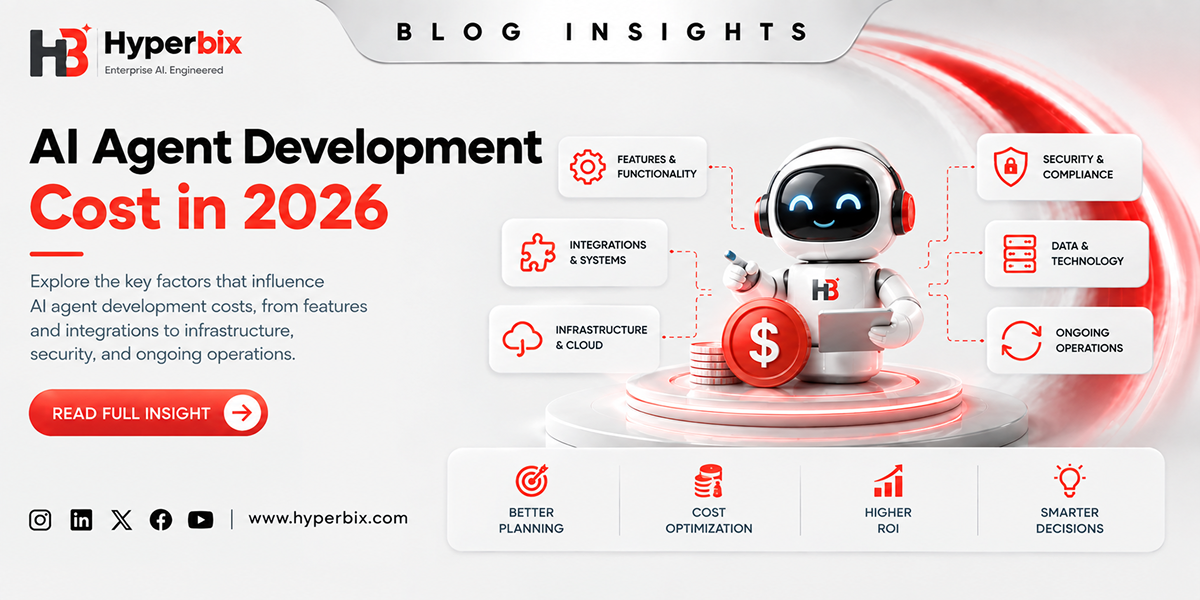
The cost of developing an AI agent depends on several factors beyond the AI model itself. Functionality, data requirements, integrations, security, scalability, testing, and infrastructure can all influence the overall development budget.
Agent functionality and complexity
The number of tasks an agent can perform directly affects development effort. An agent that answers questions requires less logic than one that independently completes business workflows.
AI model selection
Different AI models have different capabilities, performance characteristics, context limits, and usage costs. Businesses should select models according to the actual requirements of the agent rather than automatically choosing the most advanced option.
Model usage itself can also become an operational expense. Cloud providers increasingly separate model consumption from other agent infrastructure costs.
Data requirements
The agent might require access to documents, data bases, APIs, customer data, product data, or internal data. Preparing, cleaning, organizing, securing, and integrating this data might become a considerable portion of development.
Number of integrations
Every external system adds technical considerations. There may be the need for different APIs, authentication, permissions, and error handling for CRM, ERP, payments, helpdesk, analytics, communications, and internal applications.
User interface and platform requirements
A basic chat interface has different requirements from a complete web application or enterprise dashboard. The project may also require role-based access, user management, administration, reporting, or mobile support.
Security and compliance
Business AI agents may interact with sensitive information. The security requirements may encompass such elements as authentication, authorization, encryption, access control, auditing, logging and others. For regulated industries, compliance requirements can add further architecture and testing considerations.
Testing and monitoring
AI systems need more than traditional functional testing. Businesses should evaluate response quality, tool selection, hallucination risk, retrieval accuracy, workflow completion, security behavior, and failure handling.
Monitoring is equally important after deployment because model behavior, data, usage patterns, and connected systems can change.
Scalability requirements
The infrastructure that a certain application is required to have will depend on its intended audience. An agent meant for a small internal team will have an infrastructure different from the one meant for a wide external clientele.
AI Agent Development Cost by Development Approach
AI agent development costs can vary based on the approach used to build the solution, such as existing AI APIs, custom development, open-source technologies, or a complete platform. Each approach involves different levels of development effort, infrastructure requirements, flexibility, and ongoing costs.
Building with existing AI models and APIs
Using existing AI models and APIs can reduce the need to develop foundational AI capabilities from scratch. This approach can be suitable when the business needs an application built around established models rather than its own foundational model.
Custom AI agent development
Custom Development allows for greater control of workflow, integration, data management, user interface, and business logic. It is the right choice when out-of-the-box solutions for agents do not have all the necessary features or when the agent has to integrate well with the current business process.
Open-source AI agent development
Open-source models and frameworks can provide flexibility over architecture and deployment. However, businesses still need to account for infrastructure, model management, security, updates, evaluation, and engineering resources.
Building an AI agent platform from scratch
A complete platform involves much more than an individual agent. It may include agent creation tools, model management, knowledge management, workflow orchestration, authentication, analytics, monitoring, administration, and governance.
AI Agent Development Cost Based on Features
Features should be selected according to business requirements rather than added simply because they are available.
Interaction Through Natural Language: Facilitates user communication through natural language rather than commands, making the agent convenient to use in customer services, internal support, and business processes.
Context Management and Memory: Helps the agent recall information from previous conversations that is pertinent to carrying out a specific task.
Retrieval-Augmented Generation (RAG): Enables the agent to connect to outside sources of knowledge and retrieve relevant information before generation of a response. It is helpful for retrieving company documentation, policies, products' information, and other business-related knowledge.
Tool and API Calling: Allows the agent to interact with external tools, APIs, applications, databases, and business systems, retrieving information or performing certain actions upon user request.
Workflow Automation: Enables the agent to perform a series of business activities connected into one process with minimal human intervention.
Integration With Knowledge Base: The AI agent integrates with structured/unstructured data from the business knowledge base. The agent gains access to necessary business data required to respond to inquiries and perform other tasks.
Multiple AI Agents Coordination: Several specialized AI agents coordinate their efforts when performing complicated tasks. Each agent performs its part of work under the supervision of an orchestration layer.
Analytics and Monitoring: Businesses gain insights into how agents are used, their performance, errors, and task execution results. All these insights assist in identifying problems and improving the agent.
Admin Dashboards: An interface that allows you to manage agents, their users, permissions, configuration settings, knowledge sources, and use cases.
AI Agent Technology Stack and Its Impact on Cost
The technology stack influences both development effort and ongoing infrastructure expenses. The choice of models, frameworks, databases, APIs, and cloud infrastructure can also affect the overall budget and operational requirements.
Large language models - The model handles language understanding, reasoning, generation, or other AI functions. Model selection should reflect the complexity of the task and required performance.
Agent frameworks - Agent frameworks can provide components for orchestration, tool calling, memory, workflows, and other capabilities.
Vector databases - Vector databases are commonly used when an agent needs semantic search over documents or other knowledge sources.
Backend and APIs - The backend manages business logic, authentication, data access, integrations, and communication between the agent and external services.
Cloud infrastructure - Cloud services can provide compute, storage, databases, networking, monitoring, and AI infrastructure. Current agent platforms may separately bill resources such as agent compute, memory, sessions, storage, and model usage, which makes infrastructure planning important.
Frontend applications - The frontend determines how users interact with the agent. This could be a web application, internal dashboard, mobile application, or embedded business interface.
Third-party AI services - Speech recognition, document processing, search, translation, analytics, and other AI services can add additional usage-based operational costs.
AI Agent Development Cost Breakdown
The overall cost of AI agent development is distributed across several stages, from planning and design to development, integration, testing, deployment, and maintenance. Understanding these cost components helps businesses create a more realistic budget for their AI agent project.
Discovery and planning
This stage defines the problem definition for the business, users, processes, sources of data, integration, success factors, and the technical requirements. Proper planning can help avoid unnecessary functionality in the initial scope of work.
Architecture and UX Design
The architecture sets the interaction of the agent, models, data, tools, APIs, security controls, and applications. UX Design deals with user interactions with the system.
AI agent development
This includes agent instructions, reasoning workflows, tool use, memory, retrieval, business rules, and related application logic.
Backend and integrations
Backend programming allows integration of the agent into databases, API’s, CRM and ERP solutions, communication tools, and various other business applications.
Testing and quality assurance
Testing needs to address both functional and AI-driven aspects. Evaluation can include response accuracy, retrieval quality, tool usage, security behavior, and workflow completion.
Deployment
Deployment includes environment setup, authentication, infrastructure setup, database setup, monitoring, and access to production.
Monitoring and maintenance
AI agents need to be monitored as the models, APIs, business data, and user behavior might evolve. Maintenance can involve addressing integration issues, refining prompts, optimizing workflows, infrastructure management, and analysis of model updates.
AI Agent Development Cost by Business Use Case
Customer support agents: These agents can answer product questions, retrieve customer information, classify requests, and support service workflows.
Sales and lead generation personnel: Sales personnel are capable of qualifying the lead, collecting information, updating the CRM software, and participating in follow up activities of sales.
Marketing agents: Marketing agents can support content research, campaign workflows, audience analysis, and reporting.
Internal knowledge agents: These agents provide employees with access to company policies, documents, processes, and internal knowledge.
Data analysis agents: Data agents can help users explore business information, generate summaries, identify patterns, and support analytical workflows.
IT and workflow automation agents: IT agents can assist with support requests, system checks, task routing, and repetitive operational workflows.
Finance and operations agents: Finance and operations agents can support reporting, document processing, information retrieval, and process coordination. These applications usually require careful access controls and validation.
Hidden and Ongoing Costs of AI Agents
AI agent costs do not end after the initial development and deployment. Ongoing expenses such as model usage, cloud infrastructure, data storage, monitoring, security, maintenance, and system updates should also be considered when planning the overall budget.
AI model and API usage: Each interaction can consume model resources. Costs can depend on model selection, input size, output size, request volume, and other provider-specific factors. Current AI platforms use different consumption models, so usage should be monitored rather than treated as a fixed expense.
Cloud hosting: Applications require computing, networking, storage, and other infrastructure.
Database and storage: Knowledge bases, conversation history, agent memory, logs, and application data can require ongoing storage.
Monitoring and observability: Businesses may need tools for logging, tracing, performance monitoring, error tracking, and AI evaluation.
Security updates: Security is an ongoing responsibility. APIs, dependencies, authentication systems, and infrastructure need regular review.
Model and prompt improvements: AI agents may require updates as business needs evolve or AI model behavior changes.
Maintenance and support: Integration might break, API changes can happen, information might go stale, and there might be new business needs. These costs should all be included in the budget from the start.
How to Reduce AI Agent Development Costs?
Cost optimization does not have to come at the expense of essential functionality. It means focusing resources on the capabilities that provide meaningful business value.
Start with a focused use case
Begin with a clearly defined problem instead of automating an entire department.
Use existing models and infrastructure where practical
Existing models, APIs, frameworks, and cloud services can reduce unnecessary foundational development.
Prioritize essential features
Start with the capabilities that directly support the main business objective. Once the core workflow is validated, additional features can be added based on evolving needs.
Build integrations incrementally
Connect the most important systems first. This helps avoid unnecessary integration work during the initial development phase.
Plan for scalability from the beginning
The architecture should leave room for growth without forcing the business to build every enterprise capability immediately.
Monitor AI usage and infrastructure costs
Usage monitoring helps identify expensive workflows, unnecessary model calls, excessive storage, and inefficient processes.
Cloud providers are increasingly adding cost-control and billing tools specifically for agent workloads, reflecting the importance of managing usage as agents become more complex.
How to Calculate Your AI Agent Development Cost?
A practical budget estimate should start with business requirements and project scope, rather than choosing technologies first.
Describe the Business Goal
Define the specific business challenge the AI agent is expected to solve. Make sure that you specify the business result rather than just a description of the technology.
Identify Required Functions
Describe the tasks that the agent will need to accomplish – for example, answering questions, fetching data, making API calls, and automating processes.
Describe Needed Integrations and Sources of Data
Make a list of all the databases, applications, APIs, documents, and business systems that you will need to integrate. The number and complexity of integrations can significantly affect the overall development process.
Choosing the Development Approach
Decide which development approach will suit your needs the most – using an AI API already available on the market, developing your own AI solution from scratch, using open source software, or working with an AI agent platform.
Estimate Development and Infrastructure Costs
Take into account the development resources, AI services, databases, APIs, cloud infrastructure, security measures, testing and deployment, etc. Reviewing these components will help to understand your overall budget better.
Estimate Ongoing Operational Costs
This includes the operational cost of the model, hosting, monitoring, maintaining the agent, and any other continuous operational expenses.
AI Agent Development: Build vs. Buy
Factor | Build an AI Agent | Buy an AI Agent Platform |
Customization | High flexibility to design features around specific business needs | Limited to the platform’s available features and customization options |
Development Control | Full control over architecture, workflows, data, and integrations | Platform provider manages the core technology |
Development Effort | Requires planning, development, testing, and deployment | Faster to configure and launch using existing capabilities |
Integrations | Can be built around existing business systems and APIs | Depends on the platform’s supported integrations |
Data Control | Greater control over how business data is stored and processed | Data handling depends on the provider’s policies and infrastructure |
Scalability | Architecture can be designed according to future requirements | Scaling options depend on the platform |
Maintenance | Business or development team manages updates and maintenance | Provider typically handles platform-level updates and maintenance |
Security & Compliance | Security controls can be designed according to business requirements | Security features depend on the platform and its compliance capabilities |
Upfront Development | Requires internal or external development resources | Usually involves configuration rather than building everything from scratch |
Best Suited For | Businesses with unique workflows, specialized requirements, or greater control needs | Businesses looking for existing AI agent capabilities with less custom development |
Evaluating the Business Value and Monetization Potential of AI Agents in 2026
For businesses developing AI agents as products or commercial services, monetization should be considered alongside development and operational costs.
Choosing a suitable monetization model
Choosing the right monetization model helps businesses determine how users will pay for the AI solution and how revenue can be generated sustainably. Common AI agent monetization approaches include:
Subscription-Based Model: The customer subscribes by paying a recurrent charge for accessing the AI agent and its functions. Different subscription plans can be offered based on customer needs and the functionality included.
Usage-Based Pricing: The customers are charged depending on the extent of their usage of the AI agent. The pricing could be tied to the number of interactions, requests, task completion, or other usage metrics.
Per-Seat Pricing: Companies pay per the number of seats that access the AI agent. This is usually an ideal model for business solutions or collaboration software used internally.
Freemium Access: There is a free basic level of access to the AI agent while more advanced functions are accessible via paid plans.
Transaction-Based Pricing: There is a charge on the AI agent when it has completed certain transactions or actions related to businesses.
API-Based Billing: A company pays to incorporate the capabilities of the AI agent in their application or platform via API. Billing can be structured around API usage or the selected service tier.
Enterprise Licensing: Companies pay for extensive licensing of the AI agent to use in various business units. An enterprise license may include administrative options, security features, and customer support.
White-Label Solutions: The AI agent is supplied to one business for use as a product of their own brand. The customer manages the user interface, and the supplier controls the AI agent technology.
Custom AI Agent Services: Companies pay for an AI agent tailored to their business processes. Custom AI agents suit cases when standard AI agent solutions do not satisfy special business requirements.
Factors to consider before launching
Before the launch of the AI agent product, factors such as the need of the potential customers, the differentiation offered by the product, manageability of the costs of operations, and compatibility of the price with the usage must be considered.
Factors such as the dependability of the agent, the scalability of the product, its security, and the requirements of integration must also be taken into consideration.
How Hyperbix Approaches AI Agent Development?
Hyperbix approaches AI agent development around the specific business problem rather than treating every project as the same type of AI implementation. The process can begin by understanding the workflow, users, data, systems, and desired outcomes. From there, the appropriate agent architecture can be defined.
The development of an AI agent begins with setting out business objectives and choosing an appropriate architecture that would help accomplish this reasoning, remembering, retrieving, and automating tasks. Moreover, it includes integration of relevant business data, APIs, applications, workflow design, testing of the agent against business needs, and further monitoring of its performance. The objective of this process is to develop an AI agent that meets business workflow needs.
Conclusion
The total cost of development of AI agent in 2026 is influenced by many factors apart from the selection of AI model. The complexity of the project, the required integrations, data, features, infrastructures, security, development costs, and the operational costs need to be considered in the total investment.
Thus, companies should refrain from calculating the cost based on one technology or feature. Instead, they could follow the business objective, the capability requirements, the integration and data requirements, and the correct development strategy along with development and operational costs.
It is thus possible to build practical and scalable AI agents using proper scope definition, technology selection, integration, and cost management. Businesses looking for AI development services can also work with experienced teams to define the right approach for their requirements.
Blog FAQs
Frequently Asked
Questions
AI agent development costs vary based on the agent’s complexity, features, integrations, data requirements, technology stack, security needs, and ongoing operational requirements. There is no single cost that applies to every AI agent project.
Key factors include agent functionality, AI model selection, data requirements, integrations, user interface, security, testing, monitoring, and scalability requirements.
Yes. Different AI models have different capabilities, usage requirements, and operational costs. The model should be selected according to the agent’s actual business and technical requirements.
A simple agent with a focused task generally requires less development than an agent involving multiple tools, workflows, systems, or specialized agents. Greater complexity can require additional architecture, testing, monitoring, and infrastructure.
Yes. Connecting an AI agent with CRM, ERP, databases, APIs, helpdesk platforms, or other business systems can add development and testing requirements. Authentication, permissions, and error handling may also need to be addressed.
There will likely be costs associated with using the AI model and API, cloud hosting, databases, storage, monitoring, security patches, maintenance, and improving the model or prompt.
The decision should be based on the business needs. Custom development allows for more flexibility regarding workflows, integrations, data, and functionalities, whereas an out-of-the-box AI agent platform is an alternative option that will require less custom development.
Features like memory, RAG, tools/APIs calling, workflow automation, integrating with knowledge base, collaboration between agents, analytics, monitoring, and admin dashboards can expand the technical scope.
A business can concentrate on particular use cases, consider necessary functionalities, rely on available AI models and infrastructure as much as possible, integrate gradually, and monitor usage of AI and infrastructure.
The process can start with identifying the business goal, necessary capabilities, integrations, data sources, development approach, infrastructure, security, and operational costs. A well-defined scope of work results in a more accurate estimate than choosing technologies first.