What Is Conversational AI? A Complete Guide
Listen to this articleTap play to start listening

Introduction
The development of conversational AI is changing the approach of customers when working with businesses and online platforms. Instead of filling out menus or forms, using chatbots, customers can use the conversational capabilities of the AI-powered system.
Be it customer support services, virtual assistance services, employee helpdesk services, or intelligent business application, conversational AI is proving itself to be a valuable addition to the digital era. The ability of such systems depends on the technology used in it, the quality of its data sources, and the way it manages conversations.
The knowledge about the concept of conversational AI allows companies to know in what areas of their business can this technology bring improvements. It also allows decision-makers to distinguish between the basic chatbot and an advanced conversational AI system.
What Is Conversational AI?
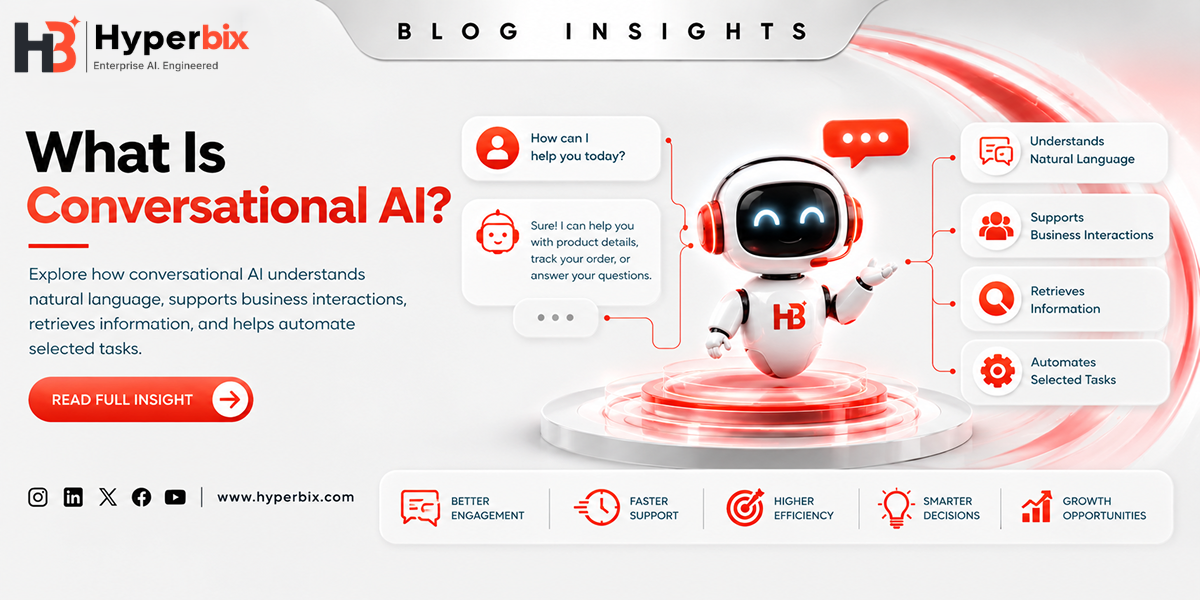
Conversational AI is the technology which allows computers to interact with humans via natural language. It allows software to understand the user’s question, comprehend the meaning of their message, and choose the right answer.
The use of conversational AI in business is to assist customers, respond to sales queries, help employees, and provide information. Based on the design and integration of the system, it may even allow a user to complete a task.
How Does Conversational AI Work?
Conversation AI is an intelligent mechanism whereby a machine understands the user’s message, makes sense out of the message, decides on an answer, and provides the answer to the user through a conversation.
Step 1: Receive the User's Message
The system receives the question through either text input or voice input. In case of voice input, speech recognition is used to convert the user's voice into text.
Step 2: Understanding the User’s Intention
The system processes the question using natural language processing. It extracts key details from the question such as an order number or an address
Step 3: Use the Conversation Context
Using relevant context from the conversation history to handle follow-up queries is an essential step in the process.
Step 4: Retrieval of Information or Creation of Responses
For any questions that might come up, the system can retrieve relevant information from knowledge bases or create a response using an AI model. In some situations, the company policy might be used.
Step 5: Perform Actions, Where Necessary
When necessary, the system is capable of performing different actions in addition to answering the user’s queries. It might include such actions as ticket creation, checking the order status, recording customer queries, etc.
Step 6: Deliver the Response and Upgrade the System
The response is delivered either by text or voice and requests clarification where needed. Businesses have an opportunity to analyze their feedbacks, unanswered questions, and responses to make the system better. Any modification of the system might be required.
What Are the Core Technologies Behind Conversational AI?
Conversational AI involves the integration of various technological tools for understanding the language, processing the information, giving an answer, etc. All technologies are not needed by all systems. It depends on the purpose and degree of complexity that is involved.
Natural Language Processing
NLP helps the conversational AI systems to process and analyze the human language. It helps the conversational AI systems to identify patterns in the language and handle the various forms in which a request can be stated by the user.
Natural Language Understanding
NLU is needed for identifying the intent and meaning behind the user’s message. NLU can, for instance, recognize that “Book a meeting room” means booking some resource.
Machine Learning
Machine learning allows conversational AI systems to spot patterns in data, categorize messages, and train. The efficiency of machine learning depends on the quality of the input data and testing methods.
Large Language Models
LLMs produce contextually relevant outputs. LLMs assist with such tasks as answering questions, providing summaries, and conducting conversations. Businesses can explore LLM development services to build AI applications tailored to their data, workflows, and business requirements
Outputs generated by LLMs should be verified to minimize wrong outputs.
Knowledge Base & Information Retrieval
The conversational AI system utilizes a knowledge base to store useful information such as company policies and products' information. Information retrieval helps conversational AI systems to find relevant information.
Key Components of a Conversational AI System
The technologies that are responsible for creating conversational AI interact via some components that include the following. Knowledge of these components can allow companies to assess which requirements should be met by a solution.
User interface: The place at which the interaction occurs, i.e., a website chat window, a mobile app, messaging system or voice interface.
Conversation processing layer: The component that is responsible for receiving messages from users, understanding the user's intent, conducting dialogue and determining actions to be performed by the system.
AI model: The algorithm utilized for natural language processing, classification of requests and generation of answers. Some systems include more than one model as opposed to one model per each function.
Knowledge and data sources: Approved documents, databases and any other sources of information utilized for answering questions. The access to these sources must be limited according to the sensitivity of information.
Conversation context and state management: The tools that keep useful information active during the conversation process. They ensure that the assistant can understand follow-up questions without asking for previously provided data.
Integration layer: The links between the conversational agent and other applications outside of the system. Through this layer, users can get information retrieval and conduct business functions.
Security and access control: The software which will help to achieve protection of the users’ data, authentication of permissions, and restricting specific actions.
Monitoring and evaluation: The processes carried out to measure the quality of the response generated, to find any problems, analyze the unfinished conversations, and improve in areas where improvements are needed.
How Is Conversational AI Different from Traditional Chatbots, Generative AI, and AI Agents?
Technology | Main Purpose | How It Works | Example |
Traditional Chatbots | Answer common, predefined questions | Proceeds by means of pre-programmed instructions, decision paths or tree | A chatbot provides store opening hours from a predefined response. |
Conversational AI | Understand and respond to natural-language conversations | Relies on NLP, language models, contextualization and connected knowledge base | A virtual assistant answers customer questions about orders and delivery policies. |
Generative AI | Create new content based on user prompts | Produces text, synopsis, explanations or content utilizing AI algorithms | An AI assistant drafts a product description or summarizes a document. |
AI Agents | Undertakes operations with certain objectives | Performs planning and actions utilizing permitted resources using AI | An AI agent retrieves order details, checks an issue, and initiates an eligible support workflow. |
Types of Conversational AI
Conversation AI can be classified based on the type of user interaction and its use case. The two types can overlap, and the same solution could be used for more than one type of conversation.
Text-Based Conversational AI
Communicates via text-based exchanges on websites, applications, and messaging apps. It allows users to ask queries, get answers and suggestions. Example: Web assistant answering customers' queries.
Voice-Based Conversational AI
Enables the use of spoken text for interaction. The use of speech recognition and natural language processing technology to enable such an interaction is done. Example: Voice Assistant.
Customer Support Assistants
Assists customers in comprehending policies, solving problems and getting related information. Proper integrations could enable access to user accounts or initiating a support request. Example: Customer Support Assistants.
Assistants for Employees Within the Company
Provide assistance in locating company policies, procedures, and internal information. They may direct employees towards relevant sources. Example: An assistant showing how to request new IT equipment.
Information Retrieval Assistants
Provide information and explanations from trusted documents, databases, and knowledge bases. They assist in finding reliable business-related answers. Example: An assistant providing answers to questions about product documentation.
Task-Oriented Conversational Assistants
Help users go through certain procedures and assist in doing legitimate tasks. They may gather information, update records, or make requests via connected systems. Example: An assistant filing a customer support ticket.
What Are the Common Applications of Conversational AI in Business?
Conversational AI can be implemented in a variety of areas that involve question-and-answer processes. Its effectiveness depends on whether it serves a real necessity of the company and is integrated with its processes.
Customer Support and Service
The system answers questions related to services, refunds, account settings, customer support processes. Conversational AI allows users to obtain necessary information easily and not wander from one page to another. Complex cases can be referred to customer support managers.
Sales and Lead Generation
Conversational AI interacts with website visitors, answers questions related to provided services, gets requirements of future clients. Conversational AI allows asking additional questions and distributing inquiries among the sales team. It will help to structure leads for future processing.
E-commerce and Product Search
Conversational AI assists buyers in searching for products, comparing its properties, obtaining information about current orders. Users may tell what kind of products they are looking for using natural language. Reliable product information is important here.
Human Resource and Employee Assistance
Employee assistants provide solutions for any queries related to organizational policy, hiring, or leave management. They could guide employees regarding what forms, documents, or departments they could refer too. Certain sensitive actions may require extra verification or approval from a human.
Finance and Administrative Processes
Conversational AI will be helpful for users seeking information related to invoice process, financial policies, and administration processes. With proper integration, it could even provide invoice status or send queries to the correct department. Financial data requires proper authorization and authentication.
IT Helpdesk and Technical Assistance
Conversational AI directs employees with regard to troubleshooting and processes in IT. This is useful in getting details about an issue and submitting support ticket when required. It will be useful in helping the IT team identify issues and manage support tickets.
Communication in Healthcare Services
Healthcare assistants will be able to assist patients in acquiring knowledge on issues surrounding appointments, clinics, and administrative processes. They will be able to point patients in the right direction in terms of information and services. Proper confidentiality should be assured during these interactions.
Education and Learning Assistance
The conversational AI is good for assisting the learner understand the learning materials and source relevant information from the courses. Learners must critically assess answers provided by AI.
What Are the Benefits of Conversational AI for Businesses?
The application of conversational AI can enhance the way in which a business provides information and conducts interactions. This will be based on the nature of the implementation process, its applicability, and maintenance of the program.
Easier Customer Interactions: Helps the customers query things in a more natural manner and makes information access easy.
Automation of Support Functions: Deals with common questions and enables the support personnel to focus on complicated issues of the client.
Easier Access to Business Information: Facilitates easy access to the business information, product policies and queries in simple terms.
Lead Generation: Engages with the visitor on the website, finds out his requirements and helps to generate leads for the company.
Workflow Integration: Introduces workflow integration with business applications for support ticket management, etc.
Challenges and Limitations of Conversational AI
Despite its useful functions, there are difficulties connected to using conversational AI that businesses should be aware of. Awareness of these difficulties will allow companies to have realistic expectations and develop more reliable solutions.
Incorrect or Inaccurate Answers: The output of AI could be wrong at times; hence the importance of proper testing of knowledge sources and reliable ones.
Data Security and Privacy: Personal data and confidential information have to be safeguarded against any kind of thefts.
Data Integration Problems: This involves integrating AI with already established CRM platforms and business software.
Lack of Contextual Understanding: At times the system fails to understand ambiguous inquiries from users.
Regular Testing and Maintenance: Periodic performance evaluations are required as well as regular maintenance of the system.
How Can Businesses Implement Conversational AI Effectively?
Successful conversational AI implementation begins with a clear business need rather than selecting a technology simply because it is available. Businesses should identify the problem, understand the people who will use the system, and decide how to evaluate its usefulness.
Identify the Business Problem
Identify specific challenges, such as repetitive customer inquiries or manual workflows, that conversational AI can solve. A clearly defined problem helps align the solution with business goals.
Define Users and Use Cases
Determine who will use the system and what tasks it should perform. This helps establish the required features and limitations.
Select Suitable Technologies
Choose appropriate technologies, such as NLP, LLMs, RAG, or APIs, based on business requirements. The right combination ensures efficiency without unnecessary complexity.
Prepare Reliable Knowledge Sources
Use accurate, relevant, and updated documents, policies, and databases to support reliable responses. Well-maintained knowledge sources improve answer quality.
Plan Integrations and Permissions
Connect the AI system to the necessary business applications while implementing appropriate access controls. Certain sensitive actions may require extra verification or approval from a human.
Design Natural Conversations
Create simple, user-friendly conversations that understand common questions and follow-ups. Ensure the system can clarify requests and escalate unresolved issues.
Test Realistic Scenarios
Test common questions, ambiguous inputs, unexpected requests, and security controls. Evaluate response accuracy, task completion, and the overall user experience.
Monitor and Improve
Track performance metrics, user feedback, and unresolved requests after deployment. Use these insights to update knowledge sources and improve system performance.
What Is the Future of Conversational AI?
AI-based conversations are becoming more than just question and answer exchanges. The developments in language models, information search, voice, and integration of the systems create new possibilities of more adaptive digital assistants.
More Natural Voice Conversations
The speech recognition and synthesis technologies are becoming more and more advanced. Businesses will be able to implement them for customer service, their own employees, and hands-free services. It is still crucial to have accurate recognition under different accents, languages, and noise conditions.
Multimodal Conversation Experience
Multimodal AI will allow processing text, images, audio, and document data in one conversation. A customer may send an image of the product that has some issues, and receive assistance in finding the problem.
Increased Context Awareness
The conversational AI is capable of responding based on the conversation history and business information that may be associated. This would make it possible for users to complete their tasks without having to repeat the same information over and over again.
Increased Utilization of AI Agents
Conversational applications can integrate natural language capabilities with the functions of AI agents who can do certain actions. For example, an assistant can gather a service request, file a ticket and report the outcome. Reliable integration, permissions, and human intervention still remain important.
Higher Emphasis on Governance and Trust
There has been an increased emphasis on transparency, privacy, security, and accountability in AI systems by businesses. Usage boundaries, access management, and human escalations can help build trust among users. Value lies in providing reliable assistance within defined boundaries.
Conclusion
Conversational AI allows people to use natural language to communicate with computer programs to ask questions, acquire information, and perform selected tasks. It can help in various business operations, including customer service, sales, e-commerce, and employee support. Businesses exploring these capabilities can learn more about AI development and how it supports practical business applications.
Responses’ accuracy, data privacy, complicated integration, and human factors should be considered when implementing such technology. Organizations must set particular goals, ensure the information source’s reliability, and select appropriate tools to benefit from conversational AI, learning its specific features and providing an opportunity to measure performance.
Blog FAQs
Frequently Asked
Questions
Conversational AI is a kind of technology that helps computers perceive and give the answers for human speech. This one allows businesses to provide answers, assist customers, help employees, and perform some actions.
Conversational AI receives the text or voice messages, interprets the intentions of the user, uses the conversation context, and gives a reply or creates a reply. In case it is applied to business applications, conversational AI will be able to perform some actions such as creating tickets for the support service or checking the order status.
Conversational AI may use natural language processing, natural language understanding, machine learning, large language models, and information retrieval. Technologies will depend on the purposes of the system and its complexity.
Typically, traditional chatbots work based on the pre-designed rules and decision flow in order to provide answers to frequently asked questions. Conversational AI is able to interpret the natural language, take into account the conversation context, and provide flexible responses due to connections.
Conversational AI is concerned with facilitating natural-language communication between humans and computers. On the other hand, generative AI is concerned with generating new content. Generative AI can be employed in the process of conversational AI.
Businesses can utilize conversational AI for customer service, sales and lead generation, e-commerce, helpdesk for employees, finance and administration, IT support, administration in healthcare, and education.
Conversational AI makes information more available, enables automation of repetitive support processes, improves customer communication, helps with lead generation, and connects the communication with business processes.
Yes. By being integrated into authorized business systems, conversational AI can take some predefined actions like creating support tickets, searching for information related to orders, making records, or sending inquiries to relevant departments.
The risks include inaccuracy, data security issues, problems with integration, lack of context, as well as testing and maintenance. Properly chosen knowledge sources and access to the application could alleviate them.
In general, businesses should clearly identify what kind of problem they have, who the users of that problem are and how to solve the problem, choose right technology, create adequate knowledge bases, and do necessary integrations and permissions setting.