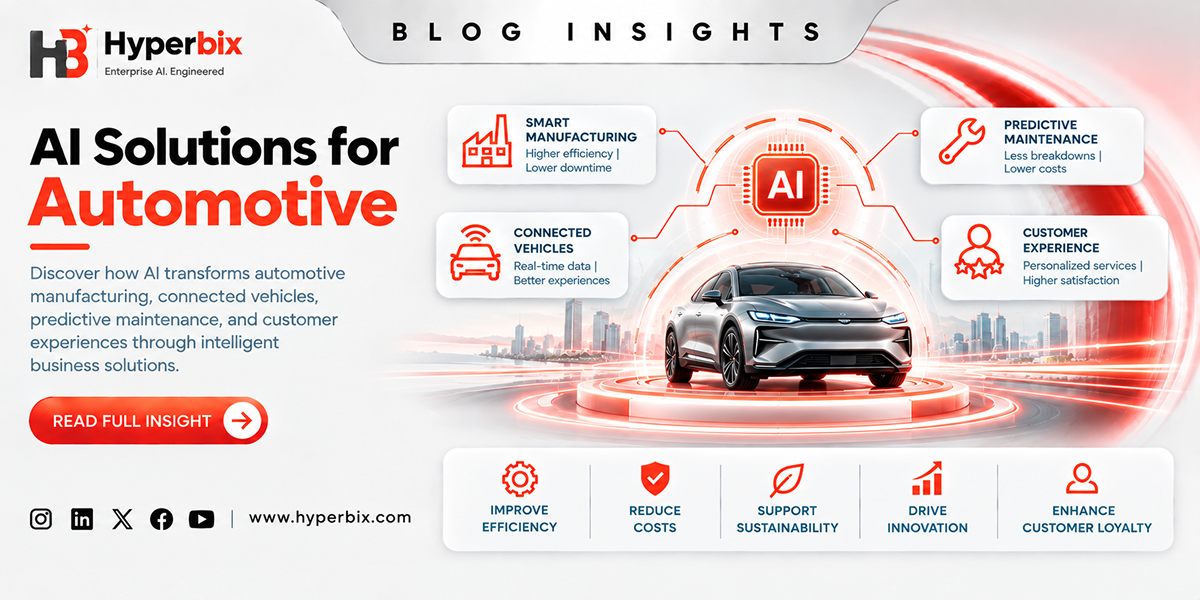
AI Solutions for Automotive: Intelligent Mobility, Manufacturing & Customer Experience
Listen to this articleTap play to start listening

Introduction: Why AI Is Now Core to Automotive
The industry is evolving with the connected car, intelligent manufacturing, and mobility through the software system. Artificial intelligence is revolutionizing the industry by analysing data and optimizing the processes to develop better automotive solutions. It may be about predictive maintenance or automated quality inspection.
AI Is Transforming Automotive Business Operations. Automotive companies can use AI within their appropriate processes to make more informed decisions, solve business issues, and, most importantly, provide a better experience for their customers.
What Are AI Solutions for Automotive?
AI Solutions for Automotive are software systems that leverage automation, machine learning, computer vision, and natural language processing to enhance both the manufacturing and maintenance of the automotive sector and business operations and customer experience.
The above-mentioned solutions will analyze data coming from the cars, machinery on the factory floor, maintenance logs, supply chain management, and customer interaction for any insights.
If, artificial intelligence can be applied to detect the defects during manufacturing, estimate the maintenance plan for equipment, monitor the performance of cars in the fleet, or assist customers with vehicle maintenance planning using smart assistants.
Key AI Technologies Transforming the Automotive Industry
Automotive industry applications require various types of AI. Whether one will use machine learning, vision, automation, etc. It depends on what type of application they would like to solve.
Machine Learning and Predictive Analytics
Machine learning analyzes historical data in order to find out some trends and make predictions.In the automotive industry, AI helps predict equipment failures, forecast demand, optimize production planning, and monitor vehicle performance. For instance, due to machine learning technologies we can determine when the machine would fail and conduct investigations.
Computer Vision and Sensor-Based Intelligence
Computer vision analyzes images and videos in order to find flaws during manufacturing process, equipment inspection, and assessing product quality. Information from car sensors, including cameras and radar, also helps create driver assistance systems and environmental perception systems.
Generative AI and AI Assistants
Generative AI is used in automotive companies to analyze technical documents, find answers to various questions. Through generative AI development, businesses can explore AI assistants may help customers in answering their questions about vehicle features, maintenance processes, and dealership services.
AI Agents and Intelligent Automation
AI agents are capable of performing specific tasks through interpretation of information and engagement with the interconnected systems. An example of this is a car servicing agent which classifies customer needs, gathers the necessary information, and prepares the requests for servicing to be analyzed by the concerned personnel. Permissions and human intervention are crucial for such activities.
Edge AI and Connected Vehicle Intelligence
Edge AI analyses the data either in the device itself or in proximity of the device and can be used in applications where rapid response and minimal dependency on internet connection is required. Along with cloud computing, it can facilitate vehicle diagnostics, fleet management and maintenance scheduling but should have proper security and privacy mechanisms.
AI Applications in Automotive Manufacturing
In automobile manufacturing, there are several processes that go hand in hand, such as component manufacturing, assembling, inspection, inventory management, and maintenance of the equipment used. AI can assist the manufacturers in analyzing data from all these processes and finding ways of improving the quality of their products, minimizing avoidable disruptions, and making better production decisions.
Predictive Maintenance for Manufacturing Equipment
AI analyzes sensor data and examines the performance of machinery to identify the early signs of failure, which assist the maintenance department in investigating the failures.
Automated Quality Inspection and Defect Detection
Computer vision technology assesses pictures of automobile components to determine any defect or assembly errors. It is useful for automated quality control, although in some cases, human inspection is required.
Intelligent Robotics and Assembly-Line Automation
With AI, the robots have capabilities of identifying their parts, understanding sensor readings, and learning how to perform particular manufacturing activities. If used together with safety measures, it enables increased flexibility of manufacturing and assembling activities.
Production Planning and Supply Chain Optimization
AI reviews all data related to demand, inventories, production schedules, and suppliers to reveal any possible shortages and other planning-related problems. This way, auto companies can enhance their management of inventories and production plans.
AI Solutions for Intelligent Mobility and Connected Vehicles
The following are the ways that AI is being used in intelligent mobility such as understanding the environment of the vehicle, assisting the driver and providing various connected services. These applications range widely depending on the level of complexity and the degree of safety they require.
Advanced Driver Assistance Systems
With the help of AI, ADAS utilizes different technologies such as cameras, radars, etc. and provides the features such as Lane Departure Warnings, Adaptive Cruise Control, Automatic Emergency Braking, etc. It performs based on the system specifications, surrounding environmental conditions and validation. Drivers must understand the system’s limitations and remain attentive while driving.
Autonomous Driving and Driver Monitoring
AI assists the autonomous driving system with scene understanding, predicts the motion of adjacent objects and assists in making driving decisions. The driver-monitoring system can detect the inattentiveness of drivers and give alert.
Connected Vehicles and Real-Time Data Analysis
The AI will analyze the data and diagnostic information from connected vehicles to spot unusual trends and make recommendations on how to maintain them. This is useful in assisting service teams in diagnosing potential problems with vehicles.
Fleet Management and Route Optimization
AI will use traffic data, requirements for deliveries, vehicle performance data, and route data to assist in making planning decisions for the fleet. This includes suggesting efficient routes and identifying patterns in fuel consumption.
How AI Improves Automotive Customer Experience?
The journey of automotive customers starts from the research, vehicle choice, all the way up to purchase and maintenance activities. AI technology allows companies to offer customers more relevant information, to deal with their standard requests, and direct them to the appropriate departments.
AI-Powered Customer Support and Chatbots
An AI-based chatbot provides information about different car features, warranties, and dealer services. Having access to CRM or service databases in a secure manner, chatbots classify requests, help in service request process and direct more complicated requests to employees.
Personalized In-Vehicle Experiences
Using AI, car features are personalized for a particular driver depending on their preferences, such as setting preferences for navigation, voice commands, and multimedia suggestions. User control, privacy protection and safety matters should be considered in terms of collection and usage of personal information.
Intelligent Vehicle Recommendations and Sales Assistance
The AI recommendation system allows customers to compare different vehicles based on their needs, like number of seats, purpose of purchase, etc. AI assistants provide detailed explanations about technical characteristics based on approved materials, while sales professionals take care of other tasks.
Predictive Vehicle Maintenance and After-Sales Support
Through analysis of car diagnostics, operational data, and servicing information, AI is able to detect potential need for car maintenance. This can assist in provision of customer services, although it does not substitute manufacturers' scheduled maintenance plans or car checks.
Benefits of AI Solutions for Automotive Businesses
For AI to provide added value in the automobile industry depends on the satisfaction of certain requirements of that technology in the particular sector. To what extent the technology will be valuable will depend on the application and implementation of the technology in addition to evaluation by the company of the results.
Improved Operational Efficiency and Product Quality
With automation technology, AI is able to detect any faults within the production process and plan for testing and automation of tasks. With computer vision, the AI will be able to show possible issues with a particular product.
Enhanced Vehicle Safety and Reliability
AI can be used to implement selected safety functions through identifying road users, interpreting driving situations, and unusual vehicle performance. AI can also be used to detect manufacturing defects and identify maintenance issues in vehicles.
Better Customer Engagement and Service
AI assists in answering common questions, offering product information, and directing the queries to the appropriate department. Service platforms will assist employees to offer better responses, and in cases of complicated inquiries, human interaction is still important.
Data-Driven Decision-Making Across Operations
The process of analysis using AI involves relevant information collected from production, sales, diagnostics of vehicles, services provided, as well as from the supply chain processes.
Key Challenges in Adopting AI in the Automotive Industry
The introduction of artificial intelligence is accompanied by some difficulties. It is important to be aware of these limitations to ensure that companies create realistic approaches.
Data Quality, Availability, and Integration
AI requires relevant and accurate data. Lack of proper maintenance data, out-of-date documentation, and disconnected systems decrease the quality of outputs. Automotive companies should prioritize standardization, data accessibility, and the integration of relevant platforms before implementing AI solutions.
Cybersecurity and Vehicle Data Privacy
Connected cars and businesses' systems store customers', locations', and diagnostic data that could be considered sensitive. Various security approaches include encryption, data access control, monitoring, and software updates. Also, businesses need to take into account related privacy regulations.
Safety, Reliability, and Regulatory Compliance
The application of AI technologies in the control and assistance of drivers is associated with various tests and controls. Companies working with automobiles must evaluate all possible system limitations, scenarios of failure, necessary regulations, and the role of humans in the process before implementing their plans.
Legacy Systems and Workforce Readiness
In many cases, manufacturing equipment and business platforms cannot easily integrate with modern AI solutions. It can be necessary to update relevant interfaces, data formats, and procedures. Training and procedures also allow staff members to understand how AI operates and under what circumstances human interventions become necessary.
How to Implement AI Solutions in Automotive Operations?
The introduction of automotive AI should begin with pinpointing the business issue first, not the new technology. The use of the systematic process will help the organization to select the correct application and minimize the risks associated with the solution.
Identifying Business Challenges and Relevant AI Applications
Select an issue like defects in the manufacturing process, lack of ability to find information, ineffective customer support service, bad fleet management. Select the necessary results and ensure that the AI is the correct solution to the problem.
Assess Data Readiness and Infrastructure
Make sure that you have enough and accessible data. Consider existing infrastructure, integration, security, and computing power. Generative AI applications may also need authorized documents and knowledge resources.
Select the Right AI Models and Technologies
The right technologies will depend on what is needed. For example, machine learning will be helpful to perform the predictive maintenance task, computer vision – to detect visible defects and RAG to find answers based on available documentation. Consider accuracy, risks, necessary integration and possible human intervention before picking your solution.
Integrate AI With Existing Automotive Systems
Integrate your AI application to proper platforms. This will be manufacturing systems, ERP/CRM, accounting/management software, inventory, fleet management software etc. Determine access rules and include proper validation and authorization for actions affecting business processes.
Test, Deploy, Monitor, and Improve AI Solutions
Test your solution on realistic, unusual and problematic examples prior to deploying. Once deployed, monitor your solution performance, accuracy, security, user reaction and changing patterns in data.
How Hyperbix Helps Automotive Businesses Innovate With AI?
There are diverse needs in automotive business enterprises ranging from management of manufacturing data to improved customer interactions and business application integration. Hyperbix helps businesses explore AI development services by focusing on practical use cases, suitable technologies, and integration with existing workflows.
Custom AI Solutions for Automotive Workflows
Hyperbix assists automotive enterprises to examine opportunities of custom AI solutions such as intelligent assistants, predictive analytics, knowledge bases, and workflow automation.
AI Integration With Manufacturing, CRM, ERP, and Vehicle Platforms
AI may connect to compatible manufacturing, CRM, ERP, and car platform applications in order to enhance data access and automation with proper security and data control mechanisms.
Scalable AI Applications for Connected Mobility and Customer Services
Hyperbix allows for exploring scalable applications of AI in connected mobility, customer support, and intelligent operations in a safe manner.
The Future of AI in the Automotive Industry
The future is for AI that is tightly linked to software in cars, manufacturing process, mobility services and customer-related applications. The course of the development would be defined by technical developments, safety needs, regulatory environment, available data and adoption by automotive companies of these technologies.
AI-Defined Vehicles and Software-Driven Mobility
The software-defined vehicle uses software to improve functions of the vehicle itself, whereas the AI is helpful in providing driver assistance, personalization and vehicle health analytics. The secure updates, compatibility and validation of safety requirements are required.
Agentic AI for Automotive Business Operations
Agentic AI will help perform operations such as collecting maintenance information, compiling summary of equipment problems and work request preparation. The permissions and human control are important in managing the important business operations.
Digital Twins and Intelligent Manufacturing
The digital twin technology uses information to model the physical assets and manufacturing processes. Together with AI, it enables the team to analyze processes and look for possible ways to improve them.
The Growing Role of Human-AI Collaboration
AI may be helpful in performing analysis and repetitive tasks, while employees have the necessary skills and can take decisions about exceptions. Using the AI possibilities in combination with the human decision-making process is essential for responsible automotive business.
Conclusion
The applications of AI for automotive businesses include manufacturing, intelligent mobility, connected cars, maintenance, and customer experience. The AI can help with predictive analytics, computer vision can be used for quality control, and generative AI can facilitate technical information acquisition. While there are practical applications available, they depend on good data, proper integration, proper testing, and human supervision.
When choosing to implement AI into the processes of automotive business, one should begin with the definition of the problem at hand. Using the right tools and integrating them into the workflow, one can investigate how to improve efficiency and customer experience.
Hyperbix is here to help you understand how custom AI development can become a part of your business and what kind of implementation can bring the most benefit.
Blog FAQs
Frequently Asked
Questions
AI systems for the automotive industry make use of such technologies as machine learning, computer vision, generative AI, and automation, which can be used in automotive manufacturing, maintenance, fleet management, and customer experience.
AI can help automotive manufacturers predict breakdowns, find product defects, automate assembly processes, control quality during manufacturing, and conduct inventory and supply chain planning.
AI evaluates vehicle diagnostics, sensors readings, and servicing history to see whether the car requires any servicing at all. This data helps to identify potential problems and schedule car maintenance.
AI makes use of vehicle sensors data, traffic, and diagnostics to develop driver assistance, vehicle diagnostics, fleet management, and route optimization.
Generative AI and AI assistants help automotive enterprises to obtain technical data, answer customers’ queries, tell about vehicle’s features, maintenance procedures, and dealership services.
By communicating with the connected systems, the AI agent can be able to classify the service requests, obtain necessary information on the vehicles, summarize the maintenance problems, and generate the work request.
The AI technology has the potential to increase operational efficiency, product quality, identify possible maintenance issues, provide good customer services, and make business decisions using data from various operations.
Some of the challenges include data quality issues, legacy systems, cyber threats, privacy of vehicle data, safety considerations, regulatory compliance, and personnel preparedness.
For the businesses, they need to identify applicable cases, evaluate data readiness, choose appropriate AI technologies, integrate them into their systems, and deploy and monitor the solutions with proper security and human oversight.
Hyperbix assists automotive businesses in exploring AI technology for their custom needs such as intelligent assistants, predictive analytics, knowledge systems, and workflow automation.