AI Agents vs AI Automation: Which One Do You Need?
Listen to this articleTap play to start listening

Introduction: Understanding AI Agents and AI Automation
The arrival of AI technology has altered how organizations process their information, automate their functions, provide customer services, and make decisions. For instance, according to the forecast of Statista for the AI market in 2026, the global AI market size will reach the volume of $707.48 billion in 2026. Thus, it shows how the value of AI technology has increased in any industry and the importance of knowing what technologies there are for businesses.
Two particular technologies are AI automation and AI agents. The former type automates well-defined workflows, whereas the latter type of technology can understand goals, use tools at its disposal, and take actions according to the situation. As per the forecast for enterprise AI agents by Statista, the number of active AI agents in enterprises worldwide will rise from 28.6 million in 2025 to over 2.2 billion in 2030.
What Is the Difference Between AI Agents and AI Automation?
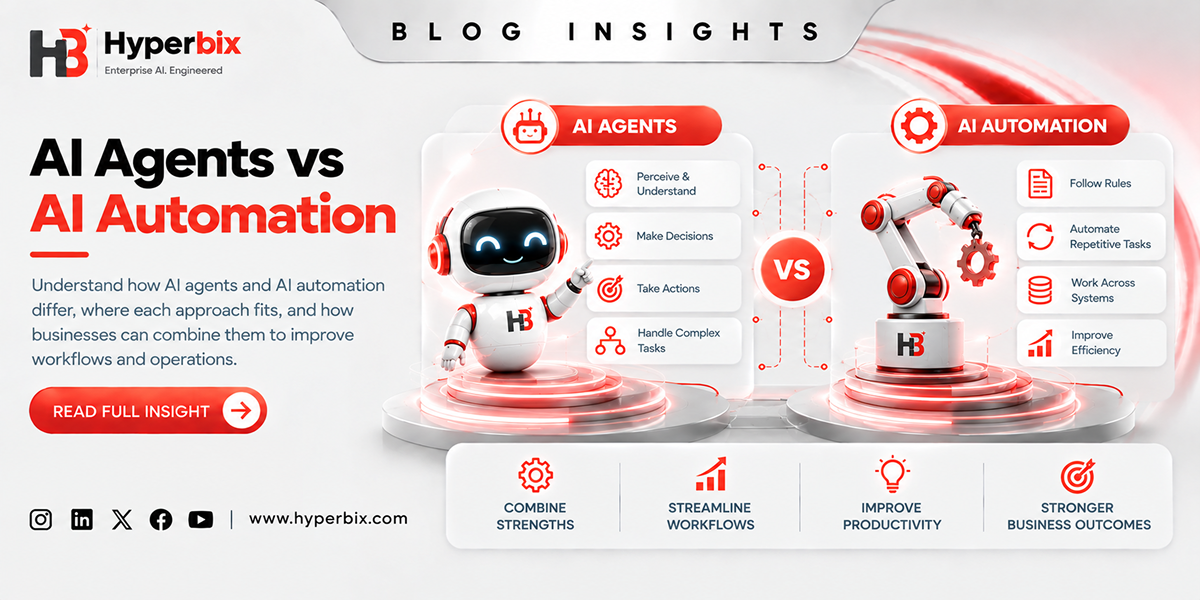
The primary distinction between AI agents and AI automation is that the former can perceive and interpret information and act accordingly, while the latter performs predefined tasks based on rigid instructions or conditional logic.
An illustrative example would be a system sending an automated email to a customer who filled out a contact form on a website, and an AI agent that can analyze the customer’s request, retrieve additional data, and decide whether to respond directly, ask clarifying questions, or forward the request to a human representative.
Both approaches can use AI to process information, support decisions, and improve business workflows. AI automation applies to a repeatable workflow, while AI agents are used to accomplish more complex tasks.
How AI Agents Work and What They Do?
AI agents are software systems that use artificial intelligence to understand objectives, evaluate information, and determine suitable actions to accomplish specific tasks. They use connected devices or even corporate systems to collect facts and make context-based decisions while undertaking multiple tasks.
How AI Agents Work
Firstly, the agent acquires the goal, understands the information and selects an appropriate action. Secondly, it may use tools, evaluate the outcome and decide on the necessity of further actions.
For instance, the agent may scan customer information, evaluate their qualifications and extract information from the CRM system to create a priority lead list. Yet, its proper operation will require testing, authorization, monitoring, and human approval due to the possibility of errors.
What Is AI Automation and How Does It Work?
AI Automation refers to the utilization of AI technology to perform tasks and process information in a more efficient manner with little intervention from humans. Here, we combine artificial intelligence technology and automation technology to process things like documentation, routing customer requests, etc.
How AI Automation Works
AI automation works with the help of workflows that are triggered by events such as the receipt of an email or a submission of a form, and the information provided is processed through the use of rules, artificial intelligence, or a combination of the two.
The workflows are then used to perform certain actions or send the request for manual processing. For instance, an invoice workflow can be triggered to extract data from the invoice received and cross-verify the information with purchase orders in the system. In cases where there are mismatches, the system can notify the user and send the invoice for approval.
For the process to be efficient, it is important to ensure the fields in the invoice are captured correctly and efficiently, reliable systems are used when exchanging information, and where necessary, manual processing of the invoice is performed.
AI Agents vs AI Automation: Key Differences Explained
Both AI agents and AI automation involve similar technologies, but they differ in terms of task organization, action selection, and adaptability to changes in information. The choice between the two should be made based on the level of complexity of the workflow and flexibility needed by the company.
Comparison factor | AI automation | AI agents |
Primary purpose | Automate defined tasks and workflows | Work toward goals using selected actions |
Workflow structure | Usually configured in advance | Can select different steps based on context |
Decision-making | Uses rules, conditions, model outputs, or configured logic | Can evaluate context and choose among available actions |
Handling changes | Responds according to configured rules and capabilities | Can reassess and adjust actions within its design |
Task complexity | Well suited to repeatable processes | Useful for multi-step tasks with variable paths |
System interaction | Triggers actions in connected systems | Can select and use connected tools when authorized |
Human involvement | Often needed for exceptions and approvals | Can escalate uncertain or sensitive decisions to people |
Oversight | Requires workflow monitoring and exception handling | Requires monitoring of decisions, tool use, permissions, and outcomes |
One vital difference is that these categories are not mutually exclusive. AI automation can have intelligent decision points, AI agents can be part of an automated process, and the comparison is about how the solution is engineered, not just whether it uses artificial intelligence or not. For a well-defined process, a traditional automated workflow is probably more straightforward to implement and audit.
AI Agents vs AI Automation: Feature-by-Feature Comparison
Analyzing individual capabilities can help determine when to use each of the two approaches. Instead of understanding which technology is more developed, companies should look into what a specific task needs.
Workflow control: The AI-based automation technology includes the predefined processes involved in actions such as reminders, updating of the database, and routing process. Actions would be determined depending on the goals of the AI agents and the information available then.
Handling of Information: Information handling tasks are done through automation technology of AI for collecting information from the document, arranging email messages, and workflow initiation. The AI agent will gather information about the environment and make the decision concerning the appropriate action to take.
Flexibility: AI-based automation takes care of variations by use of pre-configured rules and conditions. AI agents will vary their actions depending on the current situation although ambiguous request may cause an error.
Integration with Business System: Both can be integrated with business system such as CRM, databases and internal applications. The automation will perform specific actions while the AI agent will choose the appropriate tool to use for a given task.
Monitoring: AI-based automation is generally easier to monitor since actions are pre-set. AI agent on the other hand will need proper monitoring to evaluate their accuracy and quality of action.
What Are the Real-World Use Cases of AI Agents and AI Automation?
AI automation and AI agents may be applied to similar areas within the various departments to address different aspects of their operations. The below examples demonstrate how companies might utilize both solutions.
Customer service
AI automation can be employed to filter the requests received, send out confirmation messages or relay the queries to the right department. AI agents can read through the messages that customers send and provide solutions to their requests or bring those issues to the attention of human beings. The complex and sensitive requests need to be relayed to the human operators.
Sales and Marketing
AI automation can be employed to sort sales leads, reply to marketing queries and update the CRM database with customer details. AI agents can assist in identifying and analyzing potential sales leads, summarizing customer communications, and coordinating meetings for sales executives. The customer conversation should be reviewed by the authorized marketing executives.
Finance and Accounting
AI automation can be employed to review invoices from customers or suppliers, compare them to other documents and notify the differences in those records. AI agents can gather the required information in order to analyze the discrepancy or the outstanding invoices for reminders. The financial operations should be reviewed and approved by the authorized fiscal departments.
Human resources
AI automation may be utilized to acknowledge the candidate applications, schedule the job interviews, and remind applicants of the upcoming stages. The AI agents may answer the employees’ questions using the official documentation and summarize the relevant policies. The sensitive or complex issues should be addressed by the human resources executives.
Business operations
AI automation may be applied to track inventory levels, issue the low-stock alerts, and update the relevant databases. The AI agents may analyze the collected data in the connected software systems and identify the necessary actions. The purchase, production, or customer-related instructions should be reviewed by the authorized departments.
What Are the Benefits and Limitations of AI Agents vs AI Automation?
Both approaches could be successfully applied in various business processes, but their implementation and design features should be carefully considered while performing specific tasks and algorithms.
Benefits of AI Automation
The use of artificial intelligence could eliminate a significant amount of human labor from the business processes and ensure the achievement of enhanced performance outcomes due to the optimization of various operations. AI algorithms could be relatively easy integrated into the processes with a set of specific triggers and actions to support decision-making and document management.
Limitations of AI Automation
The approach would have significant limitations in case of dynamic changes in the considered business processes or the appearance of unexpected data types which require additional clarification steps. Overall, the effective implementation of AI automation tools would still require proper configuration and continuous adaptation to evolving circumstances.
Benefits of AI Agents
The application of AI agents offers a possibility to perform a variety of multistep tasks, acquire necessary information from external sources, and take appropriate actions depending on the situation. AI agents can be applied in diverse areas to relieve human operators from the necessity to perform exhaustive research and coordinate the work of different applications. Such technology can be used for multistep tasks that have clearly defined goals but require different actions.
Limitations of AI Agents
The application of AI agents bears certain risks depending on the availability of relevant information and tools. In addition, such agents can provide incorrect results, fail to comprehend instructions, and execute inappropriate actions. Therefore, the utilization of AI agents requires additional security measures to ensure that such agents do not violate the privacy of users and cause harm to the business by implementing incorrect actions.
Can AI Agents and AI Automation Work Together?
AI automation performs the predetermined tasks, while AI agents process the information and determine the action needed through analysis. Integrating both AI technologies would enable businesses to streamline their workflows and execute tasks that require flexible and adaptive decision-making.
Example: Customer Service
Automation can direct incoming tickets to the right department, but AI agents will analyze customer problems and access the necessary information from an authorized knowledge base. Requests concerning refunds or any other sensitive issues can be directed to employees for approval.
Working Together
AI automation deals with triggers and actions that need to be repeated, while AI agents deal with information processing and actions. The results of analysis can be passed to the automated process to update the status of tickets or close them.
Key Considerations for Implementation
Introducing AI agents and automation to a company’s workflow is not a guarantee of success; therefore, the implementation should be built considering the responsibilities of each party, integration, data availability, error resolution, and the ability to begin with one process and then move to others. An essential step before the full-scale introduction of the technology is the pilot stage.
How Do You Choose Between AI Agents and AI Automation for Your Business?
Choosing the Right Approach to AI Automation Depends on Business Task and Required Flexibility. Understanding the process itself and its desired results can help the business to make the right choice of solutions.
Determine the Nature of the Task
Task analysis is the next step. The use of AI automation can be applied to those tasks where there are any repetitions in work. For instance, those tasks include reminders, paper processing, request form routing, and database updating. AI bots would be the best choice for those tasks that require information collecting, context comprehension, and action selection.
Analyze Your Business Needs
Consider the complexity of your business process, the amount of data, system integration requirements, security concerns, and human intervention. Define the criteria of success.
Test it Before You Scale it
Start by designating a particular business process and analyze solution’s ability to manage day-to-day operations and address unique circumstances. Study the results, determine the areas of improvement and upgrade your solution before you plan to integrate it into other processes.
Make a Choice: AI Agents Or Automation?
In some cases, the combination of both approaches might be beneficial, but it has to fulfill particular demands of the process. Automation is ideal for mechanical tasks while AI agents are better at withstanding more complex operations which involve making decisions. Do not forget that combination should not make things worse, but improve the existing outcomes.
Make the Right Decision Based on Prioritization
The choice between AI agents and automation is not necessary a matter of which solution is more sophisticated. Thorough analysis of the needs of the business process, followed by pilot testing and opportunity analysis will help you to make the right choice and satisfy your business needs.
How Hyperbix Helps Businesses Build AI Agents and Automation Solutions?
Hyperbix will help to convert your AI ideas and concepts into real-life solutions which will be practical, efficient, secure, and measurable. We do not pay attention to the available opportunities; we concentrate on your approach, operations, and automation concepts, creating a system based on existing solutions and solving particular cases.
AI Automation and Agent Development
Hyperbix can help to create AI-powered systems and agents which will automate your daily routine tasks and processes such as lead routing, document intensive processes, communication, and reporting. Our AI agent development solutions can also handle more complex tasks, including research, contextual data analysis, and interactions with other software systems or agents.
Secure and Responsible AI
We take care of the important issues of systems and processes security, controlled access, human interaction and approval, and audit of operations to help you use AI and avoid some of its problems and challenges.
End-to-End AI Development
From discovery to solution design, development, integration, testing, deployment, and optimization, Hyperbix enables the entire process of AI development. This strategy assists companies in adopting solutions that suit their business processes.
Conclusion: Choosing the Right Approach for Your Business
Artificial Intelligence is suitable for repetitive and predictable tasks and processes. However, AI agents can perform more complex, multi-step operations that involve judgment calls. These two concepts can be used together to optimize a company’s operations so that they can meet all requirements and goals by ensuring proper implementation, data protection, and personnel management.
Hyperbix helps businesses develop custom AI solutions, including AI agents and automation, tailored to their objectives and specific requirements. These solutions can better align with business goals and employee needs than generic, off-the-shelf tools.
Blog FAQs
Frequently Asked
Questions
The AI automation executes tasks according to preset workflows, but the AI agent interprets data, selects actions and changes its approach in order to accomplish certain objectives.
AI automation is an intersection of automated workflow and artificial intelligence used to process information and execute certain tasks according to the set of triggers, rules and AI models.
An ai agent is a computer program that understands the goals, processes information and makes choices on actions to be taken; these programs can also use other tools to accomplish tasks.
Yes. The automation is used to handle routine tasks, but the AI agent can interpret data and choose the right actions to take. Thus, both can be used in certain workflows.
The AI automation would be more suitable in situations where there are repetitive and predictable tasks such as reminders, updates, and requests.
They can support customer service, sales and marketing, finance, human resources, and business operations. Automation handles routine workflows, while AI agents support tasks requiring contextual understanding.
AI automation can reduce manual work, improve workflow consistency, and streamline document processing, request routing, and other repetitive activities.
AI agents may misunderstand instructions, produce inaccurate results, or take unsuitable actions. Proper testing, access controls, monitoring, and human oversight help manage these risks.
Businesses should evaluate task complexity, decision-making requirements, data availability, system integrations, security risks, and expected outcomes before selecting an approach.
Hyperbix helps businesses develop custom AI solutions, including AI agents and automation, through requirements analysis, solution design, development, integration, testing, deployment, and optimization.