What Is RPA? A Complete Guide to Robotic Process Automation
Listen to this articleTap play to start listening

Introduction
Several organizations have been doing various digital processes in a repetitive manner. These include copying information, updating information, form verification, document processing, and sending emails. While these processes are important, they may also distract people from engaging in other important things.
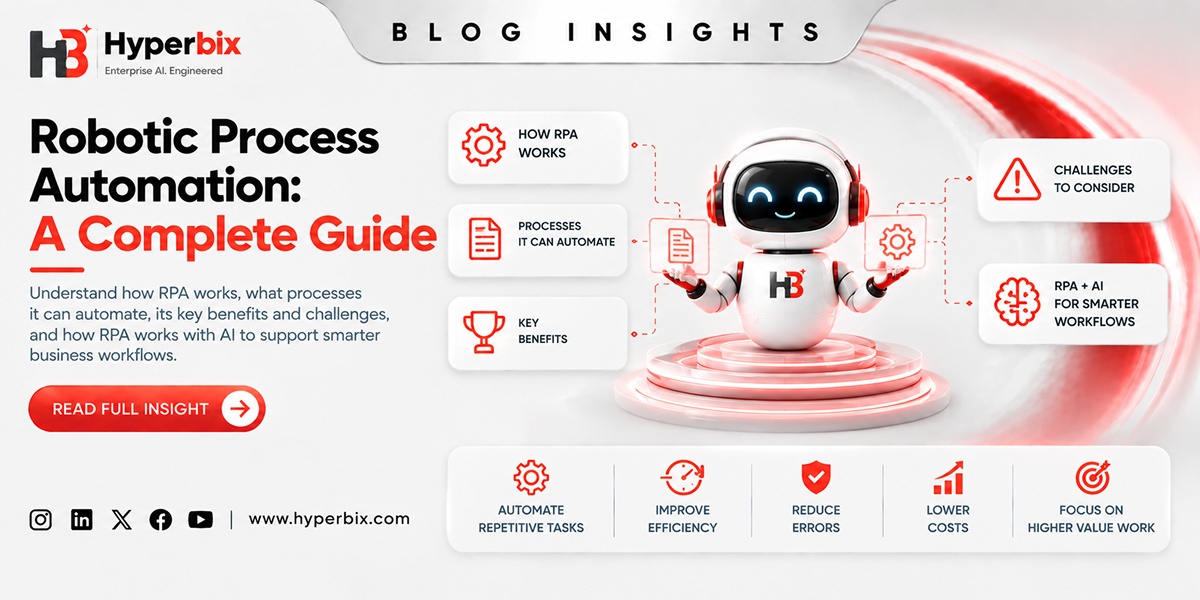
Robotic Process Automation or RPA makes use of bot software that performs various processes in a systematic manner depending on given instruction. The bot software can perform various tasks in digital platforms such as applications, Excel, email, and forms among others.
This process does not automate people. Instead, it enables people to engage in other important activities such as problem solving, decision making, and customer services.
What Is RPA?
Robotics Process Automation, or RPA, is a methodology of implementing software robots to perform repetitive computer-based tasks. Robots are not actual machines. Rather, they are software tools capable of interacting with websites, spreadsheet files, emails, applications, and internal systems.
There are several situations where RPA can be helpful when a certain action is performed repetitively by individuals, for instance transferring information between systems, performing verification, updating information, and sending messages. RPA uses the guidelines provided to the robot and performs all actions in a consistent order.
The use of RPA does not mean that all operations in an organization will be automated. It is a technology for routine activities where rules are clearly stated. Humans still make judgments in cases of decision-making, customer interaction, exceptions, and other creative tasks.
What RPA Bots Actually Do?
These bots follow their tasks through a predefined workflow. The tasks that these bots perform could be information collection, transfer of information from one application to another, validation of the information according to some parameters, and so forth.
The tasks that these bots can perform could be working with files, emails, web forms, enterprise applications, and database entries. According to the tasks that the bots are supposed to perform, they can generate reports, enter information, download files, notify people, or assign tasks to employees.
How Does Robotic Process Automation Work?
RPA transforms the manual process into a digital workflow. The bot follows the pre-established procedure of gathering data, carrying out checking and actions, and handling the exceptions in various applications. The efficient nature of automation is a result of an established process definition, high-quality data, and business rules.
Identifying rule-based tasks
RPA processes have a defined set of actions and decisions based on these actions. Thus, bots can check the existence of order numbers before updating a record. In case of absence of some information, the task is assigned to employees.
Capturing and processing data
Bots can gather data from spreadsheets, forms, emails, portals, and business software. Bots arrange the gathered information, perform checks, and compare the values with those in the database. Artificial Intelligence algorithms can be used to collect the unstructured data.
Executing predefined actions
After the data has been processed, the bot executes the actions which were pre-assigned to it. These actions can include opening of the application, completing forms, creating records, downloading files, and changing the status of the request.
Moving information between applications
The RPA allows to transfer information between disconnected applications. A bot gets data from a file, enters them into a business system and informs the responsible department. Thus, there is no need to constantly use the Copy-Paste function in various applications.
Validating and completing workflows
Before further actions, bots make sure that data correspond to specific conditions. In case data is correct, the workflow goes on; otherwise, bots inform about mistakes and submit them to the review. Thus, incorrect processing of information can be avoided.
Monitoring automated processes
After the deployment of bots, businesses should monitor their activities. Monitoring tools indicate whether bots managed to perform the task or stop the workflow due to errors. Activity logs are useful for identification of problems and updating of workflows.
What Are the Core Components of RPA?
The RPA environment does not only comprise the bot. This environment also contains various tools for designing bots, managing automation, integrating systems, and monitoring outcomes.
RPA Bots
RPA bots are software programs that function automatically on different digital platforms. These RPA bots can log into systems, enter/read data, manage files, and do many other things depending on how the workflow is set up. A company could have individual bots for each team or activity.
RPA Development and Design Tools
Development tools assist the team during design of bot workflows. These tools can be used by users to map out the actions, decisions, validations, and handling of errors in an illustrative form. The workflow must consider both standard and clarification scenarios.
Bot Orchestration and Management
Bot orchestration gives businesses the ability to manage several automations. This is achieved through setting the bot which handles the action, when it will perform this and the assignment of work.
Workflow and Process Logic
The workflow logic is the sequence of instructions that the robot must follow in order to execute its work. This entails the data that will be used, the systems that will be accessed, the decisions to be made, and how an error will be handled. The workflow should have the validation and exception handling steps.
Applications and Systems Integration
RPA integrates into applications via interfaces, APIs, databases, files, or any other authorized system integration. Bots can extract data from one application and update another. The kind of integration to be used is determined by the system of the business.
Monitoring, Logging, and Reporting
Monitoring enables teams to track whether robots are executing their processes. Logs capture the critical events and errors while reports capture the workflow activities and typical problems.
What Types of RPA Bots Are There?
RPA bots can be designed to work with employees, independently in the background, or through a combination of both approaches. The right approach depends on the process requirements, level of human involvement, and the degree of automation needed.
Attended RPA Bots
Attended bots operate on the employee’s computer and help the individual complete a task. Such bots are usually activated by the employee at their discretion.
If a customer support representative may trigger a bot that pulls customer information from various systems within the organization. The bot gets the information, while the representative continues to converse with the customer and make decisions.
Unattended RPA Bots
Unattended bots do not require an individual to manage their actions at each step. These bots can be scheduled or activated automatically when a certain event occurs – such as a file upload or a request in the system.
These bots are best used in back-office operations that include data updating, document routing, record checking, and reports creation.
Hybrid RPA Bots
Hybrid RPA includes attended and unattended automation. The bot can initiate a workflow, pass the exceptional case to an employee, and resume after the employee makes some changes or approves.
This approach is applicable in the case when one part of the process is repetitive while another one needs human judgment.
How Do Businesses Choose The Right Bot Type?
The type of bot depends on the level of employee participation in the process. If the task is performed within the customer interaction, attended automation can be used. In the case of the routine process which can work independently, unattended automation is preferable. Hybrid automation can be applied when there are regular exceptions, approvals, and decisions to make.
What Processes Can RPA Automate?
RPA will be able to perform most of the digital processes if there is a pattern available and accessible information.
Data Entry and Data Transfer
The robots will be able to input the information into forms, spreadsheets, portals, and enterprise software. Moreover, the bots will transfer information from one application to another without having an employee to copy-paste the same information.
Data Extraction and Validation
It will extract data from the structured data, forms, emails, and systems. In addition, it will check for completeness, compare the information with the standards, and detect exceptions.
Invoice and Documents Handling
Bots will assist in the handling of invoices through collecting data, verifying it, updating the accounting system and forwarding exceptions to the right place.
If there is a need to handle documents which have different formats or unstructured data, RPA could operate together with document handling or AI solutions.
Reporting
The robot will collect data from different systems, create a report and save the file. After that, it will distribute it among the appropriate people.
Email & Notification Workflow
The bots are capable of monitoring specific inboxes, filtering out necessary emails, extracting necessary data, and creating notifications based on the predefined criteria. They can create new follow-ups or update records upon receiving any request.
Customer & Employee Onboarding
RPA solution can be employed for onboarding by creating the account, updating record, sending the required documents, informing team members, and executing the process. The employees continue to be responsible for decision-making, approvals, and human interactions.
Repetitive Back-Office Processes
A lot of administrative processes require the execution of repetitive steps in multiple systems. The examples include updating records, processing forms, evaluating requests, filing, and other repetitive internal processes.
What Business Benefits Does RPA Offer?
RPA can enable structuring of daily activities because of the repetition of actions. The success of RPA depends greatly on the selection of processes and management of automation.
The Elimination of Repetitive Manual Tasks: Using RPA, one is able to automate the actions that would otherwise need to be done manually without RPA. This means that one does not have to copy data, verify standard information, update records, and make expected follow-ups.
Enhancement of Process Accuracy: The bot acts according to the instructions of the process workflow. If the data is valid and the automation is set up correctly, it will allow reducing errors in manual data entry and omissions in the process.
Improvement of Operational Efficiency: This is because robotic process automation helps in the streamlining of the workflow process. In this case, workers can take less time in moving around different systems.
Support of Rapid Completion of Tasks: Standard processes can be performed immediately once the required information becomes available. This allows avoiding delays related to manual queuing, especially when it comes to standard requests.
Enhancement of Process Consistency: The bots will always go through the same process flow. This will help in ensuring consistency in the processing of tasks and will be useful to the business in maintaining its standard processes.
Allowing Employees to Undertake Value-Based Activities: As a result, the employees will have time to focus on those tasks that require interaction, creativity, and customer support among others.
Process Visibility: Automated workflows will enable one to know the areas where work is being done, delayed, and halted. This makes it possible to recognize the challenges in the process.
What Are Common RPA Use Cases?
RPA would help in carrying out business operations for almost all sectors since repetitive administrative activities exist in almost every sector.
Finance and Accounting: Robots will be used by the finance department for invoice management, updates, reconciliations, reports generation, expenses processing, and auditing.
Banking and Financial Services: Banks and financial organizations will use robots for updating customer details, document processing, request routing, account servicing, and data validation.
Healthcare: Healthcare institutions would employ RPA for administrative functions such as appointments-related updates, patient records-related tasks, forms management, claims processing, and communications-related tasks. These functions must be carried out in line with the set privacy and security controls.
Insurance: Insurance department would use RPA for claims intakes, policy management, document management, data transfer, customer communications, and other internal processing tasks.
Human resources: Human resources would employ RPA for employee records updating, onboarding tasks, document management, leave-related management, access requests, and other internal notifications.
Retail & eCommerce: Bots can be used in retail for order updates, inventory data, product data, return processes, communication, and reporting.
Manufacturing: RPA can be used in manufacturing for production data updates, supplier data, inventory process, quality documentation, and reporting.
Customer Service: Customer service teams can use attended bots to pull account data, fill out forms, create service tickets, update records, and assist agents during customer interaction.
IT Operations: IT teams can use RPA for service requests, user account processes, ticket updates, system checks, access processes, and administrative reporting.
RPA vs Traditional Automation and AI: What Is the Difference?
Comparison Factor | RPA | Traditional Automation | AI |
Primary Purpose | Automates repetitive tasks | Automates system-level processes | Handles intelligent and complex tasks |
How It Works | Follows predefined rules and workflows | Uses software logic, APIs, and integrations | Analyzes data and generates intelligent outputs |
Best Suited For | Repetitive, predictable tasks | Structured business processes | Variable tasks requiring interpretation |
Data Handling | Primarily structured digital data | Mostly structured system data | Structured and unstructured data |
Decision-Making | Follows predefined rules | Follows programmed logic | Identifies patterns and supports decisions |
System Interaction | Often works through application interfaces | Usually connects directly with systems | Uses models, APIs, and tools |
Flexibility | Best for stable workflows | Best for well-defined processes | More adaptable to changing or complex information |
How Does RPA Work With AI, Machine Learning, and Generative AI?
The flexibility of RPA increases when it is used together with technologies that are able to process data in addition to rules and predefined fields. This combination allows automation to handle a wider range of business tasks and adapt to less structured information.
RPA With AI-Powered Data Processing
Artificial intelligence is capable of extracting information from documents, emails, and other unstructured forms. The extracted information is used by RPA to perform updates or other tasks within the system.
RPA With Machine Learning and NLP
With the help of machine learning, it is possible to detect patterns and classify requests. Simultaneously, natural language processing will help to interpret the text. RPA takes output from machine learning and NLP to continue the business process.
RPA With Generative AI and AI Agents
With the help of generative AI, it is possible to create summaries of the information, generate responses, and organize content. In addition to this, with the help of AI agents, it is possible to determine the next action. RPA performs routine actions like updating records or generating tickets and communications.
Intelligent Automation
Basic RPA works according to fixed rules, while intelligent automation consists of RPA, AI, analytics, and human-in-the-loop.
What Are the Limitations and Challenges of RPA?
RPA is useful, but it is not the right solution for every process. Understanding its limitations helps businesses use it responsibly.
Dependence on Consistent Processes - RPA bots work best when the processes they automate are clear, consistent, and well-structured. When the process changes frequently and is poorly documented, automation will be difficult to manage.
Problems with High Variability of the Process - The RPA is rule-based. The problem may stem from the fact that each task differs from another and requires context-based decision making.
Changes in Application and Interface - If some elements such as screens, forms, buttons, or log-in process of the application change, then the bot that works with this interface will also have to be changed. Effective testing and maintenance processes are needed here.
Problems with Data Quality - The bots use the input data. In case the data is incorrect, inaccurate, or inconsistent, the bot will have to have some validation rules to continue working.
Security and Access Management - Access to vital systems and information may be necessary for bots. Controlled access, secure credentials, logging, and proper governance policies are advised.
Bot Management and Monitoring - Bots should be maintained. Bot errors should be monitored, process changes should be evaluated, updates should be tested, and bot workflows should be aligned with new requirements.
Scaling Problems - As automation continues to grow, businesses will need to handle more bots, workflow, users, credentials, and exceptions.
What Is the RPA Development Process?
Businesses typically follow a structured RPA Development process to turn suitable business tasks into automated workflows, from process discovery and workflow design to bot development, testing, deployment, and maintenance.
Process Discovery
In the process of discovering teams should analyze how work is done now. They need to see what tools employees use what information they require the steps of the process and typical exceptions.
Process Assessment and Selection
But not all the processes can be automated right now. Teams must choose the processes which are repetitive defined and consistent enough for the bot to execute.
Workflow Design
While designing workflows automation specialists document each step a bot would make. The list of steps may consist of process routes validation rules error handling approvals etc.
Bot Development
The bot is being developed in the RPA development environment. Specialists develop the sequence of actions decisions the way how data is handled the interaction with the system according to the workflow design.
System and Application Integration
The automation is integrated into the systems applications files databases and communication channels. The access should be provided strictly according to the scope of actions the bot is allowed to do.
Testing & Validation
Testing determines whether the bot works properly using data, partial data, and various exceptions and system errors. Testing stage allows identifying problems before using the workflow in operations.
Deployment
After the bot has been tested and approved it goes live. It is important that the business team and the automation team know who will monitor the bot and how exceptions will be handled.
Maintenance
Once the bot is deployed it must be monitored regularly. Sometimes the bot needs to be changed because applications change, business rules change or new exception types appear.
What Is the Future of RPA?
There is an evolution taking place in RPA as it becomes more than mere task automation and is being incorporated into digital processes. It is now all about incorporating automation with AI, process intelligence, analytics, and user-based processes.
Intelligent Automation: It entails the use of RPA with AI capabilities, data management, and analytics among others. This enables creation of workflows that involve structured as well as more ambiguous types of data.
AI-Powered RPA: An AI-powered RPA enables companies to use data from documents, messages, and other unstructured content. In such cases, automation continues to play the role of carrying out operational tasks.
Hyper-Automation: Hyper-automation is an umbrella term which refers to the usage of different tools in identifying, automating, monitoring and enhancing various business processes. RPA can also be a component of hyper-automation.
Combining RPA with AI Agents: Combining RPA and AI agents would enable the combination of fixed and dynamic processes that need interpretation. While bots perform reliable digital processes, the role of AI agents is to facilitate the interpretation of commands, organization of data, and subsequent action.
Process Intelligence: Process intelligence allows seeing work flows through organization's systems and people. Thus, process intelligence may disclose bottlenecks, recurring delays, unneeded handovers, and possible automation.
Human-AI Cooperation: The future of automation implies cooperation of people and technology. Thereby, bots are responsible for performing routine tasks, AI will help with information-related activities, while employees take control over decision-making and comprehension of customers' needs.
Adaptable Business Workflow Processes: Business processes will be more adaptable because of connections between RPA, AI, and workflow systems. Instead of going through just one workflow in a sequence, future workflow will adapt depending on available information yet still following business controls.
Conclusion
RPA is a tool that helps automate repetitive tasks, in the digital world. RPA lets companies move data, update systems handle documents check information and run everyday workflow processes.
It performs better in the case of using for consistent activities based on rules and having process designs, security measures, monitoring, and human oversight in place. Being complemented by such technologies as AI, ML, and generative AI, AI Development can help businesses build more intelligent processes while keeping human involvement in place.
The most useful application of RPA consists in enhancing rather than merely automating routine procedures as people have time to make decisions and solve problems.
Blog FAQs
Frequently Asked
Questions
RPA is a technology for automation involving software bots that carry out repetitive and rules-based computer operations. The bots can interact with websites, spreadsheets, emails, applications and systems.
The RPA bots utilize predefined workflows for gathering, transferring, verifying and processing information. These bots can also enter information, generate reports, download files, notify and assign tasks.
Automation via RPA involves detection of repetitive tasks and their conversion into digital workflows through predefined actions. The bots carry out, verify and manage these workflows in interconnected applications.
There are three types of RPA bots namely attended RPA bots, unattended RPA bots and hybrid RPA bots. This depends on the extent of employee participation and other factors.
Some examples of tasks to be automated using RPA include information entry, information transfer, document management, reporting, emails and onboarding tasks. It also aids in repetitive back office processes.
RPA can help to cut down repetitive manual processes, improve accuracy, increase the efficiency of operations, and complete tasks faster. Moreover, RPA can help ensure process consistency and let employees focus on more valuable activities.
RPA can be hard to handle in cases of high variability of processes or frequent changes in applications/interfaces. Data quality and security, robot maintenance, monitoring, and scalability can cause issues, as well.
RPA primarily operates according to set regulations, whereas traditional automation relies on software and integration. AI processes the information and manages more variable or complex activities which can include intelligent analysis of information.
RPA can be used together with AI, machine learning, NLP, and other intelligent systems for RPA. This way, companies can switch from task automation to intelligent automation.
In the future of RPA, there will be intelligent automation, AI-enabled RPA, hyper-automation, process intelligence, AI agents. Also, in the future, more flexible workflows can be achieved by using RPA along with AI.