AI Solutions for Agriculture to Enable Smarter, More Efficient Farming
Listen to this articleTap play to start listening

Introduction: How AI Is Transforming Modern Agriculture
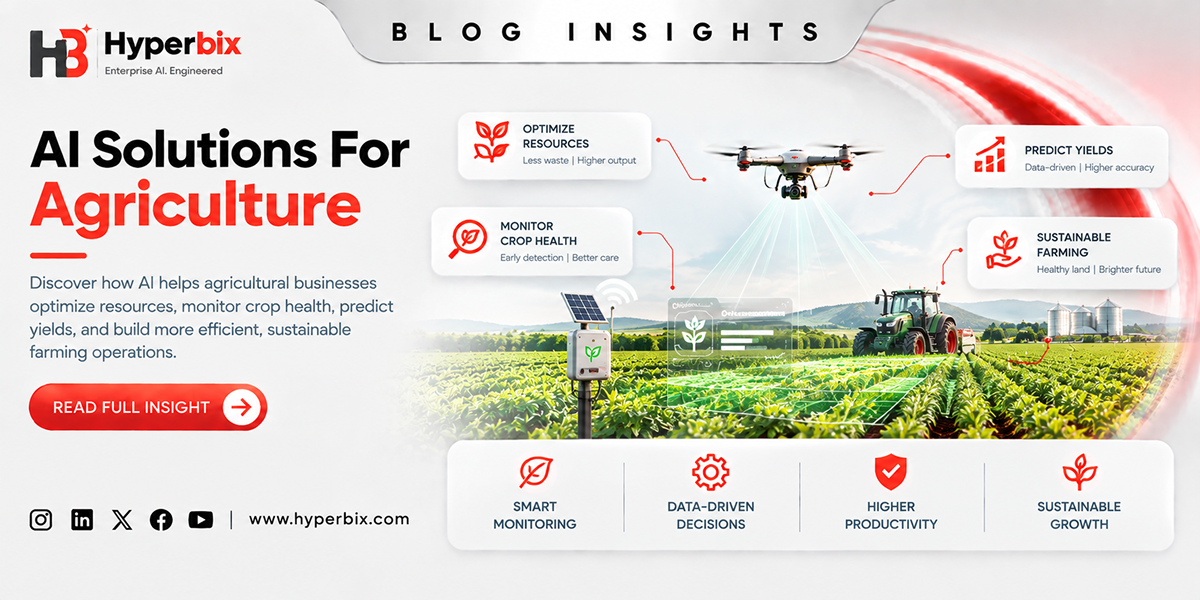
Agriculture has always been dependent on judgment calls. The time for planting, the quantity of water to be applied, the field that requires immediate attention – all these decisions have traditionally been based on nothing else but experience and intuition. Today, farmers have to deal with growing costs of input supplies, an uncertain climate, shortage of workers, and constant need to do more with less. Experience plays an important role, but becomes even more efficient if combined with facts.
This is where AI can make a practical difference in agriculture. The technology finds patterns in soil, climate, crop, machinery data, which is not available to a person, and converts them into practical suggestions. The handbook describes what AI is, how it is used in agriculture, and how to use it correctly.
What Are AI Solutions for Agriculture?
AI Solutions for agriculture include software programs that learn from information received in farms and use it to either assist in or automate the decision-making process. This can range from identifying a disease on a leaf to predicting future harvests weeks in advance.
Traditional farm software mainly records information. AI interprets it. A spreadsheet shows last season’s yield, while an AI model can point to why it dropped and suggest what to change. That shift from records to recommendations is what sets AI-driven farming apart from earlier digital tools.
How Artificial Intelligence Works in Agriculture?
The majority of agricultural AI software programs adhere to the following simple process - gather data, analyze data, gain insights and take action based on those insights.
Agricultural Data Collection
Data gathering comes first in the agricultural AI process. Soil sensors, weather stations, drones, satellites, tractors, and farmer input generate data for analysis. The quality of the data collected directly influences the results.
AI Data Analysis
The algorithms analyze the gathered data to establish various connections between such parameters as moisture level, air temperature and crop growth. With time, they become smarter due to gaining more experience during different seasons and fields analysis.
Predictive Insights and Recommendations
After the patterns have been identified, the system can then predict what is going to occur next, whether it will be an attack by pests or even a reduction in the output of crops and suggest what needs to be done. Certain agricultural operations also use the retrieval form of AI; RAG development helps to ensure that the suggestions provided are specific to their agronomy manuals and other documents.
Automated Farming Decisions
The last step is implementation. Irrigation scheduling can self-regulate, equipment can use optimal routes, and notifications can be sent to the appropriate person in real-time. Intelligent systems developed using AI agent development are capable of monitoring the situation and implementing necessary decisions on their own, while allowing people to make the decisions.
Core Technologies Behind AI-Powered Agriculture
Several technologies work together to make a farm smarter and more efficient. All of them have their own roles in the process.
Machine Learning and Predictive Analytics
Machine learning learns from historical and live data to make predictions about yields, prices, and risks. It discovers patterns in various seasons depending on such factors as weather and soil conditions. It is the engine of all the farm forecasts and suggestions.
Computer Vision and Crop Health Monitoring
Through computer vision, the software can understand the images that are captured by the camera. The software can detect an unhealthy leaf, weed or ripe fruit immediately. This means that the farmer gets the information on the condition of their crops in time without having to visit each row of the plants.
AI-Powered Drones and Satellite Imaging
Drones and satellites allow receiving images of entire fields in one sweep. With the help of AI algorithms, these images are analyzed and crop stress is detected even if it is not visible from the ground. It allows farmers to react on time and pay attention to the necessary area.
IoT Sensors and Smart Farming Systems
Sensors measure the moisture, temperature, and nutrients level of the soil continuously. This provides AI algorithms with a steady flow of real-world data to analyze and learn from.
Robotics and Intelligent Farm Automation
The robotic systems perform repetitive operations such as plantation, spraying, and harvesting operations with equal accuracy all the time. The robots can also perform for prolonged periods without any mistakes and save the inputs as well. It helps to relieve the burden off the workforce and enables the teams to concentrate on better decisions.
Farm Management Platforms and Data Integration
The systems bring all the information related to sensor readings, drone observations, machine data, and other records at one place. The decision-making process will take into consideration the overall information. The system also features a simple dashboard that presents the data in a clear, easy-to-understand format.
Top Applications of AI in Agriculture
AI has an essential application at any step in the agricultural process. AI enhances agriculture through smarter, more efficient, and sustainable farming practices.
Crop Health Monitoring and Disease Detection
* Early Diagnosis: AI-powered image analysis detects plant diseases and nutrient deficiencies at an early stage, helping farmers take timely action to protect crop health and improve yields.
* Proactive steps: The farmer needs not to take measures on the entire farm but only at the spots which have been affected.
* Consistent monitoring: Using the images taken from satellites or drones, one can monitor how well the crops are doing through the growing period.
Precision Irrigation and Water Management
* Smart scheduling: The application of AI uses data on soil moisture in conjunction with weather predictions to determine whether the crop needs watering.
* Exact dose and exact location: Water goes to places where it is needed, not being wasted in any other parts of the field.
* Conservation of resources: Wise consumption of water saves it as an important resource for the farm.
Soil Analysis and Fertilizer Planning
* Soil Insights: AI analyzes soil test results to identify nutrient levels, pH, and other essential soil properties.
* Individual recommendations: The system recommends the optimal fertilizer and its amount in each particular case.
* Waste reduction: The balanced nutrition that help to save money and maintain soil health.
Pest and Weed Detection and Control
* Precise crop recognition: Cameras and algorithms detect crops and weed plants as well as possible insect damage.
* Selective use of chemicals: Farmers need to use herbicides and pesticides in places where necessary only.
* Prompt warnings: They receive warnings about possible threats and be able to deal with the problem at an early stage.
Climate and Weather Prediction for Farming Decisions
* Local weather forecasts: The AI provide individual forecast based on information about the field.
* Better planning: Farmers be able to manage the sowing, spraying, and harvesting of the crops based on weather.
* Advance warnings: They have time to protect the crops from the impact of weather changes.
Yield Prediction and Harvest Planning
* Projection: The model uses the data about the plants, the soil, and the climate to forecast the expected yield.
* Planned: One has a good idea of where the harvest is going to take place, as well as how much equipment and space will be needed.
* Improved decision making: Predictions enable better decisions to be made about marketing and pricing.
Livestock Monitoring and Animal Health
* Real time tracking: All movement from the livestock are being constantly tracked by sensors and cameras.
* Detection of health problems: irregular activity because of these animals can be treated as soon as possible.
* Enhanced management: Details of behavior and productivity allow easier management of animals by farmers.
Agricultural Supply Chains and Post-Harvest Management
* Demand Prediction: AI-powered demand forecasting helps farmers make informed decisions about production and distribution, reducing waste and aligning crop supply with market demand.
* Quality sorting and storage monitoring: AI sorts agricultural products by quality whereas sensors are used to monitor storage environment like temperature and humidity.
* Spoilage prevention: Accurate handling from harvesting to delivery prevent spoilage.
Key Benefits of AI Solutions for Agriculture
The value of AI in agriculture stems from completing the routine tasks with a higher level of accuracy. The following three areas of impact represent the main benefits of AI for farming:
Getting More Out of Fewer Resources
* Resource utilization optimization. Proper use of water, fertilizers, and labor allows for higher efficiency of the same area of soil thanks to the ability of the AI solution to indicate precisely where these resources should be used.
* Avoiding losses. Early warnings about potential crop risks enable farmers to take timely action, protect their harvest, and minimize financial losses.
Making the Right Decisions
* Decision making based on facts. Farm management decisions become data-supported due to comparing the alternatives based on the data obtained from the field.
Growing Stronger Over Time
* Improved efficiency and productivity. With all these improvements, there will be increased efficiency and productivity, since people will take less time to conduct repetitive tasks and engage in other work requiring human decision-making skills.
* Sustainable agriculture techniques. Precise and efficient use of agricultural inputs reduces the consumption of chemicals, water, and energy, promoting sustainable farming practices and preserving soil health for future generations.
Real-World Examples of AI in Agriculture Across Farming Operations
The impact of AI becomes clearer when traditional farming methods are compared side by side with AI-powered solutions. Here is how common farm tasks change when AI supports the work.
Farming Operation | Traditional Approach | With AI | What Improves |
Vineyard | Crews walk the rows and treat whole blocks to be safe. | Drone images are analyzed to find stressed vines, and only those rows are treated | Less time spent and fewer inputs used |
Vegetable Farm | Watering follows a fixed schedule | Smart irrigation adjusts to soil moisture, even overnight | Right amount of water, no waste |
Dairy Farm | Illness is noticed only when signs become obvious | Collar sensors flag a cow that is eating less than usual | Earlier health checks and faster care |
Farmer Advisory | Farmers often wait for field officers to get answers to their questions. | An AI-powered chatbot provides instant, easy-to-understand guidance on crop care, input schedules, and market timing, anytime, anywhere. | Quicker, more convenient guidance |
Large Grain Operation | Storage and logistics are arranged close to harvest | Yield forecasts show expected output weeks ahead | Better planning and smoother handling |
Challenges of Adopting AI in Agriculture
AI technology is quite impressive but is not without effort; honesty regarding its flaws will help farms to prepare.
Data Availability and Accuracy: The accuracy of the model is determined by the quality of the data, but many farms lack good data and appropriate sensors altogether. Poor-quality data will lead to poor-quality prediction.
Issues with Infrastructure and Connectivity: There are some issues with internet connectivity in remote rural locations that complicate the process of implementing real-time systems. There are some technologies that must work in offline mode or be synchronized when the connection becomes available.
Implementation Costs and Resource Requirements: Hardware and software investments can seem rather expensive, but it's always possible to start with just one use case.
Technical Expertise Required and Training of Farmers: The team has to be properly trained before working with any technologies. User-friendly interface and instructions are beneficial.
Data Ownership and Concerns over Data Privacy, Reliability: Farms need to know whose data they are giving away, and whether it is safe and secure. It's better to have a person in charge of technology always.
How to Implement AI Solutions in Agriculture?
The successful adoption of an AI solution will go through three stages: plan, build, and prove. These stages each consist of two steps, and thus the farm will know where it stands always.
Phase 1: Plan before You Invest
* Identify farming challenges and business goals. Start with an issue such as water wastage or late detection of diseases rather than technology. This would help in ensuring that the project stays on course, and its success is easily quantified.
* Determine the availability of data and infrastructure currently available. Find out the available data, its accuracy, and connectivity at the farm level. Artificial intelligence will be limited by what it is fed, and hence, this step will identify what is available and what needs improvement.
Phase 2: Build Around What You Already Have
* Select appropriate AI techniques. Do not look for the latest technology, but select a solution that fits the task and the scale of operation rather than what is available and newest.
* Implement AI technology together with existing farm technology. Innovations have to be introduced gradually, using at hand technologies and machinery alongside, not substituting the whole package in a single step.
Phase 3: Prove It, Then Improve It
* Try, examine and test the working of an innovation. Test new tools in one field or herd and compare the performance against clearly defined standards.
* Regularly observe the performance of solutions implemented and update AI models regularly. AI models should be reviewed and updated depending on different crops, seasons, and changing circumstances.
Future Trends in AI-Powered Agriculture
AI will revolutionize agriculture through smart farming, robotics, and predictive analysis. These will make farming more productive and resource-efficient. In future, farming will be more efficient and sustainable.
Autonomous Farming Equipment & Robotics: Self-driving tractors and harvesters are being moved from trial to implementation to carry out hard tasks.
AI in Climate Adaptation: AI plays an increasingly important role when it comes to selecting appropriate crops, planting timing, and methods in relation to changing weather.
Smart Farming With Sensor Networks: Advanced network sensors make it easier to monitor farm areas in much more detail.
Increased Accessibility Of AI For Small Farmers: Easier-to-use technology, such as voice assistants and mobile technology, makes AI accessible to small farms too.
How Hyperbix Helps Businesses Build Custom AI Solutions for Agriculture?
Each farm and agribusiness is unique, which means that pre-fabricated solutions will not always apply. Hyperbix creates custom AI solutions based on how your agricultural business functions.
Custom AI Solutions for Agricultural Operations - Solutions are created for your crops, your data, and your goals, whether those are monitoring crops, managing farms, or providing agricultural advice.
AI-driven Automation and Insights - Automation makes things easier to do, while insights help your team make better decisions.
Integrating AI with Your Business Systems - We integrate AI into the business systems that you use, without disrupting your current processes.
Building AI Solutions Based on Your Business Needs - We begin with one clear use case and scale from there. If you are looking into AI for your agricultural business, you can contact us to find out what might work for you.
Conclusion: Building a Smarter and More Efficient Agricultural System
AI doesn’t replace a farmer’s experience; it complements it by turning raw data into meaningful insights. Whatever the issue – water management, soil condition, harvesting, livestock – the gains are very tangible, when there is a good match between the technology and its application.
The best approach is to start with one challenge, test what works, and expand gradually. Farms that use data to guide decisions and adjust their practices can better prepare for future growing seasons. With the right AI development solutions, businesses can explore ways to apply AI to practical challenges in agriculture and improve everyday operations.
Blog FAQs
Frequently Asked
Questions
AI in agriculture refers to software applications designed to interpret information from farm settings in order to make informed decisions regarding crop health, irrigation, soil management, pest management, livestock, and harvest.
AI technology can be applied in crop monitoring, yield prediction, plant disease detection, irrigation management, soil analysis, weather risk forecasting, livestock health management, and agricultural supply chain management.
AI-based agriculture involves machine learning, predictive analytics, computer vision, Internet of Things sensors, drones, satellite imagery, robotics, and farm management platforms to interpret agricultural data.
AI interprets images collected by cameras, drones, and other similar devices to recognize signs of plant disease, pest infection, weed infestation, and nutrient deficiency. Identification of these problems helps farmers act on time and prevent losses.
Yes, it does. AI takes into account the moisture content, nutrient content, crop needs, and weather forecasts in order to determine when and where to irrigate and fertilize the land.
AI uses past farm records, crops' state, soil composition, and weather information to predict yields. Such predictions allow farmers to plan harvest, needed equipment, storage, and transportation better.
Benefits include efficient use of resources, risk identification at an early stage, increased productivity of farms, making decisions based on data, reduced waste, more efficient farm processes, and assistance in sustainable farming.
The common issues are lack of data, poor internet connectivity, high implementation costs, absence of technical skills, farmers' training needs, and problems with data privacy and ownership.
A company from the agricultural industry may start with the identification of a farming issue, assessment of data and infrastructure, selection of appropriate AI technologies, integration with existing systems, piloting the new solution, and improvement according to the results.
AI development services for businesses that work in agriculture can be customized according to the specific needs of such a business. They can cover such areas as crop monitoring, irrigation, farm automation, livestock management, and prediction.