Generative AI vs Traditional AI: What’s the Difference and Which One Does Your Business Need?
Listen to this articleTap play to start listening

Introduction: Generative AI vs Traditional AI
Using AI, companies can improve customer experiences, automate processes, and achieve more value from data. There are various types of AI built for specific needs.
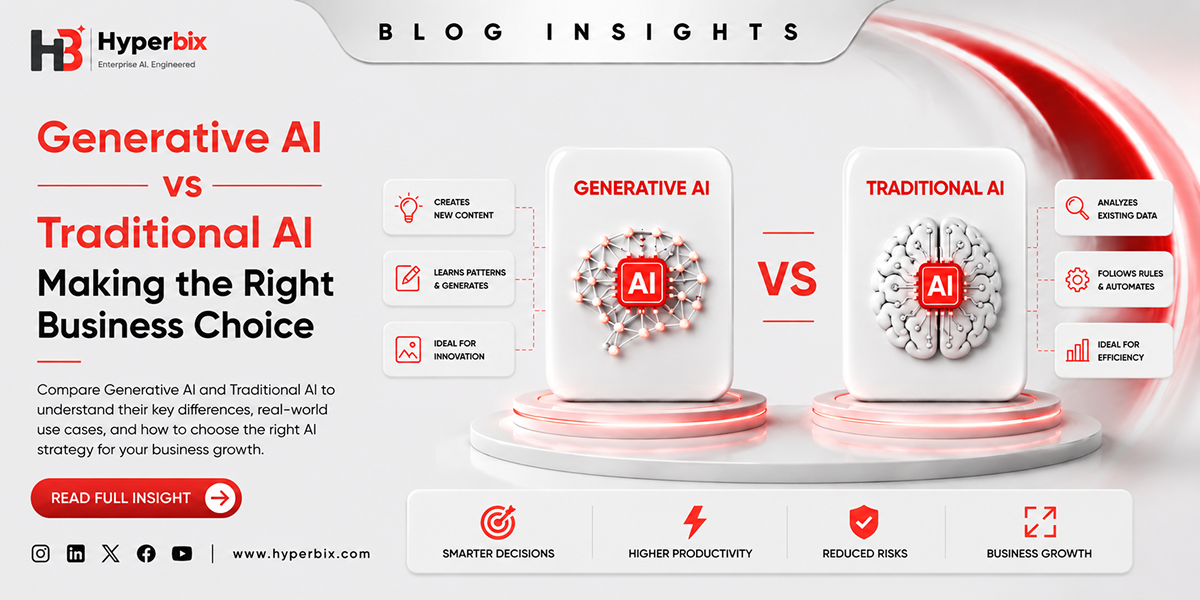
Traditional AI is used to make prediction, classify, detect and give recommendations. Generative AI is used for content creation, regeneration and transformation like answering questions, writing response, internal knowledge summarization, generating product content.
More companies are using AI every year showing just how important it has become in business. A 2026 global survey by McKinsey found that nine, out of ten organizations use AI in at least one area of their business. 44% Say AI is spreading across their whole company.
Why Businesses Need to Understand the Difference?
The ability to differentiate between generative AI and traditional AI will be useful to the companies because it allows them to pick the correct AI for the particular challenge they face.
Traditional AI is more applicable in activities like demand forecasting, fraud detection, analysis of customers' behavior, and generating data-driven suggestions. Generative AI is the best choice for content creation, data summarization, chatbot operation, knowledge searching, and automation of the communication process.
This choice of the approach saves the companies from unnecessary complexity, increases the level of accuracy, assists in better decision making and helps in the development of the AI solution for the company's needs. In some cases, it may make sense to apply both kinds of AI together.
What Is Generative AI and How Does It Work?
Generative AI is a type of artificial intelligence which makes new content using the learned patterns from training. This kind of AI can create various types of outputs such as text, images, audio, videos, codes, summary, conversation, and others.
How It Works: Generative AI models find patterns and connections from huge amounts of data and use that together with your prompt, context and instructions, to generate new responses that take into account what it has learned.
As a generator rather than a retriever, this output can at times be wrong or inappropriate so critical outputs-especially for business, legal, medical, financial or customer-facing decisions-should be human reviewed first. Businesses can fulfill these needs by deploying Generative AI Development Services to develop tailor-made, reliable and business-optimized AI applications.
What Is Traditional AI and How Does It Work?
Traditional AI can be said to comprise of AI systems that examine data to classify, predict, recommend, and make decisions based on certain tasks. The system learns from previous examples and then applies the patterns to new data.
How It Works: Traditional AI learns by finding patterns in data, and then making use of these in new scenarios. Taking the delivery example used above, we could use a model trained on historic delivery data to estimate the likelihood of a late delivery.
Given variables such as distance, traffic, weather, package volume, and location, the model will return a value. Unlike generative AI, this is usually a score, category, prediction, risk level or suggestion, not text, images or code.
Generative AI vs Traditional AI: Comparison Table
Feature | Traditional AI | Generative AI |
Primary purpose | Predict, classify, detect, rank, or recommend | Create, summarize, explain, converse, or transform content |
Typical input | Structured business data, historical records, numerical fields | Prompts, documents, text, images, audio, code, and knowledge sources |
Typical output | Score, label, forecast, probability, recommendation, or alert | Text, image, code, summary, report, response, or other generated content |
Best for | Forecasting, fraud detection, segmentation, recommendations, and risk analysis | Chatbots, content creation, knowledge search, summarization, and coding support |
Training approach | Often trained on task-specific historical data | Often uses pretrained foundation models, with retrieval, prompting, or fine-tuning |
Flexibility | Strong within a specific, defined task | Broad and adaptable across language and content-based tasks |
Predictability | Usually more consistent for well-defined scenarios | Can vary by prompt, context, model settings, and source quality |
Main risk | Poor predictions caused by weak, biased, or outdated data | Incorrect or fabricated outputs, unsafe responses, prompt injection, and data leakage |
Human role | Review predictions and make final operational decisions | Review generated output, approve actions, and handle escalations |
Example | Predicting which products may be in demand | Drafting a customer-facing product campaign |
Benefits of Generative AI for Businesses
Increased productivity - Automates mundane activities such as content drafting, document summing-up, and code creating while employees are released to do other tasks which need more brain power.
Faster innovation ideas - Allows for quick generation of prototypes, marketing messages and other creative materials reducing the cycle time.
Revenue growth – Allows for your customers to tailor experiences, better engage and improve your current offering and the exploration of new streams of products/services that boost sales.
Cost efficiency - By using few manual processes and outside tools we lower running costs while still keeping high quality.
Better customer experience - With chatbots, tailored suggestions and personal communication we increase customer happiness and loyalty.
Benefits of Traditional AI for Businesses
Proven forecasting capabilities- uses historical information, and analyzes to produce accurate sales trends forecasts, inventory levels and the risk factors.
Efficient automation of standard activities - Automates monotonous activities like invoice processing, data input, quality check etc.
Guides smarter decisions - Offers data-driven analysis, risk assessments, and suggestions that support leaders in making sound strategic decisions.
Advanced customer segmentation - Uses customer data to help provide personalized services. It drives marketing campaigns and recommendation engines by understanding customer needs and preferences.
Enhanced operational efficiency- Refines job processes, utilization of resources and management of supply chain resulting in quicker operations and less cost.
Generative AI vs Traditional AI: Real-World Business Use Cases
Both models have the potential to add value to various departments. The choice of technology relies on the need for either a prediction, decision-making aid, output generation, or workflow automation.
Customer support: Generative AI formulates answers to queries and summarizes the chats; whereas, traditional AI classifies tickets and routes queries.
Content creation: Generative AI generates blogs, description of products, social media postings, emails and visuals; whereas, traditional AI assists in identifying the target audience segments and engagement patterns.
Document processing: Generative AI formulates summaries of documents; whereas, traditional AI extracts and verifies the required data.
Fraud detection: Traditional AI detects suspicious transactions and calculates the risk score, whereas, generative AI summarizes the transaction for easy reading.
Product recommendation: Traditional AI recommends the products as per the user's purchase behavior, whereas, generative AI formulates personalized product recommendation messages.
Demand forecasting: Traditional AI forecasts the future demand, sales patterns and inventory requirements; whereas, generative AI formulates a report of the same.
Customer segmentation: Traditional AI clusters the customers based on their purchase patterns and preferences, whereas, generative AI formulates personalized messages for them.
Intelligent automation: Traditional AI prioritizes and routes tasks; whereas, generative AI drafts messages, summarizes the tasks and updates the workflows.
Which AI Approach Is Right for Your Business?
Different types of AI technology should be selected based on the purpose, data, risk level, user requirements, accuracy requirements, and systems in place.
When Generative AI Is the Better Choice
Generative AI should be selected when the task involves generating content such as natural language and other content. It will be ideal for tasks such as customer service assistants, knowledge bases, workflow applications, document summarization, sales support, code assistance, and employee copilots.
Traditional AI – When It Is a Better Fit
If the organization requires forecasts, classification, detection, scoring, optimization, or making recommendations based on business data, then traditional AI will work well.
This would be perfect for solving problems of fraud detection, sales forecasts, customer churn, demand planning, lead scoring, customer segmentation, and recommendation engines.
Factors to Consider Before Choosing
Before making a choice, it is important to consider:
The particular business problem that needs to be solved
What is needed from the system: predictions, scores, recommendations, or content generation
Data availability, quality, and ownership
Privacy, security, and compliance concerns
Real-time performance requirements
Integrations with other systems that are required
The implications of getting the wrong answer
Amount of human intervention needed
Testing, monitoring, and improvement plan
Can Generative AI and Traditional AI Work Together?
Yes. Generative AI and traditional AI are compatible because each is capable of performing certain roles within an organization’s activity.
Data Analysis and Predictions: Data analysis, prediction of future results and risks, and recommendations, traditional AI deals with such functions.
Content creation and communication: Explanation of data analysis in natural language through the creation of messages, summaries, responses, and other types of content – tasks of generative AI.
Intelligent Automation of Workflows: These technologies are complementary for smarter automation by letting traditional AI classify or prioritize activities and generative AI write replies or prepare workflow changes.
Improving Decision Support: They complement each other and help to translate data, predictions, and risk score into understandable information for employees.
Human Approval and Control: Human approval and control are needed for sensitive operations, decision-making, transactions, and situations when personal information is involved.
Personalized Customer Experience: Both technologies are helpful in improving personalized customer experience through recommendations and explanations of results.
Generative AI vs Traditional AI: Development Cost Factors
The investment required to create AI depends on the extent of the problem being solved, the volume of data, the need for integration, security, and complexity.
Model Selection and Building: Classical AI involves data preparation, feature selection, training of the model, its validation, and updating from time to time. Generative AI can involve using foundation models, prompt engineering, RAG, fine-tuning, or internal models.
Data and Infrastructure: Data gathering, storing, labeling, security, and updating influence the project complexity. The infrastructure can include cloud solutions, databases, vector search, API, analytics, monitoring, and tools for hosting the model.
Third-Party Integrations via APIs: There can be connections between the AI solution and third-party products including CRM, ERP systems, payments, searching tools, customer support software, messengers, etc.
Integration and Customization: A standalone AI assistant is less complicated compared to a solution that is integrated into the customer data, inventory management, workflows, permissions, analytics, and other business systems. Custom workflows, multi-language support, access control, and auditing influence the project scope.
Security and Updates: AI solutions need monitoring, quality assurance, security testing, updates of the model or prompts, and data sources maintenance.
Cost-Drivers for Implementation of AI Solution: The total cost of development depends on the number of users, number of channels, data complexity, AI model used, real-time requirement, degree of integration, security needs, customization, and further maintenance.
Challenges and Considerations When Implementing AI
Quality of Data
AI operates using quality and relevant data. Missing, outdated, irrelevant, and poor-quality data will give inaccurate outputs.
AI Hallucinations and Reliability
Generative AI may create responses that seem correct but include erroneous and unverified details. Businesses need to use reliable knowledge resources, test them on actual situations, and employ humans where necessary.
Bias and Accuracy
AI models will be affected by biases that can exist in data, business rules, or development process. Frequent testing and human analysis will minimize chances of such issues.
Data Privacy and Protection
Companies are supposed to keep information that will be used by AI secure. Data access regulations, encryption, users' permission, and logs can be helpful in protecting information from any problems related to privacy and protection.
AI Governance and Compliance
AI governance means specifying those persons who are accountable for controlling use, risks, decisions, and performance of AI. It will allow companies to make policies and control over AI systems usage responsibly.
Monitoring and Maintenance
AI systems require monitoring after their launch due to changes in data, users' needs, policies, and functioning. Evaluation will provide companies with accurate and secure results.
How Can Custom AI Solutions Meet Your Business Needs?
Custom solutions for AI development are based on a company’s workflows, users, data, policies, and integrations. Such technologies are designed to enable organizations to develop AI-powered applications based on their workflows, brand guidelines, and security standards.
AI Applications Specific to Business - Custom AI can be used to enable businesses to implement specific workflows, including document processing, assistance to employees, services matching, operational analytics, and assistance to users.
Generative AI Applications - It is possible to build customized AI-powered chatbots, knowledge assistants, content generation applications, document summarization solutions, AI copilots, and multilingual applications according to brand, rules, and approved data.
Predictive AI and Machine Learning - Such solutions can help businesses to predict demand, detect fraud, estimate risks, make recommendations for users and products or services, segment clients, and make decisions.
RAG and Knowledge Base - This technology connects AI assistants with the approved internal knowledge base to provide more accurate and relevant answers.
AI Automation and Integration - Custom solutions for AI can be integrated with CRM, ERP, support systems, payments, e-commerce, and communication systems to automate such processes as categorizing requests, preparing reports, writing responses, and managing workflows.
Security and Scalability of Architecture - A secured architecture includes access control, data and content protection, monitoring, auditing, encryption, and controlled integration. The scalability of architecture means that the platform will be able to accommodate an increasing number of users and workloads.
Future of Generative AI and Traditional AI
Traditional and Generative AI will complement each other to make intelligent business applications. Predictions and data insights will be provided by traditional AI, and content generation, communications, and automation, among others, will be done by Generative AI.
Combined AI approach: Companies will employ both generative AI and traditional AI for developing even more advanced applications.
Capabilities of generative AI: The capabilities of generative AI will include business communication, creation of content, creation of summaries of documents, assistance with conversations, and workflow automation.
Capabilities of traditional AI: Companies will use traditional AI for making decisions based on data, detecting fraud, making product recommendations, demand forecasting, and gathering customer insight.
AI agents: Companies will be able to create AI agents that will be able to understand user requirements, access information, use certain tools, and perform multistep tasks.
Specialized AI models: Small AI models will be used for solving business tasks where privacy, speed, and performance are essential.
AI-native applications: Future business applications will feature intelligent search capabilities, automated workflows, personalized recommendations, and conversational assistance.
Responsible AI implementation: Proper governance, security measures, oversight of human workers, testing, and monitoring will be required for the responsible implementation of AI solutions.
Why Choose HyperBix for AI Development?
HyperBix can be of great assistance to those companies that seek to implement their ideas about AI into efficient, reliable, and scalable digital products. An AI development partner must begin by addressing the actual problems that your business is facing, followed by the selection of technology that meets the goals, data landscape, and processes.
AI Strategy for Business - HyperBix assists you in defining your use cases of AI, target audience, data requirements, metrics of success, integration needs, and risks.
Custom AI Solutions - HyperBix creates custom AI-based software applications which are tailored specifically to meet your business processes and needs.
Generative AI and Machine Learning - HyperBix develops innovative solutions of generative AI, RAG knowledge systems, predictive analytics, machine learning, and intelligent automation.
Integration and Automation of AI - HyperBix integrates AI into your business applications, APIs, databases, customer platforms, and processes.
Scalable and Secure AI Architecture - HyperBix provides you with scalable and secure AI architecture with privacy controls, access management, and monitoring.
Conclusion
Generative AI and Traditional AI are two technologies that do not compete with one another. These technologies offer solutions to different kinds of business issues and are highly beneficial depending on how they are implemented.
The best way for most businesses to benefit from these two technologies is by implementing both. Traditional AI will give you insights, but the generative AI technology will make your insights more actionable. Start with a well-defined business issue, apply secure data, create governance and security controls, experiment, and maintain human involvement in decision-making processes
Blog FAQs
Frequently Asked
Questions
Traditional AI uses the data to forecast the outcome, classify the information, spot the patterns, and offer recommendations. The generative AI generates new content like text, images, summaries, code, and responses to the conversation.
Traditional AI works well in predicting the outcome because it leverages the business data from the history to discover the patterns and predict the future outcomes. It helps in demand forecasting, sales planning, inventory management, and customer churn analysis.
Generative AI should be used in those businesses where there is a need for content generation, document summaries, chatbot operations, knowledge search, personalized communication, and coding.
Yes, Traditional and generative AI can work in one business app simultaneously. While conventional AI provides predictions and risk scores, generative AI helps in explaining insights, creating reports and personalized responses.
Some of the Traditional AI applications are fraud detection, demand forecasting, customer segmentation, lead scoring, product recommendation, dynamic pricing, and predictive maintenance.
Even though generative AI can utilize a pretrained model, incorporating business data can lead to improved business relevance and accuracy. Companies can integrate their approved documents, company policies, product data and knowledge management system with generative AI.
Key risks related to business context include quality, bias and inaccuracy, privacy and security, as well as access control and permission issues. To handle those, businesses can implement AI governance, tests, ongoing monitoring and human review processes.
The choice of AI type relies on the identified business use cases, types of desired output, existing data sets, risk levels, integration complexities and user experience goals. Traditional AI works well with prediction oriented problems while generative AI has greater value with content and conversational outputs.
HyperBix offers a new way for companies to realize AI use cases as practical digital solutions that can be scaled and are secured. HyperBix provides services covering end to end of AI development lifecycle ranging from strategy to custom solution development, integration, testing and deployment, to management and monitoring.
Human review is necessary for an extra check on AI outputs to assure they will not impact customers, financial implications, compliant legal or business decisions or sensitive aspects of a business if they occur and especially critical when it involves personal information of an individual.