How to Build an AI Agent for Your Business?
Listen to this articleTap play to start listening

Introduction
AI agents are becoming an essential component of modern business processes. Companies use them for automation of repetitive operations, customer support, information processing, workflow management, and help for employees in their daily routine. As opposed to the usual software that just performs operations according to pre-set commands, AI agents have the ability to comprehend goals, process information, make decisions, and act accordingly to the current circumstances.
For instance, an AI agent may perform such operations as qualification of the sales lead, data gathering from corporate databases, answering customer questions, scheduling meetings, or updating CRM without the need for performing all the operations by employees.
Yet, the creation of an AI agent is more complex than just linking a model to a chatbot. There are specific steps for identifying use cases, defining an agent's responsibilities, choosing relevant technologies, integrating business systems, and testing the agent.
What Is an AI Agent and How Does It Work?
AI Agent refers to the software that understands the particular purpose, analyzes information, decides and acts in order to accomplish the given task. The combination of artificial intelligence models and business-related data, tools, APIs, and rules helps to perform workflow without much human involvement.
In contrast to the standard chatbot that only answers questions, AI agent can take some actions. Thus, in case the customer asks about the product, AI agent will analyze the request, analyze the product information, determine what the customer needs and choose the product.
The fundamental steps of the workflow include the receipt of the instruction, understanding the context, reasoning about the task, making a decision on what action to take, using particular tools and analyzing the outcome. In some cases, depending on the application, an agent can keep in mind the information from previous interaction. Such agents may help to automate multi-step business processes requiring analysis and performing of actions.
Why Do Businesses Need AI Agents?
There are numerous repetitive processes that take time from the employees daily. Responding to similar inquiries of customers, updating databases, verifying documents, qualifying leads, generating reports and responding to regular requests may require a lot of manual labor. AI agents can make such processes automated while giving the possibility for employees to concentrate on something else.
The next advantage is quick responses. AI agents may respond to the requests around-the-clock without relying solely on business hours and availability of employees. It may be especially helpful in case of customer support and lead management.
Furthermore, AI agents can assist businesses to deal with increased workload. Companies do not need to process each request manually; they may delegate suitable ones to agents and complicated cases - to human employees.
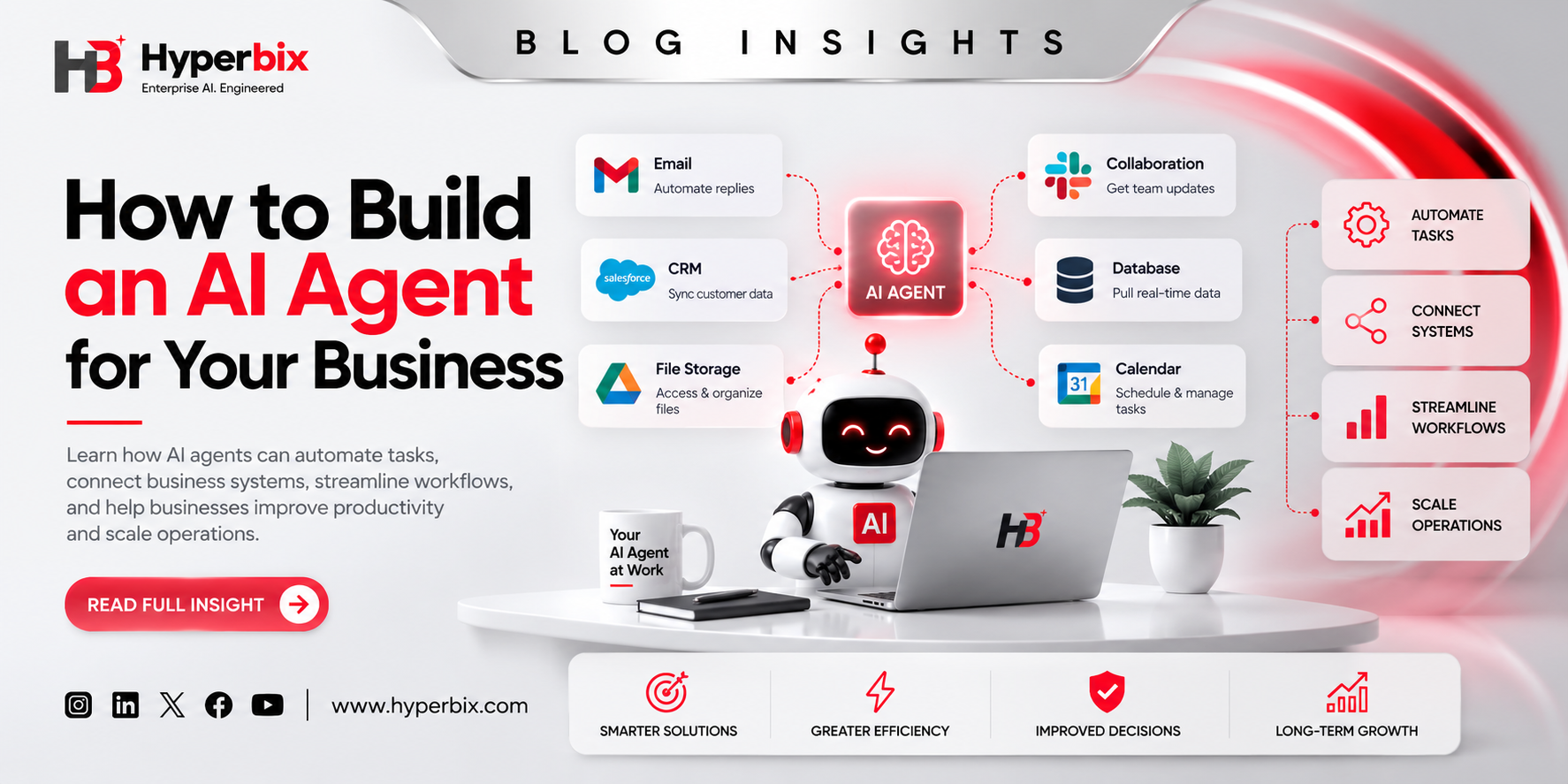
Besides, AI agents can integrate various systems used in businesses and move information between them. If properly integrated, an AI agent may interact with CRMs, databases, communication systems, knowledge bases and other programs. For those who want to increase efficiency but are not interested in changing everything they have now, AI agents may be a good addition to the current infrastructure.
What Can AI Agents Do for Your Business?
Depending on their design and the availability of certain systems, the AI agents can be programmed to perform different tasks. Customer service is an area that can be covered by these agents. The agent will provide answers to questions, gather client information, sort out client support requests, and send the complicated ones to humans.
Sales department can benefit from the agents in lead qualification, follow-ups, updating customer information in CRMs, preparing client information, and scheduling meetings. In marketing, there can be such tasks as conducting research, workflow related to creating content, analyzing campaigns, and segmenting customers.
Internal processes of any business can also be supported by AI agents. It is possible to ask agents to get information from business documents, execute regular requests, prepare reports, check records, and help employees with internal questions.
Financial departments can get help with document processing, invoice workflows, and data validation. Operational tasks may include process monitoring and coordinating tasks across different systems. The important point is to pick a particular workflow for automation rather than make one agent do everything.
How to Build an AI Agent for Your Business?
Development of an AI agent begins with defining the process in the business which needs to be improved using technology. The tool should serve the business goal instead of being the goal itself.
Identify the Business Goal
The first step is finding the exact problem. Find out which business process requires considerable manual effort and what the result of its automation will be.
Determine the Duties of the Agent
Decide on what the agent should do and what it shouldn’t. Thus, a sales agent can qualify leads, gather customer data, and update the CRM database, while negotiations can be passed to the sales person.
Choose the AI Model
Select the type of AI model depending on reasoning capabilities, time of response, context understanding, costs, and complexity of the workflow.
Link Data and Software
Link the agent with all the required databases, APIs, documents, CRM, and other software.
Adding Memory and Context
With memory, the agent will be able to utilize relevant information based on the past interactions and keep the context during more complex workflows.
Testing the Agent
The agent should be tested using real-life business cases, such as ordinary requests and unexpected ones. Verify if it comprehends the commands and acts properly.
Deployment and Monitoring
After finishing the testing, integrate the agent into the chosen workflow and monitor its activity constantly. Updates will ensure accuracy with evolving business requirements.
Key Features of an AI Agent
Apart from having a conversation tool, a business AI agent should have the following features that will assist in carrying out the assigned tasks and interacting with business systems in a secure manner.
Natural Language Understanding
The ability to interpret natural language commands, recognize the intention behind it, and comprehend the context before coming up with any action to be taken.
Reasoning and Decision-Making
Reasoning enables the agent to assess the information and make decisions on the next steps to take as opposed to giving pre-programmed responses.
Tool and API Integration
The AI agent uses APIs and third-party tools to fetch information or perform any actions on CRMs, databases, calendar apps, payment solutions, and other applications.
Memory and Context
Memory enables the agent to retain any information that is pertinent in all processes and conversations to come up with consistent actions and responses.
Task Automation
An efficient AI agent should be able to undertake tasks like sending messages, record updating, fetching information, report creation, and workflow triggering among others.
Human Handoff
In situations where human input is required or it is outside the duties of the AI agent, then the task is handed over to employees.
AI Agent Technology Stack
The technology stack for an AI agent depends on its purpose, complexity, integrations, and expected scale. A well-planned stack helps the agent process information, communicate with external systems, manage data, and perform business tasks efficiently.
AI Models: OpenAI GPT, Claude, Gemini, Llama
Programming Languages: Python, JavaScript, TypeScript
AI & Agent Frameworks: LangChain, LangGraph, LlamaIndex, CrewAI
Backend Technologies: Node.js, FastAPI, Django
Databases: PostgreSQL, MySQL, MongoDB
Vector Databases: Pinecone, Weaviate, Milvus, Qdrant
APIs & Integrations: REST APIs, GraphQL, Webhooks
Cloud Platforms: AWS, Microsoft Azure, Google Cloud
Authentication & Security: OAuth 2.0, JWT, API Keys, Role-Based Access Control
Monitoring & Analytics: LangSmith, OpenTelemetry, Grafana
Frontend Technologies: React.js, Next.js
The final technology stack should be selected based on the AI agent's business requirements, expected workload, security needs, integrations, and scalability rather than using every technology listed above.
How to Integrate AI Agents With Business Systems?
The utility of the AI agent increases greatly if it is integrated with the systems that the company already uses. For instance, the customer service AI agent will be able to fetch information from the CRM system prior to answering a question of a customer. The sales agent can automatically update the status of a lead after the interaction with a customer, and an internal agent can fetch the needed information from the databases of the company.
To integrate an AI agent with other software tools, usually, the APIs are used. Authentication and access control need to be ensured so that the agent could have only the needed permissions to access the data and functionality.
Businesses can start from integrating the agent with few systems and build up their integration strategy step-by-step. This way, testing the agent becomes much easier and any potential issues can be detected at earlier stages. Integration will make an AI agent not just a conversational tool but a part of the workflow of the company.
How Much Does It Cost to Build an AI Agent?
The cost of developing an AI agent depends on the complexity of its functioning, the number of integrations, and other parameters.
The cost of using an AI model will depend on the chosen model type and the need for additional features like custom workflows, advanced memory capacity, multiple integrations, dashboards, authentication, and specific data processing. Moreover, cloud infrastructure, the need for databases, security, testing, development of a user interface, and maintenance should be considered as other factors that will affect the development cost.
First, businesses need to determine the purpose of the agent and all the necessary features in order to estimate the development cost easily. It will become much easier to distinguish the basic features from the additional ones after that. However, businesses should not concentrate exclusively on the cost of development but also think about the advantages of automation and the potential value of automation.
How to Test, Deploy, and Maintain an AI Agent?
It is essential to test the agent in order to make sure that it works properly in various business scenarios. The developers need to check how the agent deals with typical requests, unusual questions, wrong inputs, incomplete inputs, and situations when the agent should pass the task to a person.
The agent should be checked on response precision, tool usage, data gathering, workflow executing, security issues, and reliability. In the case of the agent working with customers, it should be tested in terms of different communication styles and misunderstanding.
Once the agent is tested, it can be deployed either via websites, applications, dashboards, messaging systems or other business programs. It is necessary to monitor the deployment process carefully at first.
However, maintenance is still required even after the deployment process. Changes in business data, APIs, workflows, and requirements can happen, so the monitoring will reveal incorrect responses or failed actions.
Thus, the business can improve its agent using the results of monitoring, updating knowledge sources, and modifying instructions.
Common Challenges in AI Agent Development
The process of creating an AI agent becomes easy if it starts with a clearly formulated goal, yet several practical issues might arise for companies during implementation. The agent might sometimes misinterpret a request, retrieve out-of-date information, or fail to perform a task due to the unavailability of an external system.
Data quality could influence the agent's performance as well. In case the data provided to the agent is either incomplete or outdated, the answer provided by the agent would become unreliable. Integration challenges may emerge when connected business systems modify their APIs or authentication.
However, most of these issues are solvable through proper testing, high-quality data sources, accurate instructions, access control, monitoring, and maintenance. In addition to that, it is useful to set some limitations on the agent's actions. Not every decision related to the business could be performed automatically; sensitive or complicated tasks could be delegated to people.
It is helpful to start with a specific workflow to implement the agent in the business. When an agent proves to work well in a particular sphere, other systems could be added later.
Why Choose an AI Agent Development Company?
Creating an AI agent is a multi-faceted technological task, which involves AI models creation, backend development, usage of API, database integration, business logic and integration, security and testing, as well as deployment. Thus, for a business that lacks the necessary technical skills and expertise, handling all those elements becomes difficult to accomplish.
Hyperbix can assist a business to find appropriate options for automation and create AI agents depending on its workflows and needs. Starting from AI models integration, through data connections and business logic, tools integration, testing and deployment, this process can be done according to business goals.
Hyperbix can also assist in integrating the created AI agent into the existing business processes, such as CRM, ERP, communication and analytics systems and others. It makes the AI agent a part of the process, not a separate solution.
In case some changes occur within the field of AI technologies or business requires them, the agent may need improvement or updating. The Hyperbix can assist in such cases and provide development and technical support.
Hyperbix offers AI Agent development services for businesses interested in implementing AI-driven automation.
Conclusion
An AI agent is now a real-life solution for companies that seek automation of repetitive tasks, increased productivity, and fast customer service. The possibility to understand information, make decisions, interact with tools, and perform actions gives AI agents the opportunity to execute more complicated business processes than ordinary automation tools.
The development process of an AI agent implies defining a business problem and deciding on the agent's tasks, finding the right AI model, integrating related data and tools, testing the workflow, and post-deployment monitoring.
The best strategy is to start with the use case and increase the functionality of the agent as it gains the reliability needed. Thanks to proper technologies, integration, security and optimization, the AI agent can be beneficial for business operations.
When it comes to using intelligent automation, it would be good for businesses to cooperate with a company that develops AI agents in order to convert their business workflow into an AI-powered one.
Blog FAQs
Frequently Asked
Questions
An AI agent can understand requests, work with business information, make decisions based on defined objectives, and carry out specific tasks. Depending on its setup, it can handle customer queries, qualify leads, retrieve information, update records, or trigger actions in other business systems.
Look for workflows that involve repetitive tasks, large amounts of information, frequent customer requests, or multiple manual steps. If employees spend significant time performing the same process repeatedly, that workflow may be suitable for AI agent automation.
Yes. An AI agent can be designed around a particular business process rather than using a generic approach. Its instructions, tools, data access, and actions can be configured according to the requirements of departments such as sales, customer support, finance, marketing, or operations.
The required information depends on its purpose. An agent may need access to company documents, product information, customer records, databases, knowledge bases, or other internal data. Providing relevant and reliable information helps the agent produce more useful results.
Yes. With the right tools and permissions, an AI agent can perform actions such as updating a CRM record, sending a message, retrieving information, creating a report, scheduling an appointment, or triggering another workflow.
An AI agent can be connected to many existing business applications through APIs and other integration methods. This allows it to exchange information with systems such as CRMs, ERPs, databases, communication platforms, calendars, and internal business applications.
Yes. Businesses can define permissions and access rules that determine which information and tools an agent can use. Limiting access according to the agent's role can help protect sensitive business data and prevent unnecessary actions.
Yes. Human handoff can be included in the agent's workflow. When a request is too complex, sensitive, or outside the agent's defined responsibilities, the system can route it to an appropriate employee.
Performance can be measured using factors such as task completion rate, response accuracy, processing time, customer satisfaction, error frequency, and the amount of manual work reduced. The right metrics depend on the purpose of the agent.
Yes. AI agents can be refined after deployment based on real usage and performance data. Businesses can update their knowledge sources, improve instructions, modify workflows, add integrations, and adjust permissions as their requirements change.