RAG vs. AI Agents vs. Agentic AI: Know the Difference
Listen to this articleTap play to start listening

An Overview of RAG, AI Agents, and Agentic AI
Artificial intelligence is moving beyond the traditional question-and-answer model. Businesses today can implement AI-powered solutions that not only retrieve information from proprietary data, use external services, carry out tasks but also process workflows including several steps. Among the most common buzzwords for such projects there are RAG, AI agents and agentic AI.
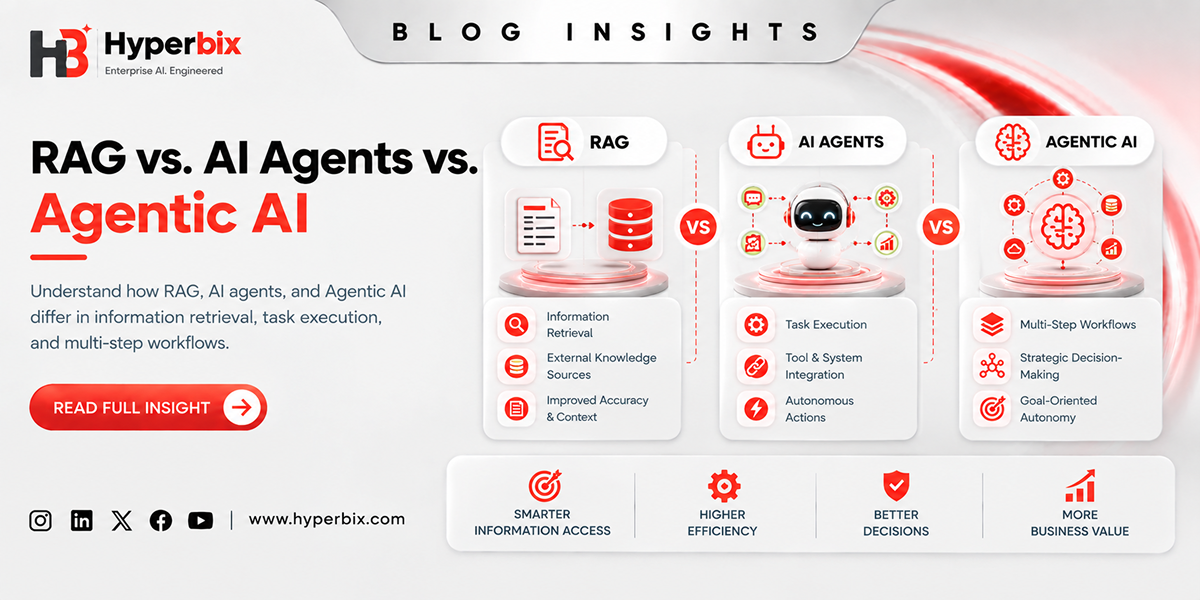
Even though all three technologies can be combined in one project, they perform different functions. In its turn, RAG allows to ensure that AI systems will give their answers based on information retrieved from connected knowledge sources. AI agents perform tasks using models, tools, APIs, and business systems. Agentic AI extends the concept of AI agents by allowing to make the AI systems pursue some goals, plan actions, react to changes and handle complex workflows autonomously.
The understanding of differences between those technologies is crucial before choosing the proper AI architecture. It is determined by the purpose the business wants to use AI system for, the data the system needs to access, business systems to connect to, and human involvement level.
What Is RAG?
RAG stands for Retrieval-Augmented Generation. It is an AI approach that combines information retrieval with generative AI to provide more relevant and context-aware responses. The key feature of such a technology is the use of not just the information which was acquired during the training process of the model but the information retrieved from relevant sources and provided to the AI model as context for generating a response.
For businesses, such sources may include internal documents, product catalogues, knowledge bases, policies, manuals, databases or any other approved sources of information. Businesses looking to connect these sources with AI can explore RAG development for building retrieval-based AI solutions.
Key components of a RAG System
The following are some of the key components that comprise a RAG system. The first component is the language model, followed by the data sources, document processing, embeddings, retrieval method, vector database, and finally context integration. Data sources will offer industry-specific data whereas document processing will prepare the documents for the retrieval process. The embeddings will contain the information in such a manner that it can be easily searched whereas the retrieval mechanism will find the relevant information.
What Are AI Agents?
An AI Agent is a form of AI that is capable of performing tasks as opposed to responding. This type of system is capable of understanding a request, figuring out what action needs to be done, using tools and APIs, communicating with other systems and then delivering the output. Businesses exploring these capabilities can also consider AI agent development for task-oriented applications.
Key Components and Tool Integration of AI Agents
The design of an AI agent includes parts like foundation models, instructions, memory, business rules, data sources, tools, APIs, and monitoring capabilities. The architecture of an AI agent depends on the specific task being performed, and the enterprise agents need to have authentication, authorization, logging, and control of the system access.
Tools and APIs provide an opportunity for the agents to work with other systems and do some tasks. So, an AI agent may get the data about customers from the CRM, see the stock level, or use a scheduling system and perform certain tasks.
This capability gives an advantage to AI agents when performing automation of tasks. The combination of reasoning and tools/ APIs allows an agent to collect data and perform the task.
What Is Agentic AI?
Agentic AI is used to refer to artificial intelligence that is based on behavior, reasoning, planning, tool use, feedback, and autonomy. In contrast to the design of artificial intelligence with regard to a single isolated activity, the agentic design may be applied in the accomplishment of a wider goal through multiple actions.
The Agentic AI will establish the need to do something, break a goal down into tasks, choose tools, review the outcomes, and plan subsequent actions accordingly.
Core Characteristics and Multi-Step Workflows of Agentic AI
Agentic AI aims at accomplishing higher-level goals by utilizing planning, reasoning, instrumental capability, memory, feedback, and controlled autonomy. The AI can determine the necessary actions, utilize appropriate tools, assess their outcomes, and adapt accordingly throughout the process flow.
As an illustration, an agentic procurement AI may determine the purchasing requirement, investigate the suppliers, conduct analysis, recommend a decision, receive authorization to proceed, and move on to the next step.
While Agentic AI is autonomous, it still needs limitations such as permissions, security measures, supervision, and human consent. The core advantage of Agentic AI is its capability to manage multi-step processes with a view toward achieving a certain objective rather than executing one order at a time.
RAG vs. AI Agents vs. Agentic AI: Key Differences
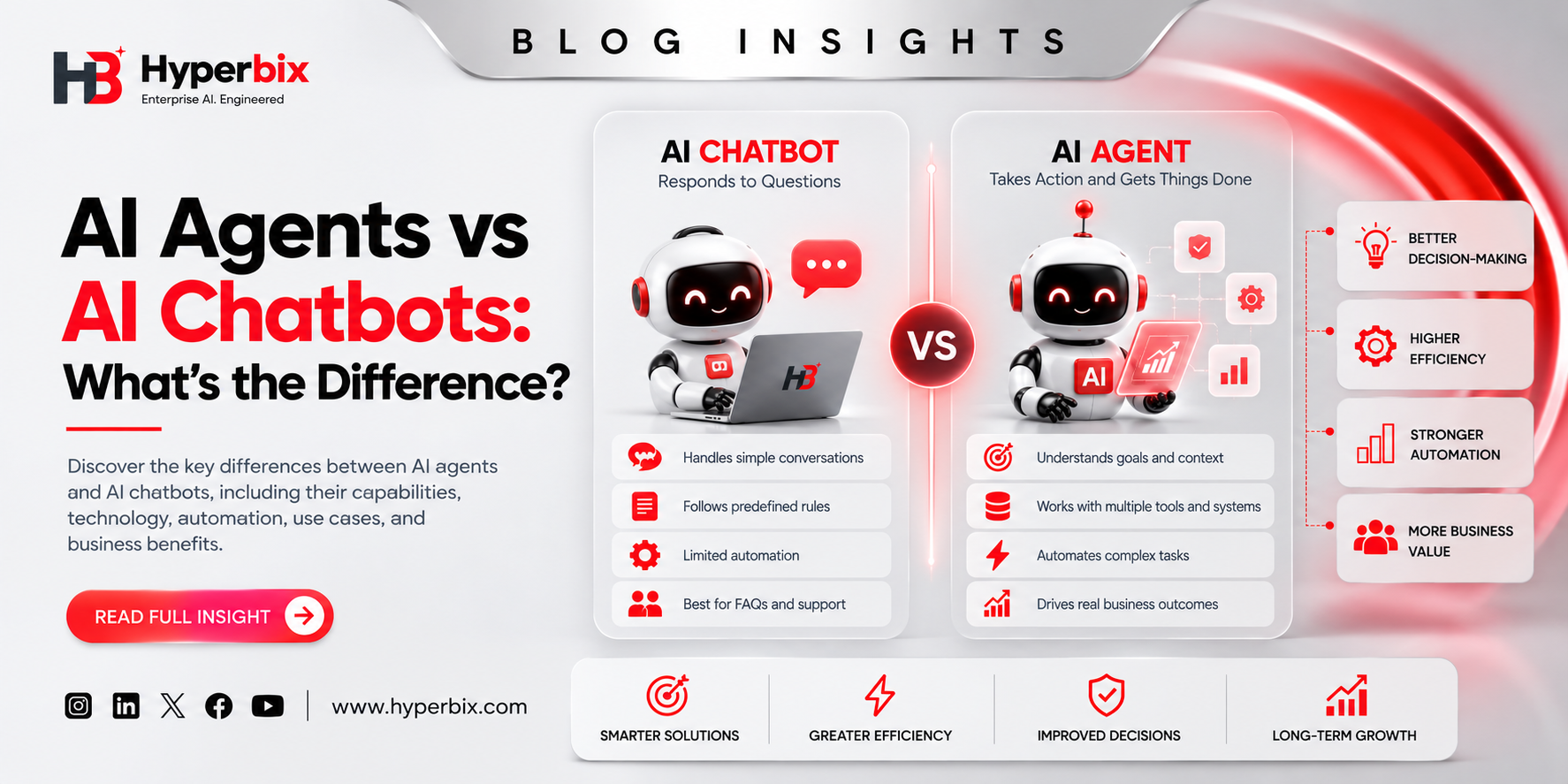
RAG, AI agents, and Agentic AI are related but should not be treated as interchangeable terms. RAG primarily addresses information retrieval and context, AI agents focus on task execution, while Agentic AI focuses more broadly on goal-oriented, multi-step behavior and adaptive workflows.
Area | RAG | AI Agents | Agentic AI |
Primary purpose | Retrieve relevant information for AI responses | Complete defined tasks | Pursue goals through multi-step workflows |
Autonomy | Usually limited | Varies by design | Often designed for greater autonomy |
Information retrieval | Core capability | Optional but common | Common and can be part of a broader workflow |
Reasoning | Used mainly to generate informed responses | Used to decide actions | Used for planning, decisions, and adaptation |
Task execution | Usually limited | Core capability | Core capability across multiple steps |
Tools and APIs | May be connected | Commonly used | Often central to the architecture |
Workflow complexity | Generally focused on retrieval and response | Task-specific | Often multi-step and dynamic |
Memory/context | Retrieved context is central | May maintain task context or memory | Context and memory can support ongoing goals |
These categories can overlap. An AI agent can use RAG to access business knowledge, and an Agentic AI system can include both RAG and AI agents as components.
RAG vs. AI Agents vs. Agentic AI: How They Work
RAG, AI agents, and Agentic AI can all use generative AI, but they follow different approaches to handling information, tasks, and workflows. Understanding how each one works makes it easier to see where they fit in a business AI solution.
RAG Workflow: RAG starts by retrieving relevant information from connected sources and providing it to the AI model as context. The model then uses that information to generate a response based on the available data.
RAG in action:
* Question
* Retrieve information
* Add context
* Generate response
In the case that an employee requests any information about the company policies, RAG can search through the internally authorized documents to extract the appropriate content and provide the answer.
AI Agent Workflow: The AI agent will concentrate on achieving a particular task. The agent will understand the task, figure out what it should do, select the right API or tool, and finally handle the output. Certain tasks may need an AI agent to complete several activities in order to achieve the task.
AI agent in action:
* Request
* Understand task
* Select tool
* Perform task
* Process result
If an agent from the customer service department can access the CRM to look at the orders, get the status, and help resolve a customer's query.
Agentic AI Workflow: Agentic AI is designed to achieve a broader objective through multiple connected steps. It can plan actions, gather information, use tools, evaluate results, and adjust the workflow when needed.
Agentic AI in action:
* Define goal
* Plan actions
* Gather information
* Take action
* Evaluate results
* Adjust next steps
If an agentic procurement system could identify a purchasing need, review suppliers, compare options, prepare a recommendation, request approval, and continue with the next authorized step.
RAG vs. AI Agents vs. Agentic AI: Use Cases and Real-World Examples
Depending on the requirements of the business, RAG, AI agents, and agentic AI have different applications. This would depend on the need to access information, complete a certain task, or manage a larger multi-step workflow process.
Information and Knowledge Access Using RAG
RAG would be appropriate for cases where businesses require AI to first retrieve relevant information from internal data sources before producing a response. These can include knowledge base search, document retrieval, product information, policy information, technical support, and customer inquiries.
Task Automation Using AI Agents
Where an AI needs to do a particular task using APIs or business applications, an AI agent is applicable. These can include order status check, CRM updates, appointment booking, customer information retrieval, sales support, and customer support tasks.
Agentic AI for Complex Business Process Flows
Agentic AI would be more suitable for flows that involve several tasks, decisions, and changing contexts. Agentic AI could help automate processes in business, procurement, logistics, research, finance, intelligent customer service, and system automation through planning actions, analyzing their outcomes, and choosing next actions within certain limits.
Can RAG, AI Agents, and Agentic AI Work Together?
Yes. They can be combined rather than be considered as alternative options. RAG is a technology that provides the knowledge layer where the AI can use the business-related data available. An AI agent can then use that information while performing a specific task. Agentic AI can coordinate multiple agents, tools, information sources, and actions as part of a larger goal-oriented workflow.
If an enterprise support platform could use RAG to retrieve product documentation, an AI agent to manage a customer's support request, and an agentic workflow to coordinate troubleshooting, system checks, escalation, and follow-up.
This type of architecture allows businesses to assign different responsibilities to different AI components rather than expecting one model to handle everything.
Benefits and Limitations of RAG, AI Agents, and Agentic AI
RAG: Benefits and Limitations
Benefits:
RAG helps to improve access to business-related information by gathering the relevant information from the connected information sources. It may be used in the development of knowledge assistants, enterprise search, and information retrieval AI applications.
Limitations:
The quality of the RAG response depends on the quality and relevance of the gathered information. The irrelevant, outdated, improperly indexed or misinterpreted information may negatively impact the RAG response. RAG is mostly oriented toward information retrieval and not task execution.
Benefits and Limitations of AI Agents
Benefits:
AI agents may automate business processes by using tools, APIs and business systems to execute a certain task. AI agents may be used for customer service, scheduling, CRM management, order processing, and information retrieval.
Limitations:
AI agents require proper authentication, permission, tool integration and monitoring. The errors in the use of tools and execution of the task may negatively impact business process.
Benefits and Limitations of Agentic AI
Benefits:
Agentic AI has the potential to help facilitate complicated business processes through planning, coordination, use of tools, evaluation, and adaptation of actions. It can be applied to processes that include a series of actions and decisions.
Limitations:
Increased autonomy calls for more governance, security, testing, monitoring, and clear boundaries. Business processes may require approval phases and human monitoring to ensure autonomy stays within the approved boundaries.
How to Choose Between RAG, AI Agents, and Agentic AI?
The selection among RAG, AI agents, and Agentic AI will depend on the objectives that the organization plans to achieve through the use of the AI system. These include the kind of information, actions that are required, the complexity of the workflow, integration requirements, and the level of autonomy.
For Business Information Retrieval by the AI? Use RAG
In cases where the key requirement of the AI is accessing information, RAG can be used. The tool helps in providing context to the AI systems through business documents, knowledge bases, database, policies, and other permitted sources of information before response generation.
For Defined Tasks by the AI? Use AI Agent
If the task to be done by the AI involves certain tasks through use of various tools and APIs, the use of AI agents can be selected.
Need AI for Multi-Step Workflows? Look at Agentic AI
Agentic AI would be useful when there is an interconnected process in a business which requires multiple steps, decisions, and changing circumstances. The solution may develop action plans, use various tools, evaluate the outcomes of each action and find the next step that will bring closer to a bigger goal.
Need Business Information, Actions and Coordination? Combine Them
Sometimes, the business process requires the combination of several capabilities. The Retrieval-Augmented Generation (RAG) system can provide business-related information while AI agents may perform particular tasks and Agentic AI could organize workflow.
Think About Human Supervision and Control
Another factor that must be taken into account is the degree of autonomy. Companies have to decide on what actions may be performed by machines and what require human intervention.
RAG vs. AI Agents vs. Agentic AI for Business Applications
RAG, AI agents, and Agentic AI can be used for various degrees of AI-assisted activities in companies. RAG may enhance knowledge access, AI agents can execute certain tasks, and Agentic AI can organize multistep procedures.
Knowledge Access: RAG could enable people to search for useful information in internal documentation, knowledge bases, products description, and any other business resources.
Repetitive Tasks Automation: AI agents may manage such activities as CRM record updates, order status checking, appointments scheduling, or information collection about customers.
Management of Multi-step Procedures: Agentic AI may control multi-step procedures, make decisions within the set framework, and alter actions based on procedure outcomes.
Integration of Business Tools: AI agents and Agentic AI may interact with APIs and tools in order to integrate business systems such as CRM, ERP, inventory, and customer service solutions.
Decision-Making Assistance: RAG may provide relevant information, while agents may collect information, and Agentic AI may coordinate required steps to make decisions.
What Businesses Should Consider Before Implementing These AI Technologies?
The choice of an AI architecture should go beyond choosing a model. First, companies need to think about their goals and see where AI could bring tangible benefits.
Define Clear Business Goals: Goals need to be set first. When there is a clear problem, it becomes easier to understand if the solution requires retrieval, action, workflows or all of them.
Assess Data Availability: The availability of data should also be considered. RAGs and agentic models rely heavily on the presence of accessible business data that has the necessary structure.
Evaluate System Integration Requirements: Integrations of systems should also be taken into account. The fact is that some AI solutions will need access to CRMs, ERPs, ticket systems and so forth.
Prioritize Security and Governance: Security and governance must be considered when there is any possibility that the AI system will have access to sensitive data or will be making decisions on behalf of the business.
Determine the Right Level of Human Oversight: Human intervention must depend on the significance of the activity being performed and the possible consequences of it. Automation may work in some instances while other times it requires approval before the execution of the activity.
Finally, businesses need to consider scalability and monitoring. The systems have to be evaluated on a continuous basis to detect any issues such as wrong retrieval, faulty outputs, tools failure, unusual behavior, or changes in business needs.
The Future of RAG, AI Agents, and Agentic AI
In the future, the RAG, AI agents, and Agentic AI technologies would be centered around bringing together trustworthy data, action execution, and workflow in business processes. Businesses could integrate all of these technologies depending on their requirements.
RAG would work as a knowledge layer, AI agents would communicate with various software and APIs, and Agentic AI would manage several actions, analyze the outcomes, and plan further steps.
Data integrity, security, governance, monitoring, human supervision, and access control would still be crucial in the future.
Overall, the direction of AI adoption will be determined by the ability of businesses to connect knowledge, task execution, and workflow automation in an efficient manner.
Conclusion: Understanding the Right AI Approach for Your Business
RAG, AI Agents, and Agentic AI serve different functions. The former gathers relevant information, agents complete tasks, and agentic workflows handle goal-driven, multistep processes. These types of AI can be used in combination, with RAG providing context, agents executing specific tasks, and workflow coordination of many tasks.
First, a business needs to determine the process or task that needs to be automated; next, businesses should take into account available data, integration capabilities, tools, level of automation and human intervention needed when deciding on AI architecture. There are also possibilities for exploring appropriate AI development services based on one’s needs. Finally, good AI technology should not only address the real business need but also be safe, reliable, maintainable, and valuable for users.
Blog FAQs
Frequently Asked
Questions
RAG emphasizes retrieving the information that will help AI in giving responses. The AI agents are developed for performing some particular task and using tools, APIs, and business systems. However, the Agentic AI involves planning and coordination of the series of actions to reach the bigger target.
No. RAG is primarily an information retrieval approach that provides relevant context to an AI model. However, an AI agent can use RAG to access business-specific information while performing tasks.
RAG can support knowledge management, intelligent search, document analysis, customer support, product information retrieval, and other applications that require access to business-specific information.
The RAG involves the retrieval of the information and the generation of the response, whereas AI agents can utilize the tools and APIs to perform certain actions. For instance, an AI agent may retrieve customer data from the CRM system, update data, schedule appointment, or order status checks.
The AI agent may have been programmed for accomplishing some particular task, whereas Agentic AI typically involves a bigger target including the series of connected actions. It may plan actions, evaluate the results, use the tools, and modify its further actions under certain limits.
Yes. The RAG can deliver the knowledge layer, AI agents can accomplish some particular task, and Agentic AI can coordinate the actions in the sequence of workflow.
The RAG approach may be recommended in cases when the main requirement for the AI application lies in the retrieval of relevant information from the relevant sources within the business.
If the business requires the implementation of some predefined actions using the help of AI, then the appropriate choice would be an AI agent that may be used in updating of the CRM system, in the confirmation of the orders, customer information retrieval, scheduling, etc.
The approach of agentic AI can be considered when there are several connected actions and decisions in a business process.
First, the business should identify the goals that they are achieving and evaluate such factors as data availability, system integration requirements, security, governance, human in the loop, scalability, and monitoring.