What Is Agentic AI? Benefits, Applications & How It Works
Listen to this articleTap play to start listening

Introduction
Artificial Intelligence now extends beyond those models that only respond to inquiries and/or produce content. These days, it is possible to build an AI that will have a goal, plan the sequence of its activities, utilize external tools, and perform actions based on the information received. Such technology is called Agentic AI.
Agentic AI is most useful in business cases that are multi-step and multi-decision-making. Instead of instructing an artificial intelligence with one task at a time, it is possible to create an agent that will try to achieve a particular goal with given constraints and permissions. Businesses exploring practical AI solutions can use this approach for customer services, sales, IT, financial, and research departments.
However, what is meant by an agentic AI? What is the mechanism and the difference from a generative or regular artificial intelligence? Let's figure out the concept.
What Is Agentic AI?
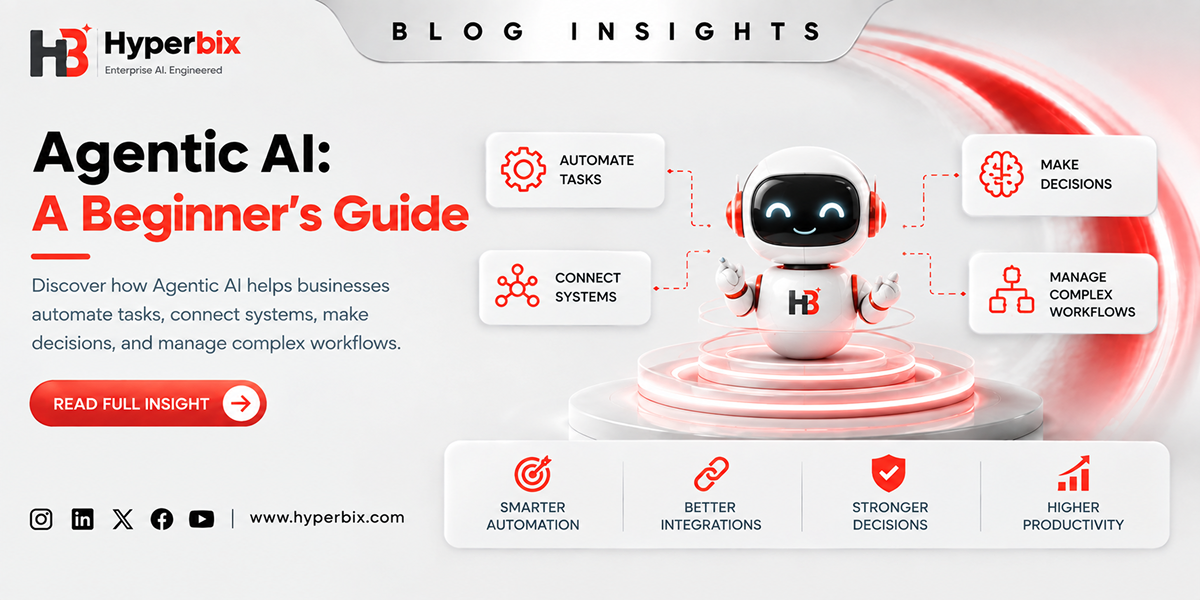
Agentic AI is used to refer to AI software that can comprehend a goal, plan the task, make decisions, operate tools and act while having minimal human input. This is in contrast with traditional AI whose operation is limited to responding to prompts from humans.
For business, agentic AI can communicate with databases, application programming interfaces and business applications to execute workflows. An illustration would be an AI agent performing customer service duties through fetching information, verifying business information and formulating a proper response.
What Makes AI "Agentic"?
The Difference is in the fact that the agent acts to accomplish an objective, not react to a certain individual request. The agent can analyze the situation, identify the necessary information, choose the right tool, do a certain job, and then evaluate its results before proceeding.
Agentic systems can thus incorporate goal-directed behavior, planning, reasoning, awareness of the context, use of tools, actions, and feedback. Such abilities enable agentic systems to be a part of workflow that otherwise requires multiple manual actions.
How Does Agentic AI Work?
Agentic AI usually relies on a continuous workflow rather than an input-output interaction process. The system recognizes the objective, collects information about the context, makes a plan regarding what needs to be done, and identifies the resources that are needed for the job.
Understanding the Agentic AI Workflow
A typical process of an agentic AI includes working towards an objective by splitting the task into several parts or subtasks. The agent can collect information, analyze the current situation, utilize different tools, and identify further actions to be performed. In such a way, several tasks can be performed together as a whole objective.
Goal Setting and Task Planning
First, the agent understands the objective and splits it into subtasks. It identifies which action has to be done before another one. In case there are any changes in the environment, the agent may change the sequence of actions within certain boundaries.
Reasoning and Decision-Making
Reasoning enables the agent to analyze all the necessary information before making a decision about taking an action. Reasoning can take into account various conditions, business rules, and outcomes of previously performed actions to choose a course of actions. In cases of critical decisions, the workflow might contain human authorization to avoid the independent decision-making of the agent.
Using Tools and External Systems
The more helpful the agent is for business processes, the more possible it is to enable its interaction with external systems via API integration. Thus, the agent will be able to get information from CRMs, databases, knowledge base, inventory management system, and other business application systems.
Taking Actions
After deciding what needs to happen, the agent can perform an approved action within its assigned permissions. This may include updating records, creating tasks, sending notifications, generating reports, or moving a workflow forward. Sensitive actions should have appropriate restrictions and may require human approval.
Learning From Feedback and Results
The agent can use the results of previous actions to determine what should happen next. If an action fails or produces an unexpected result, it can evaluate the situation and follow another permitted path. Here, learning can simply mean using feedback and results during the workflow rather than automatically retraining the AI model.
Key Components of Agentic AI
Agentic AI is built from several technologies that work together. An AI model may provide reasoning and language capabilities, while memory, data sources, tools, APIs, and monitoring systems provide the surrounding infrastructure needed to complete tasks.
AI Models
AI models provide the intelligence used to understand instructions, process information, generate responses, classify information, or support decision-making. Large language models are commonly used in agentic systems, but other machine learning models can also be included for specialized tasks.
Memory and Context
Memory and context help an agent understand information relevant to its current task. This could include previous interactions, task history, customer information, business instructions, or retrieved documents. The need for good context management arises from the fact that for the agent to make decisions based on relevant information, there should not be too much information to overwhelm the agent.
Planning and Reasoning
Planning will assist the agent to understand how it should go about attaining its goal, while reasoning will enable the agent to analyze the information it has before making its move.
Tools and APIs
Tools help agents connect with and interact with external systems. The agent can utilize APIs to get customer information, search databases, perform inventory checks, generate tickets, and make updates to business applications. The tools that the agent requires should be appropriate for its duties, and the systems the agent can access should only include what is necessary.
Knowledge and Data Sources
Agents need access to relevant information to complete many business tasks. The information could be available from internal documentation, databases, knowledge bases, customer information, product information, or linked business application systems. The retrieval system will assist the agent in getting the required information at the time of need instead of depending on the information available in the AI system.
Feedback and Monitoring
Monitoring aids businesses in knowing the behavior of the agent in the actual workflow environment. Teams can review completed tasks, failed actions, errors, escalations, tool usage, and human corrections. This information can be used to identify areas where the workflow needs better instructions, data, testing, or controls.
Security and Governance
Because AI agents may interact with business data and software, security needs to be part of the system design. Access permissions, authentication, data protection, action restrictions, approval workflows, and activity logs can help keep agent behavior within defined boundaries.
Types of Agentic AI
Agentic AI can be designed in different ways depending on how much planning, tool use, and autonomy a task requires. Common types include:
Reactive Agents - The reactive agent acts based on the present stimulus. These agents are suitable for simple jobs that do not need much planning or background information.
Goal-Based Agents - Goal-oriented agents aim to accomplish a particular goal. They do not react to the command, but they think about the action that will lead them to the desired result.
Planning Agents - Planner agents are for jobs that involve more than one step. They divide the main goal into different sub-goals and then choose how to perform them in order.
Tool-Using Agents - Tool-using agents can interact with external applications, databases, APIs, search systems, and other resources. This gives them the ability to retrieve information and perform approved operations.
Multi-Agent Systems - Multi-Agent Systems include multiple agents of AI interacting with each other. The different agents may perform different roles like research, analysis, validation, communication or work flow management.
Autonomous Business Agents - The autonomous business agents are developed to perform some business work flows with minimal human intervention. However, their autonomy must be governed by certain permissions, rules, monitoring and escalation processes.
Agentic AI vs. Generative AI vs. Traditional AI: What's the Difference?
Traditional AI, generative AI, and agentic AI can overlap, but they are generally designed for different purposes.
Aspect | Traditional AI | Generative AI | Agentic AI |
Main focus | Prediction, classification, or defined automation | Generating content and responses | Completing goals and workflows |
Interaction | Often based on predefined inputs | Usually prompt-based | Goal and task-based |
Planning | Usually predefined | Generally limited | Can support multi-step planning |
Tool usage | Depends on implementation | Can be connected to tools | Often central to the workflow |
Action-taking | Usually predefined | Usually limited | Can perform permitted actions |
Autonomy | Generally limited | Generally limited | Can operate with controlled autonomy |
These approaches can also work together. If an agentic application may use a generative AI model for language, a machine learning model for prediction, a retrieval system for business knowledge, and APIs for interacting with enterprise software.
Key Benefits of Agentic AI for Businesses
Agentic AI could prove helpful if a business process requires coordination among several activities.
Automation of Complex Workflows: Some business processes may require employees to transfer data and carry out several activities. Here, an AI agent can coordinate these activities in one workflow and avoid manual intervention during each step.
Minimizing Manual Processes: Agents can perform repetitive processes like gathering information, organizing records, summarizing information, routing requests and generating reports. This way employees get more time for work that involves decision-making and other complex processes.
Increasing Process Effectiveness: Agents connect various steps of a process together. It can retrieve information, process it, execute the approved actions, and continue with the workflow as per the rules set.
Faster Decision Making: The agent gathers information from multiple sources and organizes it. Employees will be able to examine relevant information without the need to search for it manually through multiple sources.
Personalizing Customer Experiences : An agent can use customer data, past interactions, and contextual information about the business in order to deliver more personalized support. An example is a customer service agent that understands the problem at hand taking into consideration past interactions with the customer and the customer account details.
Connecting Applications in Business: Agentic AI can integrate applications via APIs and integrations. A single process might include CRM, ERP, customer support, analytics, and knowledge management applications.
Business Process Scaling: Agents can scale higher amounts of standard processes through standardized workflows. Scaling, however, still needs proper infrastructure, monitoring, security controls, and human supervision.
Common Applications of Agentic AI
Agentic AI can be applied to business functions where employees regularly gather information, make decisions, and perform actions.
Customer Service and Support
AI-powered agents can comprehend the customer’s request, gather information from customer’s account, search for information in knowledge bases, review order information, formulate a response, and escalate complicated cases to human agents.
Sales and Lead Management
The sales agents can help with lead qualification, research, updates in CRMs, lead routing, preparing follow-ups, and summary of accounts.
Marketing Automation
Marketing teams can use agents for activities such as audience research, campaign analysis, content planning, customer segmentation, and reporting. The agent can coordinate information across different marketing tools when the necessary integrations are available.
IT and Software Operations
IT agents can assist with alert investigation, incident analysis, documentation searches, ticket creation, and routine troubleshooting. For systems that could affect production environments, additional approval and security controls may be required.
Finance and Accounting
Agentic AI can support invoice processing, document classification, financial data organization, exception identification, and report preparation. Financial workflows, because they deal with confidential information, necessitate special attention regarding access controls and approvals.
Supply Chain and Logistics
Agents may assist in tracking packages, gathering inventory data, locating orders, gathering supplier information, and identifying workflow exceptions.
Healthcare and Business Administration
Agents may assist in administrative tasks such as filing, gathering information, scheduling, and workflow management for healthcare settings and any other environment that requires sensitive information handling.
Research and Knowledge Management
Research agents can gather information from approved sources, organize findings, compare information, and prepare structured reports. This can make internal knowledge easier to find and use.
What Are the Challenges of Agentic AI?
Agentic AI introduces additional considerations because an AI system may make decisions and interact directly with business applications.
Data Quality and Availability - An agent's output depends partly on the information available to it. Incomplete, inconsistent, or outdated data can affect the quality of its decisions.
Reliability and Accuracy - AI systems can misunderstand information or produce incorrect results. Testing and validation are therefore important before allowing an agent to perform meaningful business actions.
Security Risks - An agent connected to business systems may have access to sensitive information. Organizations need to control what the agent can access and what it is allowed to do.
Uncontrolled or Incorrect Actions - An Incorrect decision will affect a greater scope if the agent is authorized to take a certain course of action. This problem can be mitigated by organizations through limited authorization and approval processes for certain actions.
Integration Complexity - Agentic systems may need to communicate with multiple applications, APIs, databases, and internal systems. Designing reliable connections between these systems can require careful technical planning.
Human Oversight - Some decisions should remain under human control. An agent should have clear conditions for when to stop, request approval, or transfer a task to an employee.
Cost and Infrastructure Requirements - Agentic AI can involve AI models, integrations, databases, monitoring systems, security infrastructure, and computing resources. Businesses need to consider the requirements of the complete solution rather than looking at the AI model alone.
How to Implement Agentic AI in a Business?
Implementing Agentic AI should begin with a clearly defined business problem. The objective is to determine where an agent can safely and practically support an existing workflow.
Identify the Right Business Process
Begin with a process that includes repeating tasks, multiple stages, information gathering, decision-making, or interaction with more than one business system.
Define Objectives and Scope
Establish the objectives of the intelligent agent and scope of its work. What can it do? What can it not do? What can it know? What cannot it know?
Select Models and Technologies
The technology should match the workflow. A solution may combine large language models, machine learning, retrieval systems, APIs, databases, workflow orchestration, and business applications.
Connect Business Data and Tools
Give the agent access to the data and systems required for its role. These connections should be designed around security, reliability, data quality, and appropriate permissions.
Design the Agent Workflow
Map out the order of events from beginning to end. Identify how the agent receives requests for tasks, plans tasks, accesses data, reasons about the situation, utilizes tools, acts, validates results, and handles exceptions.
Human Oversight of Tasks
Specify which tasks can be performed automatically and which require oversight by an employee. Human oversight becomes especially helpful in sensitive and rare cases.
Test and Monitor the System
Test the agent using normal scenarios as well as incomplete information, unexpected requests, failed integrations, and incorrect inputs. Once deployed, monitoring can help identify errors and areas where the workflow needs adjustment.
Scale Based on Results
After a workflow has been evaluated, businesses can determine whether similar processes are suitable for agentic automation. Expansion should be based on actual business requirements rather than simply increasing automation for its own sake.
What Is the Future of Agentic AI?
Agentic AI will probably get more connected to business applications and digital workflows. In contrast to standalone chatbot or assistant, AI will be embedded into the systems that people use.
More Autonomous Business Workflows: AI agents will be capable of handling bigger chunks of structured workflows according to the prescribed permissions and business rules.
Multi-Agent Systems: Different specialized agents can collaborate to perform complicated tasks: one agent collects data, another analyzes it, and the third one schedules the next step.
Human-AI Collaboration: The viable business approach includes using AI for coordination and information processing and keeping people as decision makers, exception handlers, relationship managers, and supervisors.
Higher Degree of Agentic Systems Integration with Enterprise Software: As agentic systems become more integrated with CRM, ERP, analytics, customer support, collaboration, and other business software, they can be used in business processes.
Higher Degree of Focus on AI Governance and Security: A Higher degree of AI autonomy also means higher degree of necessity to think about governance. Enterprises will have to consider access control, data protection, monitoring, auditability, human approval, and responsible use.
Conclusion
An agentic AI is the progression of an AI's capability to perform actions such as achieving set goals, planning activities, utilizing tools, making decisions, and performing allowable actions.
These abilities are possible through the combination of various components such as AI models, memory, context, reasoning, planning, business data, APIs, integrations, monitoring, and security controls.
The usage of this technology within the business environment can include customer service, sales, marketing, IT, finance, research, logistics, and many other multi-step processes. However, to use Agentic AI effectively, businesses require not only to connect an AI model with an existing system. They also should have clear objectives, trustworthy data, proper permissions, testing, monitoring, and human involvement.
The most practical path towards Agentic AI Development would be to begin by selecting a particular business process, analyzing the aspects of decisions and repetition, and identifying where an AI agent can provide support or automation.
Blog FAQs
Frequently Asked
Questions
Agentic AI is an AI system that can comprehend the goals, task plans, make decisions, use tools, and execute actions within set boundaries and permissions.
Agentic AI operates through goal comprehension, information gathering, task planning, tool utilization, action execution, and evaluation of the result to determine the next move.
AI is described as agentic when it can achieve the goal as opposed to being able to operate only based on an individual prompt. The AI can plan, reason, utilize tools, take actions, and provide feedback.
The essential components are AI models, memory and context, planning and reasoning, tools and APIs, knowledge and data sources, monitoring, feedback, security, and governance.
Generative AI involves creation of content or responses to a prompt while agentic AI makes use of the AI models in a much larger workflow to plan tasks, utilize tools, and execute actions towards achieving a goal.
The benefits of agentic AI for companies include process automation, reduction of repetitive tasks, connection of business applications, decision-making assistance, personalization of customer experience, and scaling of standard processes.
Agentic AI could be used in customer service, sales, marketing, IT, finance, accounting, logistics, healthcare administration, R&D, and knowledge management processes.
Typical problems may include data quality, accuracy, security issues, incorrect actions, difficulty of integration, need for human control, and needed infrastructure to support agentic workflows.
A company could start by choosing the right workflow, specifying goals and boundaries, choosing the right technology, connecting necessary data and systems, designing the workflow, implementing human supervision, and testing and monitoring the system.
Not necessarily. Agentic AI could work autonomously in a controlled way, but a company could specify permissions, approval rules, security limitations, monitoring, and escalation procedure.