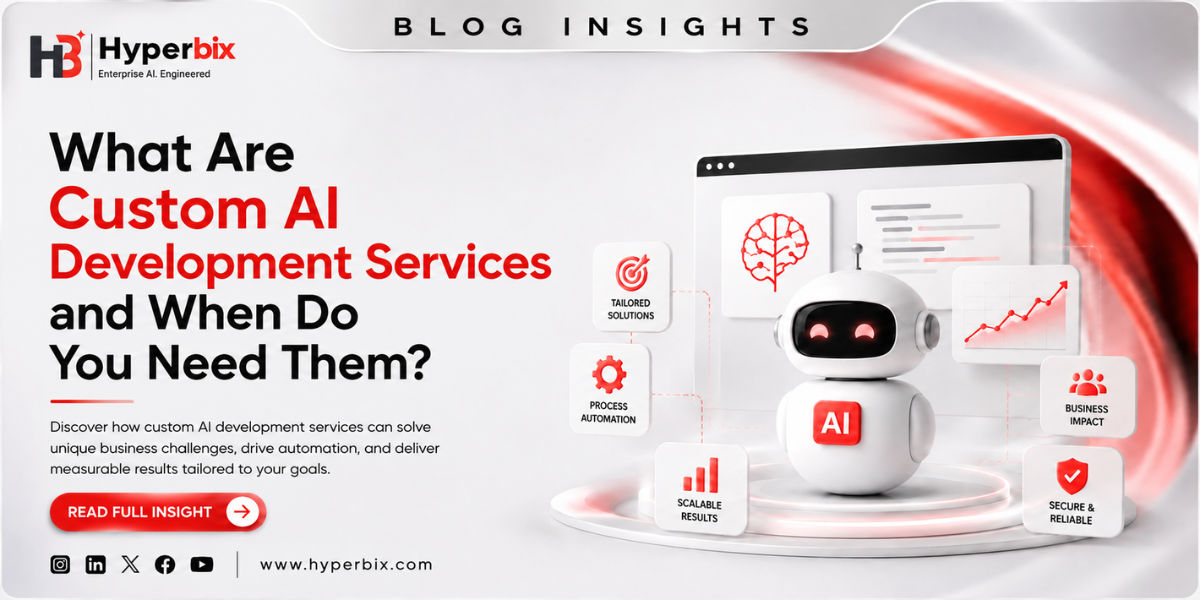
What Are Custom AI Development Services? A Complete Guide to When You Need Them
Listen to this articleTap play to start listening

Why Are Businesses Investing in Custom AI Development?
Tailored AI development services enable companies to craft AI solutions to address specific operational requirements, exclusive data, flow processes and technology landscape. Rather than using AI tools out-of-the-box, businesses can create AI solutions tailored to specific business challenges and connected to their current systems.
AI is also being applied to various industries. Statista Market Insights project the global artificial intelligence market will be worth a mere US$617.62 billion in 2026, and will be expected to grow at a 14.82% CAGR through 2026–32 to US$1.42 trillion by 2032.
But, the increase in AI isn't necessarily a call for a completely bespoke solution for every business. Custom AI becomes more relevant when it's not possible to use standard AI tools on the workflow, business data, and complex integrations, security requirements, or the level of control that a business would like.
What Are Custom AI Development Services?
Custom AI development services are designed to create AI solutions that meet the unique needs of a business and its data, workflows, and technology landscape. Custom Solutions can be designed to meet specific business needs, be integrated with existing systems, and align with specific business goals. Custom Solutions can be tailored to meet specific business needs, be integrated with existing systems, and align with specific business goals.
Custom AI development can involve machine learning, generative AI, natural language processing, computer vision, predictive analytics and intelligent automation, and AI-based applications. The best solution will be determined by the business goal, data sources, security considerations, integration requirements and desired results.
How Do Custom AI Development Services Work?
The process of developing an AI solution from a business need to a deployed solution is well defined: Custom AI Development. Each stage is dedicated to the creation of useful, secure, scalable and measurable business goals applications.
Identifying Business Requirements
The process starts with the identification of business problem, target user, needed functionality, existing systems and expected results. Implements a process to clarify requirements, to decide if the use case is suitable for AI, and to choose the development process.
Data Collection and Preparation
Relevant data is gathered from approved sources like databases, documents, APIs, business systems and applications. It is then cleaned, structured, validated and ready to be used for model training, retrieval, analysis and/or inference.
AI Model Selection and Development
The specific model or AI architecture depends on the use case. Development can be machine learning models, large language models, computer vision, NLP, predictive models or retrieval-augmented generation, depending on the need.
Testing, Deployment, and Integration
Before deployment, the accuracy, reliability, security, performance and usability of the AI application are tested. Existing business applications, cloud services, APIs and databases can then be integrated into the solution.
Continuous Monitoring and Optimization
Post deployment evaluations are necessary for AI applications to ensure performance and relevance. Quality of the response, behaviour, system performance, usage and business outcomes are monitored and opportunities for continuous improvement identified.
What Types of Custom AI Solutions Can Businesses Build?
There are various AI solutions that can be created to suit different businesses, depending on the industry, data, workflows, and objectives. Custom development enables the embedding of AI capabilities beyond just what is offered by the software, to suit specific business needs.
AI-Powered Chatbots and Virtual Assistants
Utilizing a custom AI chatbot, you can provide answers to customer inquiries, support staff, access business data, and streamline support processes. They are also able to link to knowledge bases, CRM systems, help desks, and internal applications.
Custom Machine Learning Applications
Machine learning applications can find patterns in business data and assist in the classification, prediction, anomaly detection, risk analysis, and more business data-driven process.
Generative AI Solutions
Generative AI can generate and process text, code, documents, images and more. Custom implementations can enable integration of large language models to enterprise business data, processes and applications.
Predictive Analytics and Forecasting
Predictive AI can take historical data and real-time information, and use it to look for trends and make estimates that predict future results. It could be used in various business areas such as demand forecast, sales prediction, customer churn, inventory planning, and operational study.
Computer Vision Solutions
In the field of computer vision, software can analyze images and videos for applications like quality inspection, object detection, document analysis, and visual monitoring.
Natural Language Processing (NLP)
With the help of NLP, AI applications can comprehend and use human language. It is applied in text classification, sentiment analysis, summarization, information extraction, translation and smart search, etc.
AI-Powered Recommendation Systems
Recommended products, content and services or other recommendations are the products of a system that uses data about the user, their preferences and context to serve up relevant products.
Intelligent Automation
Intelligent automation is the process of using AI alongside business processes to automate various business tasks like document processing, information extraction, request classification, decision support, and automated responses.
When Do You Need Custom AI Development Services?
When it comes to AI development, custom solutions can prove beneficial when existing AI tools are insufficient to meet a business need. It's especially beneficial in scenarios where an organization requires certain functions, exclusive data integration, advanced automation, or more oversight into how the AI acts with data.
When Generic AI Tools Cannot Meet Your Requirements?
AI products that are not considered "generic" are often tailored for specific use cases or business rules and may not be applicable to all other situations. Custom AI can be created to accomplish the specific functionality and results that an enterprise needs.
When You Need Industry-Specific AI?
Compliance requirements, terminology, data structures and processes are often different in the various industries. Industry-specific requirements can be used to create a more relevant functionality for custom AI.
When AI Must Integrate With Existing Systems?
AI could be useful for businesses to interact with CRM, ERP, e-commerce, databases, mobile applications, customer portals, or internal software. These environments can be leveraged for custom development to have AI capabilities.
When Data Privacy and Security Are Critical?
For some organizations, there is a need for more control over data processing and data access, due to the sensitive or proprietary nature of the data. Fitting authentication, authorization, encryption, access controls, monitoring and governance into custom AI architectures can be done appropriately.
When You Need Greater Control Over AI Models?
Custom AI can offer more control over both the model selection and the prompts used, as well as over the data sources, data retrieval, business logic, evaluation criteria, and the behavior of the AI application.
When You Want to Automate Complex Workflows?
Custom AI can integrate models into APIs, databases, automation tools, and application logic, enabling them to assist with the entire workflow when multiple systems are involved, as well as documents, business rules, decisions, and user interactions.
What Are the Common Use Cases for Custom AI Development?
Custom AI development supports business processes that require automation, prediction, personalization, intelligent information processing, and decision support.
Customer Support Automation - AI can automate customer queries, provide instant responses, and assist support teams.
Intelligent Document Processing - AI can extract, classify, summarize, and organize information from business documents.
Predictive Analytics - AI can analyze data patterns to forecast outcomes and support business planning.
Personalized Recommendations - AI can analyze user behavior to recommend relevant products, services, or content.
Fraud Detection - AI can identify unusual patterns and potentially suspicious activities across business data.
AI-Powered Search - AI can understand natural-language queries and retrieve relevant information from business data sources.
Workflow Automation - AI can automate repetitive tasks and connect multiple steps within complex business workflows.
Business Intelligence - AI can analyze business data to identify trends, generate insights, and support informed decisions.
Custom AI Development vs. Pre-Built AI Solutions
Custom AI and pre-built AI solutions serve different business needs. Pre-built tools can be suitable when standard functionality meets business requirements, while custom AI development provides greater flexibility for specialized workflows, proprietary data, integrations, and business-specific requirements.
Factor | Custom AI Development | Pre-Built AI Solutions |
| Customization | High | Usually limited |
| Integration | Built around required systems | Depends on available integrations |
| Scalability | Architecture can be tailored | Depends on the provider |
| Data Control | Greater architectural control | Primarily provider-dependent |
| Business Logic | Supports specialized workflows | Generally standardized |
| Deployment | More flexible | Provider-defined options |
| Maintenance | Requires ongoing management | Often provider-managed |
| Initial Complexity | Generally higher | Generally lower |
The right option depends on the business requirement. Pre-built AI can be practical for common use cases that require faster implementation, while custom AI is more suitable when a business needs specialized functionality, deeper integration, greater control, or workflows that standard solutions cannot adequately support.
What Are the Benefits of Custom AI Development Services?
Businesses have different needs and require custom AI or prebuilt AI solutions. While pre-built tools may be appropriate for simple workflows and business needs, custom AI development offers flexibility for more complex workflows, proprietary data, integrations, and business-specific requirements.
Improved Operational Efficiency
Business value can be achieved with custom AI that is built to address a specific business problem and connected into the appropriate workflow. It offers more than just automation, it also enhances customer experience, analytics, decision support and scalable digital operations.
Personalized Customer Experiences
AI can analyze customer interactions, preferences, and behavior to provide more relevant recommendations, responses, content, and services.
Better Business Decision-Making
AI can analyze large datasets and identify patterns that may be difficult to detect manually. Predictive analytics and AI-powered insights can provide additional information for business planning.
Reduced Manual Work
AI-powered document processing, classification, customer support, information extraction, and workflow automation can reduce repetitive manual activities.
Scalable AI Infrastructure
A properly designed AI architecture can support growing data volumes, users, transactions, and application workloads as business requirements evolve.
Competitive Advantage
Businesses can use custom AI to improve operational processes, differentiate customer experiences, develop intelligent products, and create new digital capabilities.
Which Industries Benefit From Custom AI Development?
Custom AI development can support industries that handle large datasets, repetitive tasks, complex workflows, customer interactions, or data-driven decision-making. Its applications can be adapted to each industry's specific operational requirements and business objectives.
Healthcare – AI for Healthcare Operations
AI can support administrative automation, document processing, patient communication, research support, and information management.
Finance and Banking – AI for Financial Services
AI can help with fraud detection, risk analysis, document processing, customer support, and financial data analysis.
E-commerce and Retail – AI for Personalization
AI can support product recommendations, customer personalization, demand forecasting, intelligent search, and inventory planning.
Manufacturing – AI for Smart Operations
AI can assist with quality inspection, predictive maintenance, production analysis, demand forecasting, and process optimization.
Logistics and Transportation – AI for Logistics
AI can support route optimization, demand prediction, fleet monitoring, shipment analysis, and logistics planning.
Real Estate – AI for Property Services
AI can assist with property recommendations, document analysis, lead qualification, market analysis, and customer communication.
Education – AI for Learning and Administration
AI can support personalized learning, content generation, student assistance, assessment support, and administrative workflows.
SaaS and Technology – AI for Digital Products
AI can be integrated into SaaS and technology products for intelligent search, customer support, analytics, recommendations, automation, and AI-powered user experiences.
What Technologies Are Used in Custom AI Development?
Custom AI development combines different technologies according to the application's objectives, data requirements, integration environment, and deployment needs.
Machine Learning and Deep Learning
Machine learning and deep learning technologies support prediction, classification, pattern recognition, anomaly detection, computer vision, and other AI applications. Frameworks such as TensorFlow, PyTorch, scikit-learn, and XGBoost can be selected according to project requirements.
Generative AI and Large Language Models
Generative AI and LLMs can support conversational applications, content generation, summarization, document analysis, coding assistance, and intelligent business assistants.
Natural Language Processing
NLP technologies enable applications to process, classify, summarize, extract, and interpret human language for text-based business applications.
Computer Vision
Computer vision technologies allow applications to analyze images and video for detection, classification, recognition, inspection, and document-processing use cases.
AI APIs and Frameworks
AI APIs and frameworks can provide access to language models, embeddings, speech, vision, machine learning, and other capabilities while accelerating application development.
Cloud AI Platforms
AWS, Microsoft Azure, and Google Cloud provide infrastructure and services for AI application development, data processing, model deployment, storage, monitoring, and scaling.
Vector Databases and AI Infrastructure
Vector databases such as Pinecone, Weaviate, and ChromaDB can support semantic search and retrieval-based AI applications. Infrastructure technologies such as Docker and Kubernetes can support deployment and scalability.
How Much Do Custom AI Development Services Cost?
The cost of custom AI development depends on the scope, complexity, data requirements, integrations, technology choices, infrastructure, security requirements, and ongoing maintenance needs. There is no single development cost that applies to every AI project.
Factors That Influence AI Development Costs
The number of features, AI capabilities, users, integrations, data sources, security requirements, and deployment environments can significantly affect the overall development scope.
AI Solution Complexity
A basic AI-powered application generally requires fewer development resources than a complex platform involving multiple AI models, large datasets, advanced automation, and numerous integrations.
AI Model and Technology Selection
Using an existing model, fine-tuning a model, implementing RAG, or developing specialized machine learning models can involve different technical requirements and infrastructure needs.
Data and Infrastructure Requirements
Data preparation, storage, processing, model hosting, APIs, GPU resources, cloud services, security controls, and monitoring can all influence the project investment.
Maintenance and Scaling Costs
After launch, AI systems may require model evaluation, data updates, infrastructure management, security improvements, performance monitoring, and optimization as usage increases.
What Are the Common Challenges in Custom AI Development?
Custom AI development requires careful planning because AI performance depends on data quality, architecture, integration, security, and ongoing evaluation.
Data Quality and Availability
Incomplete, inconsistent, outdated, or poorly structured data can affect AI performance. Data preparation and validation are therefore important parts of the development process.
AI Model Accuracy
AI outputs should be evaluated against clearly defined requirements. Testing, validation, monitoring, and human oversight may be necessary depending on the application's purpose.
Integration Complexity
Connecting AI with legacy systems, databases, APIs, and existing workflows can create technical challenges. A clear integration architecture helps reduce these risks.
Data Privacy and Security
AI applications may process confidential business or customer information. Appropriate access controls, encryption, authentication, data governance, and secure infrastructure should be considered.
Scalability and Model Maintenance
AI applications may need architectural improvements as data volumes, users, and workloads increase. Continuous monitoring also helps identify model or application performance changes.
How to Choose a Custom AI Development Company?
Choosing the right AI development partner requires evaluating technical capabilities, development processes, security practices, integration capabilities, and the ability to understand the business problem.
AI and Technical Capabilities
Evaluate the company's ability to work with relevant AI models, frameworks, programming languages, cloud platforms, databases, APIs, and deployment technologies.
Industry Knowledge
A suitable development partner should understand the workflows, users, business processes, and regulatory considerations relevant to the target industry.
Development Methodology
A structured methodology should cover requirements analysis, architecture, development, testing, deployment, monitoring, and continuous improvement.
Data Security and Compliance
Review how the development process addresses authentication, authorization, encryption, data access, secure APIs, logging, privacy, and applicable compliance requirements.
Integration Capabilities
The development partner should be able to integrate AI with existing applications, databases, APIs, CRM systems, ERP platforms, and other business software when required.
Post-Deployment Support
AI applications require ongoing monitoring and optimization. Post-deployment support can include maintenance, model evaluation, infrastructure management, security updates, and future enhancements.
Why Choose Hyperbix for Custom AI Development Services?
Hyperbix helps businesses develop custom AI solutions around specific business requirements, workflows, data, and technology environments. Its services can support AI application development, integration, deployment, and ongoing optimization.
Business-Focused AI Development
Hyperbix can align AI development with defined business objectives and practical use cases. This approach helps businesses focus on AI applications that address specific operational or customer-facing requirements.
Custom AI Solutions
Hyperbix can support the development of AI-powered applications involving generative AI, machine learning, intelligent automation, predictive analytics, NLP, recommendation systems, and other AI capabilities.
Existing System Integration
AI solutions can be connected with existing applications, databases, APIs, and business workflows. This allows AI functionality to become part of the existing technology environment instead of operating separately.
Modern AI Technology Stack
Depending on project requirements, the technology stack can include Python, Java, JavaScript, TensorFlow, PyTorch, LangChain, LlamaIndex, AI APIs, cloud platforms, relational and NoSQL databases, vector databases, Docker, and Kubernetes.
Scalable and Secure AI Architecture
AI applications can be designed with scalability, security, access control, monitoring, and data protection in mind. The architecture can be aligned with the application's data, user, integration, and deployment requirements.
How to Get Started With Custom AI Development?
Starting with a clearly defined business problem helps ensure that AI development focuses on measurable value rather than technology alone.
Define the Business Problem
Identify the process, challenge, or opportunity that AI should address and define the desired business outcome.
Identify AI Use Cases
Determine where AI can provide measurable value through automation, prediction, personalization, intelligent search, content generation, or decision support.
Assess Data Readiness
Review available data sources, data quality, accessibility, storage, security, and governance requirements before selecting the AI architecture.
Set Goals and KPIs
Establish measurable objectives such as processing speed, automation rate, response quality, prediction accuracy, customer satisfaction, or operational efficiency.
Build, Test, and Launch an MVP
A focused MVP can help validate the AI use case with a controlled scope. Performance and user feedback can then guide future development.
Conclusion
Custom AI development is most valuable when standard AI tools cannot adequately support a business's specialized workflows, proprietary data, integrations, security requirements, or operational objectives. It enables organizations to build AI capabilities around specific business processes and customer needs.
The right approach starts with identifying a clear business problem, evaluating data readiness, selecting a suitable AI use case, and defining measurable outcomes. When appropriately planned and continuously optimized, custom AI can become a scalable component of a business's digital infrastructure and support long-term operational improvement.
Blog FAQs
Frequently Asked
Questions
Custom AI development can address business problems involving repetitive processes, large volumes of data, complex information handling, prediction, personalization, and decision support. The appropriate solution depends on the organization's objectives, available data, existing technology, and the specific process that needs improvement.
Yes, custom AI capabilities can be added to existing web applications, mobile apps, enterprise platforms, and other software. APIs, SDKs, databases, and integration services can connect AI functionality with existing applications without necessarily requiring the entire system to be rebuilt.
Yes, developing an AI MVP can be a practical way to validate a specific use case before expanding the solution. A focused MVP can help evaluate functionality, user response, technical feasibility, and business outcomes before additional features and integrations are introduced.
Yes, custom AI solutions can be designed to accommodate changing business requirements, data sources, workflows, and user needs. Scalable architecture, modular components, model updates, and continuous monitoring can make it easier to enhance an AI application as the business evolves.
Yes, a custom AI platform can support different departments when the architecture, access controls, data sources, and workflows are designed accordingly. For example, the same AI infrastructure may support customer service, sales, operations, finance, or internal knowledge management while maintaining appropriate access to department-specific information.
Custom AI applications can work with approved data from databases, business applications, documents, APIs, cloud storage, knowledge bases, customer interactions, and other structured or unstructured sources. The data should be relevant, appropriately prepared, securely accessed, and handled according to applicable privacy and governance requirements.
Yes, custom AI applications can integrate third-party AI models and APIs when they are appropriate for the intended use case. This approach can allow businesses to combine existing AI capabilities with proprietary data, application logic, workflows, and user interfaces rather than developing every AI component from the ground up.
Businesses can measure AI performance using technical and business KPIs such as processing time, automation rate, response quality, prediction accuracy, user adoption, customer satisfaction, error reduction, or operational efficiency. The most relevant metrics should be defined before development so the solution can be evaluated against clear objectives.
AI applications require continuous monitoring, performance evaluation, data updates, and model optimization after deployment. Regular improvements help AI systems maintain accuracy and adapt to changing business requirements.
The future of custom AI development services includes generative AI, AI agents, autonomous workflows, intelligent automation, and industry-focused AI applications. Businesses are adopting these technologies to create smarter systems and improve digital operations.