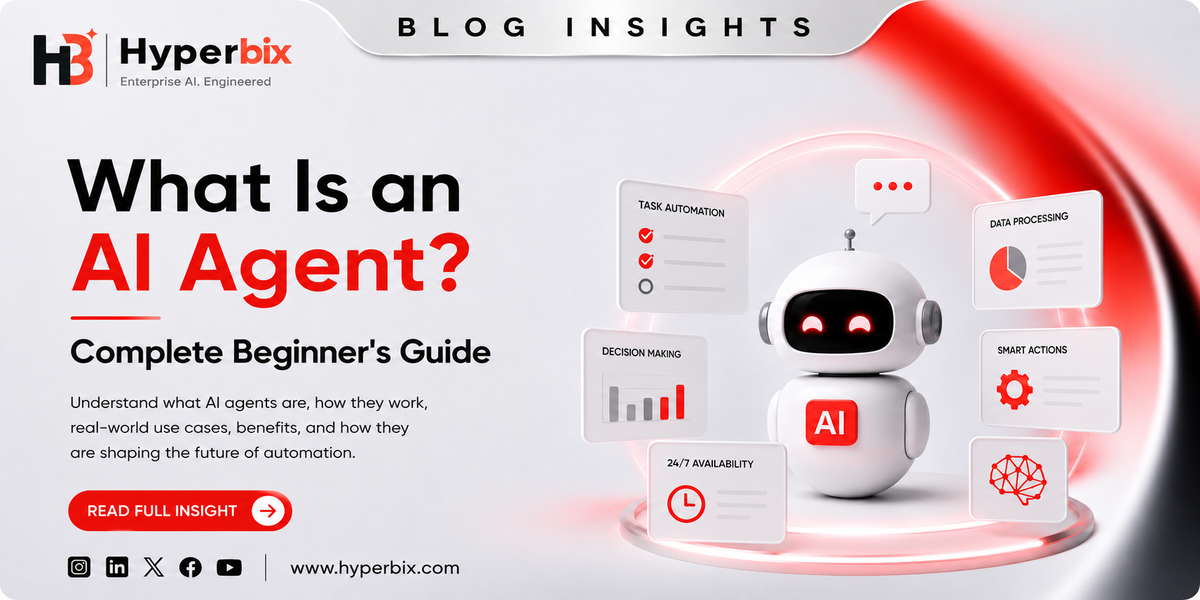
What Is an AI Agent? Complete Beginner's Guide
Listen to this articleTap play to start listening

Introduction
Artificial intelligence (AI) is altering how people work and interact with technology. One of the most significant developments within this area is the development of the AI agent. An AI agent is a software system that has the ability to understand data, think about it, and execute actions on its own without being under continuous human supervision. While typical software operates based on preset algorithms, AI agents have the capacity to interpret information and adapt themselves to varying conditions.
Currently, AI agents are actively applied in customer service, healthcare, financial industry, e-commerce, education, and many other spheres. They can provide customer assistance, automate processes, assist employees in decision-making and increase business efficiency. As the technology progresses, AI agents become a key element of any digital solution. In this beginner's guide, you will find information about AI agents including what they are, how they work, different types of agents, advantages and applications, and how to develop your own AI agent.
What Is an AI Agent?
An AI agent refers to a software that possesses the ability to analyze information, make decisions, and perform activities for accomplishing some desired goals. These programs have the capacity to gather information, analyze the same, act accordingly, and enhance their abilities. AI agents are designed to assist people or organizations in accomplishing various activities effectively.
AI Agent vs AI Chatbot
The AI chatbot is essentially created for responding to queries and interacting with the user. The AI agent can perform way more functions such as making decisions, using tools and carrying out tasks without human intervention.
AI Agent vs Traditional Automation
Automation works according to a predetermined set of rules and is able to do tasks which are pre-programmed into it. On the other hand, an AI agent is capable of understanding the situation, deciding about something, and doing things based upon the information.
Key Characteristics of an AI Agent
The most important characteristics of an AI agent include goal orientation, intelligence and adaptability. AI agents have the ability to analyze information, take decisions, accomplish tasks and learn through experience.
How Do AI Agents Work?
AI agents operate through four straightforward stages. The first one is the gathering of information. The second thing is that they analyze the gathered information. Third, they take the proper actions necessary to perform the task. Lastly, they learn from the outcome for better performance in the future. This approach makes AI agents function in an efficient and accurate manner.
Perception: Gathering Information
The first step of the AI agent includes gathering information from various sources, like user input, web sites, sensors, databases, applications, and so on.
Reasoning: Processing and Decision-Making
Once the information has been gathered, the AI agent processes it and makes a decision about how to proceed with the assigned task using AI algorithms, rules and past experience to come up with the best solution.
Action: Executing Tasks
When the decision has been made, the AI agent executes the task. The task can be in the form of answering queries, creating content, sending e-mails, booking meetings, updating databases, or engaging with other programs to accomplish the task.
Learning: Improving Over Time
The AI agent analyzes the outcome after the task is completed and gains knowledge through the process. It uses the feedback gained from the experience to enhance its performance and deliver better output.
Types of AI Agents
AI agents serve distinct functions. Some agents operate based on rules, while others are capable of learning, planning and making decisions intelligently. The kind of agent chosen to use in an operation will depend on its capabilities.
Simple Reflex Agents
The operations of simple reflex agents depend on rules. The agents react to one particular input with one action and do not remember past experiences. The agents are suitable for simple tasks.
Model-Based Reflex Agents
The model-based reflex agents keep information about the past and comprehend the current state before coming up with a decision. These agents have higher levels of complexity as compared to the simple reflex agents.
Goal-Based Agents
A goal-based agent bases its decisions on a certain goal. In other words, it compares possible actions and decides which one will help the agent realize the desired result in the most efficient manner.
Utility-Based Agents
The utility-based agent decides on the most appropriate action after evaluating all available actions. It tries to get maximum benefit or value, which is why such an agent can be used when several options are available.
Learning Agents
Learning agents enhance their performance using experience. They gain new knowledge from fresh data, feedback from the user, and past actions.
Multi-Agent Systems
A multi agent system comprises a number of AI agents who work together to accomplish a certain task. The agents have their own roles and work collectively to solve problems.
Key Features of AI Agents
There are many characteristics that make artificial intelligence agents smarter and more efficient than conventional software. These characteristics enable agents to perceive information, make decisions, and accomplish tasks with minimal intervention from humans.
Autonomous Decision-Making
AI agents can make decisions and execute actions on their own without having to be controlled by humans all the time.
Goal-Oriented Behavior
AI agents have been created with the intention of accomplishing particular goals by making the appropriate choices to get the job done.
Learning and Adaptation
AI agents continuously learn through new information and feedback from users, thus becoming better at what they do.
Natural Language Understanding
Several AI agents understand human language and are able to communicate in a more human way.
Integration with Multiple Tools
AI agents can integrate with applications, databases, APIs, and other software in order to perform tasks effectively.
Real-Time Data Processing
They are able to analyze data in real time and react to any changes that might take place.
Continuous Improvement
AI agents can evaluate their performance and based on previous experience make better decisions in the future.
Benefits of AI Agents
The AI agents will enhance the efficiency of the task completion process, make the process more precise, and reduce manual effort. The AI agents can work round the clock, make smart decisions, and increase efficiency.
Increased Productivity : AI agents automate mundane tasks and enable employees to perform other significant functions.
Faster Decision-Making :These agents analyze information and give accurate suggestions to the organizations.
Cost Savings : These agents contribute toward cost reduction for organizations due to improved efficiency.
Improved Customer Experience :The AI agents give an instant reply, personal attention, and 24/7 support, hence high levels of customer satisfaction.
Better Accuracy : They minimize the errors made by human beings due to the consistent processing of information and decision making.
Scalability : AI agents can manage several tasks and serve increasing numbers of users without compromising on their performance.
24/7 Availability : AI agents have an advantage over human beings in that they work continuously.
Real-World Applications of AI Agents
AI agents are being used in various industries for performing certain jobs and tasks and increasing efficiency. In addition to this, they are also helpful in decision-making and saving time for employees.
Customer Support
AI agents provide solutions to customer queries and concerns. They also take care of their routine concerns and are available to assist them round the clock.
Healthcare
In the field of healthcare, AI agents assist doctors in analyzing medical information, managing appointments and monitoring of patients, as well as diagnosing.
Finance
Banks and other organizations from the field of finance use AI agents to analyze transactions and risks, detect fraud, and give financial advice to customers.
Manufacturing
The AI agents help in monitoring machines, predicting failures of the machinery, and improving production planning. It will lead to reduced downtime and increased efficiency.
Retail and E-commerce
The retail companies can utilize the AI agents for recommending products, inventory management, answering questions of customers, and personalizing the experience of shopping.
Software Development
The AI agents facilitate software development processes by coding, identifying errors, testing programs and documenting code.
How to Build Your First AI Agent
To develop an AI agent, you need to have a goal in mind and know which technology will be used for building this AI agent in order to have a smooth development process.
Define Your Objective
First of all, you need to think of what goal your AI agent will serve. It can be related to customer support, automation of some processes, data analysis, or internal work processes.
Select the Right AI Platform
There are different platforms or frameworks that you may choose from based on your needs. Examples are OpenAI, LangChain, Google Vertex AI, Microsoft Copilot Studio, and AutoGen.
Connect Data and Business Tools
Allow your AI agent to access the data and tools needed to fulfill its purpose. These can be databases, APIs, cloud computing systems, websites, CRMs, or any other applications used by your business.
Test and Optimize
Test the performance of your AI agent in different scenarios to make sure it works properly. You need to improve its responses, fix problems, and develop it further according to testing results.
Deploy and Continuously Monitor
After your AI agent has been tested, put it to use in practice. You need to keep tabs on its performance and give it updates continuously.
AI Agent vs AI Chatbot vs Traditional Automation
AI agents, AI chatbots, and automation are similar in terms of automating certain activities; however, their operations are different. While the chatbot interacts with users, automation relies on predetermined criteria, and the AI agent has the ability to analyze, make decisions, learn, and perform tasks with little human intervention.
| Criteria | AI Agent | AI Chatbot | Traditional Automation |
| Primary Function | Performs tasks, makes decisions, and achieves goals | Responds to user questions and conversations | Automates repetitive tasks using fixed rules |
| Intelligence Level | High | Medium | Low |
| Learning Ability | Learns and improves over time | Limited learning capabilities | Does not learn |
| Decision-Making | Makes intelligent decisions based on data | Responds based on user input | Follows predefined instructions |
| Adaptability | Adapts to changing situations | Limited adaptability | Cannot adapt without reprogramming |
| Task Complexity | Handles simple and complex tasks | Best for simple conversations | Best for repetitive tasks |
| Tool Integration | Connects with APIs, databases, and software | Limited integrations | Works with predefined systems |
| Human Involvement | Minimal | Moderate | High during setup and updates |
| Common Use Cases | Virtual assistants, workflow automation, business operations | Customer support, FAQs, appointment booking | Data entry, report generation, invoice processing |
Key Differences Explained
The use of an AI agent is the best choice as it has the ability to process data, decision-making, and task completion without any supervision. The AI chatbot is used to deal with communication and question-answer sessions, whereas the conventional form of automation uses fixed logic for accomplishing repetitive tasks.
Why AI Agents Matter for Modern Businesses
AI agents are contributing to businesses being run more efficiently through automation, improved decision-making, and increased productivity. They enable less human effort, save time, and help companies perform well in their service provision and business expansion.
Increasing Operational Efficiency
Automating repetitive jobs by using artificial intelligence agents is done in order to give employees the chance to deal with other more significant tasks and thus increase their productivity.
Enhancing Customer Experience
The AI agent gives instant replies, makes personal recommendations for customers, and provides customer care at all times.
Supporting Intelligent Decision-Making
AI agents process vast quantities of information and make valuable suggestions. This allows firms to make smart decisions on the basis of reliable information.
Reducing Operational Costs
Through automation of repetitive processes and reduction of manual labor, AI agents assist organizations to reduce operational costs.
Scaling Business Operations
The agents are able to handle increased workload without impacting their performance levels. This is important for expanding firms since it allows them to serve more clients, analyze large volumes of data, among other things, with little extra effort.
Challenges and Best Practices for AI Agents
AI agents help improve efficiency and automate work as well as assist in making decisions. There are certain issues that businesses need to solve in order to ensure that these tools are safe, accurate, and reliable. By following the best practices, organizations may increase their benefits and reduce the risk factors.
Protect Data Privacy and Security
AI agents use different business and consumer data. To protect the data, it is necessary to apply appropriate security solutions, such as encryption, authentication, role-based access, and security auditing.
Ensure Accuracy and Reliability
Not all AI agents are always correct and may sometimes provide incorrect answers. Frequent testing, measuring of performance, and updates will help improve the quality of the answer and ensure continued reliability of the work.
Maintain Human Oversight
The AI agent is supposed to aid humans in decision making, but it should not fully take the place of humans in decision making. Human supervision is important to deal with complicated situations and make important decisions.
Continuously Monitor and Improve
The AI agent must continuously be improved through updates to account for the changing data, changing business needs, and user feedback.
Future of AI Agents
It is certain that there will be positive prospects in the future for AI agents because of their intelligence, efficiency, and capacity for performing challenging tasks. Due to developments in areas of artificial intelligence, machine learning, and automation, the future of AI agents will include greater independence, good decision-making ability, and personalization of the process.
AI agents will have a larger impact on various industries including healthcare, finance, education, manufacturing, and customer service in the future. AI agents will be able to collaborate with humans, automate business processes, and increase productivity while decreasing human effort. With the development of AI technology, AI agents will become a necessary component of digital transformation.
Conclusion
AI agents are changing the way people work and conduct business because of their ability to automate processes, make decisions, and increase efficiency. In contrast to traditional automation tools and chatbots, AI agents can analyze data, adjust to the current situation, and perform various processes with very limited human intervention.
With the ongoing development of AI technologies, AI agents will become even more advanced and widespread across various sectors. No matter whether you seek to improve your customer service, optimize your business processes, or create advanced AI-based applications, the knowledge about how AI agents function is the first thing that needs to be acquired before working with them.
Blog FAQs
Frequently Asked
Questions
An AI agent is a software system that can understand information, make decisions, and perform tasks to achieve a specific goal with minimal human intervention.
An AI agent typically follows four stages: perception, reasoning, action, and learning. It gathers information, processes it, decides what to do, performs the required action, and uses feedback to improve future results.
An AI chatbot primarily focuses on communicating with users and answering questions. An AI agent can go further by making decisions, using external tools, accessing data, and completing tasks autonomously.
Common types include simple reflex agents, model-based reflex agents, goal-based agents, utility-based agents, learning agents, and multi-agent systems. Each type has different capabilities for decision-making and task execution.
Key features include autonomous decision-making, goal-oriented behavior, learning and adaptation, natural language understanding, tool integration, real-time data processing, and continuous improvement.
AI agents can improve productivity, accelerate decision-making, reduce manual effort, enhance customer service, increase operational accuracy, support scalability, and provide continuous availability.
AI agents are used across industries such as customer service, healthcare, finance, manufacturing, retail, e-commerce, education, and software development to automate tasks and support business operations.
Building an AI agent generally involves defining the objective, selecting an appropriate AI platform or framework, connecting business data and tools, testing the agent, and deploying it with continuous monitoring and optimization.
Common challenges include data privacy, security, inaccurate outputs, integration complexity, reliability, and maintaining appropriate human oversight. Regular testing, monitoring, access controls, and continuous improvement can help address these challenges.
AI agents are expected to become more capable of handling complex tasks, collaborating with humans, integrating with business systems, and automating workflows. Their adoption is likely to expand across industries as AI technologies continue to advance.