What Is an AI Chatbot? How AI Chatbots Work, Benefits, Use Cases & Examples
Listen to this articleTap play to start listening

Introduction about AI Chatbot:
AI-powered chatbots have already moved beyond the scope of answering users’ questions. Modern AI chatbots can understand language. They remember the context of conversations. They pull in data, from business databases. They assist customers. They help qualify leads. They do other repetitive tasks.
What is an AI chatbot? What is the principle of its work and what AI chatbot should you prefer? This article provides information concerning the technology, characteristics, areas of use, pros and cons of the AI chatbots, and some other aspects related to them.
What Is an AI Chatbot?
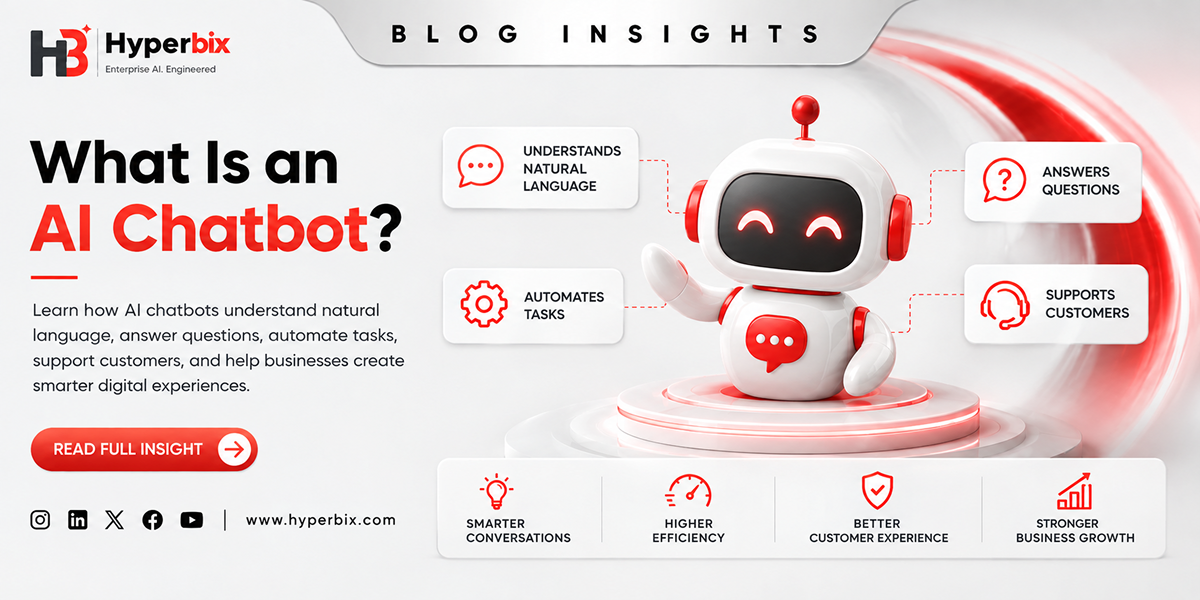
An AI Chatbot is computer software that uses intelligence to talk with people. It. Receives messages in writing or, through spoken words. In opposition to traditional chatbots that require rules and pre-set responses for working, AI chatbots are capable of comprehending numerous ways of question formulation and answering them in accordance with the context of the conversation.
Based on the AI chatbots development, they can be used for question answering, client assistance, recommendation, lead generation, discovery of internal information, appointment scheduling, and connection with the rest of the company systems.
How Do AI Chatbot Work?
AI Chatbots utilize various types of technology that allow comprehending users' messages and giving the proper response to those. Although there isn’t one particular Chatbot construction model, there are certain technologies which are commonly used in creating chatbots.
Natural Language Processing
The technique for Natural Language Processing is capable of interpreting natural language conversations since it interprets all kinds of expressions, incomplete sentences, slang, and any other variations. Consequently, the chatbot will be able to understand what the user intends to ask.
Machine Learning
Machine learning can help chatbots to detect patterns in user behavior and improve their interaction in response to particular user requests. This technology can be useful in different situations like intent recognition, classification, recommendation and personalization. It can be utilized to split concerns about products, accounts, deliveries and refunds.
Large Language Models
With the emergence of Large Language Models, today’s AI chatbots can understand and respond with coherent messages. LLM-based chatbots can be integrated within the organization's knowledge and APIs.
Context and Conversations Memory
The chatbot will be able to interpret the user's intent through memory from the context and conversations. If the user has asked for information regarding a certain product and subsequently asks "How much does it cost?", the chatbot will be able to make this connection between the question and the product.
Retrieval-Augmented Generation
The chatbot can even retrieve data from relevant business sources before producing an answer using retrieval-augmented generation. The information sources can be FAQs, product literature, policies, customer support articles, etc., and business-related information.
Types of AI Chatbots
Chatbots for business purposes could be customized to achieve various objectives. The technology employed in developing such chatbots might be similar, although their objectives and functionalities differ from one another.
Customer Service Chatbots
The main role of customer service chatbots is to provide businesses with means of handling frequently asked questions by clients and providing them with the necessary assistance. Such chatbots can also transfer conversations to human agents when necessary.
AI Virtual Assistants
AI virtual assistants facilitate user actions by answering users' questions and helping them perform daily tasks via conversational interfaces. Their primary task is to perform certain actions, not to answer specific questions.
Sales and lead generation chatbots
These chatbots can talk to visitors and turn them into real customers. The chatbots can answer questions about what the business offers. They can also collect information from visitors. This helps businesses figure out which visitors might be interested, in buying something.
Enterprise Knowledge Chatbots
The enterprise knowledge chatbot makes it easy for staff members to access information from the company’s documentation, policies, and other internal sources of information. They are especially useful for organizations that have vast amounts of information internally.
Voice Chatbots
Voice chatbots make it possible for users to interact with business entities using voice interactions as opposed to text interactions. They can be used in customer service, appointment booking, calls, and information-seeking applications.
What an AI Chatbot Can Do?
An AI chatbot can handle business and customer conversations. It can answer questions understand language give personal replies pull data from FAQs and business knowledge bases and suggest specific products or services. The AI chatbot can collect customer data qualify leads and perform tasks such, as setting appointments or tracking orders.
Benefits of AI Chatbots for Businesses
AI chatbots may have value in various aspects of business processes, especially if they are utilized to perform repetitive tasks.
Full time Customer Support - The chatbot can reply to queries from customers at any time, even if it is not a working hour. It serves as a convenient starting point for customers to seek help.
Improved Response Time - The chatbot can immediately provide an answer to routine questions rather than make the customer wait in a queue, while the complex ones can be passed to the right department.
Decrease in Operating Expenses - The automation of conversations may decrease the workload of staff members involved in support and operations activities. The employees can concentrate on work which cannot be automated.
Customized Customer Experience - By using the data of a customer and taking into account the conversation context, the AI chatbot can give a customized response. It can recommend products suitable for the customer.
Increased Productivity - The chatbot can assist the employee in finding the necessary information faster without browsing through many sources. This saves time spent on the routine internal questions.
Scalable Customer Service - An AI chatbot is capable of managing several routine chats simultaneously. It will help organizations cope with increased customer inquiries without having to increase the workloads of their support teams.
AI Chatbot Use Cases Across Industries
Chatbots powered by AI are not only useful in customer care. Depending on the industry, there are different ways that they can be applied in interactions.
Healthcare
In healthcare facilities, chatbots can help with appointments and other aspects of healthcare like patient health information, FAQ section, reminders and administrative purposes. They will also assist users in navigating the healthcare services while ensuring high levels of privacy and security.
Banking and Finance
For banks and other financial institutions, chatbots can be used in interactions about accounts, transactions, service requests, product information and customer care. It is also essential for such interactions to have security and identity verification.
E-commerce
There are many ways in which AI chatbots can be used in Ecommerce businesses. They can help the customers during their purchasing process and give personalized recommendations after purchases.
Education
The institutions of education can leverage AI chatbots for providing answers on courses, admission, application, timetable, campus information, and administrative services. The AI chatbots can help students in getting relevant learning material and institutional information.
Real Estate
The real estate business organizations can use AI chatbots to interact with potential customers who can purchase and rent the properties. The preferences regarding location, type of the property, budget, and others can be collected first and then they can be matched with the right listings or agents.
Travel & Hospitality
The travel and hospitality businesses can use the AI chatbots to get assistance in booking the travel arrangements and accommodation. AI chatbots can provide information related to hotel and help in searching through the content without visiting different pages.
Manufacturing
The manufacturing businesses can leverage enterprise AI chatbots to assist the employees in accessing technical documents, information related to the machinery used, maintenance instructions, procedures, and products. In connection with the accurate internal data, they help in searching huge amounts of technical information.
AI Chatbots vs. Traditional Chatbots
Traditional Chatbots | AI Chatbots |
Use pre-established rules | Ability to comprehend natural language |
Follow pre-established conversation flow | Ability to deal with flexible conversations |
Provide predefined responses | Dynamically generate responses |
Have poor context management | Have greater awareness of context |
Depend on keywords or buttons | Understand different ways of posing questions |
Designed for simple tasks | Can conduct more complex interactions |
Have limited knowledge extraction | Can connect with knowledge bases and business systems |
This does not mean that traditional chatbots are entirely ineffective. When a company only requires a straightforward guided flow, then a rule-based chatbot can do the job just fine. Otherwise, when there is complexity involved, AI-powered chatbots may turn out to be a more appropriate choice.
Popular AI Chatbot Examples
There are several popular examples of AI chatbot solutions that showcase the evolution of conversational AI.
ChatGPT: ChatGPT is a general-purpose AI chatbot that could be used by users to help them answer questions, write, summarize, brainstorm, code, analyze, etc.
Google Gemini: Google Gemini is an AI assistant capable of conversing with the user and helping user with information and productivity related tasks.
Microsoft Copilot: Microsoft Copilot provides AI-assistance in Microsoft's ecosystem helping users to accomplish information, productivity, and work related tasks depending on the product and environment.
Claude: Claude is an AI assistant that could converse with a user, assist in writing, analysis, coding, and other knowledge-related tasks.
Customer Support AI Chatbots: There are many AI chatbots used in businesses specifically for customer service.
Such bots are usually integrated with business systems and are supposed to perform a specific function rather than answering all kinds of questions. The idea is that businesses don't have to build an omniscient chatbot but one focused on solving a specific business problem.
Challenges and Limitations of AI Chatbots
Here are some of the limitations which should be considered in the process of developing an AI-based chatbot.
Wrong Answers: An artificial intelligence system may provide wrong information. This is especially dangerous when a chatbot works with vital information.
Challenges with Understanding of Ambiguous Requests: It can happen that a chatbot does not understand the request because it is very complicated, unusual, or may include the information which a chatbot was not supposed to handle.
Privacy Issues: Sometimes, chatbots work with confidential or personal information of customers. Therefore, businesses need proper measures for protection of this information.
Complexity of Integration: Integration of a chatbot with business systems can increase functionality of a chatbot but on the other hand it can complicate a project.
Chatbots Maintenance: Information used in business can change over time and it needs updates.
Poor User Experience: It can happen that even a well-functioning chatbot can cause annoyance of users.
Human Interaction Requirement: Some of the conversations can require emotional intelligence, negotiating skills, and many other features of humans.
How to Choose the Right AI Chatbot for Your Business?
The selection of the AI chatbot should start with defining the business need, not the technology itself. You need to define what is expected from your chatbot at first.
Define Main Use Case - Identify your goal – customer service, sales, employee support, ecommerce, scheduling of appointments or something else? It is much easier to define necessary functions if the use case is specified.
Define Your Audience - Think about who is going to interact with your chatbot and what kind of questions they can pose. The chatbot for employees will have completely different needs from the chatbot that will work in customer support.
Identify Information Sources - Specify where the chatbot is going to take information from. The sources can be websites, documents, databases, CRM-systems, knowledge bases, and other business software.
Consider Integrations - If the chatbot will have to verify orders, update the data, make appointments and so on, specify the systems you need to integrate with.
Security Requirement Evaluation - Think about the kind of information your chatbot will be dealing with and whether you have any security, access control, authentication, and privacy requirements.
Human Handover Plan - Plan when the process will be taken up by the human instead of the AI.
Scalability Consideration - The chatbot you choose must be scalable to deal with future requirements based on expansion of your organization, number of users, and information. It does not mean that the chatbot with many features is the best.
How to Build an AI Chatbot for Your Business?
AI chatbot development requires setting goals for what needs to be accomplished using a chatbot. One such development process can involve the following steps:
Define the Objective
First, Define the problem within a business that needs to be addressed by the chatbot. This may range from customer support to lead generation, help for employees, or scheduling appointments. It will determine the features and functions of the chatbot.
Identify the Required Data
This step involves finding out what kind of information the chatbot needs to provide relevant answers. This can range from FAQs to product descriptions, company documents, databases, and even business know-how. The quality and relevance of the data can affect chatbot responses.
Pick the Right AI Method
This is about picking the technologies required for the chatbot depending on its objectives.
Design the conversation
Design user interactions with the chatbot and conversation flow. Specify common questions, possible answers, error handling situations, and occasions when assistance from a human will be necessary. Thoughtful conversation flow design allows you to develop a better user experience.
Connect Business Systems
Integrate the chatbot with business systems when it is necessary to gain access to information or to perform certain operations.Integration makes sure that the chatbot uses real business data and processes.
Develop and Test
Develop your chatbot and test it with real user queries and scenarios.The main purpose of testing is to estimate both accuracy of response and general utility of the chatbot.
Monitor and Enhance
Once your chatbot is deployed, monitor its dialogue and performance to determine areas that need improvement. User dialogs will provide you with an opportunity to know about any new questions, gaps in information, and unexpected use cases. With regular upgrades, you’ll be able to keep your chatbot up to date.
Future of AI Chatbots
The future of AI chatbots is evolving towards a smarter, more personalized, and independent approach to conversations. With the development of AI technology, chatbots are forecasted to become better at comprehending the context, operate across various platforms, utilize business information, and perform more complicated actions.
Better Conversational Understanding: In the future, AI chatbots will understand context, voice, tone, images, documents, and hard queries. The future interaction of AI chatbots with users will be much closer to human conversation.
Chatbots and AI Agents: Future chatbots will not only be able to answer questions, but also complete a set of operations for their users. These might include booking services, responding to customer requests, retrieving information, and other business processes.
Increased Personalization and Business Integration: The next-generation chatbots will give even more personalized answers to their users, taking into account user’s preferences and business background. Better integration with CRM, ERP, e-commerce websites and databases is expected.
Increased Precision, Security, and Governance: Incorporating improvements in RAG, information retrieval, and validation techniques will help chatbots deliver accurate information.Meanwhile, companies will be more concerned with privacy, security, access controls, and responsible AI usage.
Expanded Application Across Various Sectors: The use of AI chatbots will spread further into the fields of health care, finance, e-commerce, education, manufacturing, and other sectors.With time, these bots will move from being basic chatbots to becoming smart assistants.
Final Thoughts
Today, chatbots for AI have advanced from mere rule-based mechanisms to becoming intelligent agents that can comprehend natural language, hold context, gather information, and perform a variety of functions for your business. They can help you optimize customer interactions, lead generation, customer service, and even ecommerce and internal business processes.
There are specific requirements that need to be taken into consideration when choosing an AI chatbot. Depending on your goals, customers' needs, data, integration, and amount of automation you need, you can choose a good option for your business.
Blog FAQs
Frequently Asked
Questions
The term chatbot refers to software that employs artificial intelligence techniques for comprehending users' messages and providing appropriate answers to them. In other words, it performs tasks such as conversing, answering questions, retrieving information, and helping users with business operations.
AI chatbots implement different techniques such as NLP, machine learning, LLMs, conversation context, and RAG to comprehend messages and generate appropriate responses.
AI chatbots help to respond to customer queries, give personalized replies, access business information, make recommendations, qualify leads, perform routine business activities, and connect to CRM and ERP applications of business.
While traditional chatbots are rule-based, AI chatbots can comprehend natural language, have flexible conversations, keep context, and generate dynamic responses.
AI chatbots can be applied in various sectors such as healthcare, banking and finance, ecommerce, education, real estate, travel and hospitality, and manufacturing among others depending on organizational needs and availability of data.
Yes. An AI chatbot can be integrated with different systems including CRM, ERP, ecommerce solutions, databases, APIs, knowledge base, and other business applications to get access to relevant data and perform certain actions.
Yes. An AI chatbot can take into account conversation context and relevant information about the client or the business to provide answers that will be more tailored to user needs.
With Retrieval Augmentation Generation, an AI chatbot can get access to relevant data from different sources such as documents, FAQs, knowledge base, and internal business data before providing a response. Thus, an answer can be generated according to business-specific data.
AI chatbots can manage many routine actions but cannot be used in every case since some complicated requests or sensitive situations require human intervention.
Development of an AI chatbot is a complex process that includes defining chatbot purpose, determining needed data and integrations, choosing the right AI technology, designing the experience of conversation, creating and testing the chatbot.