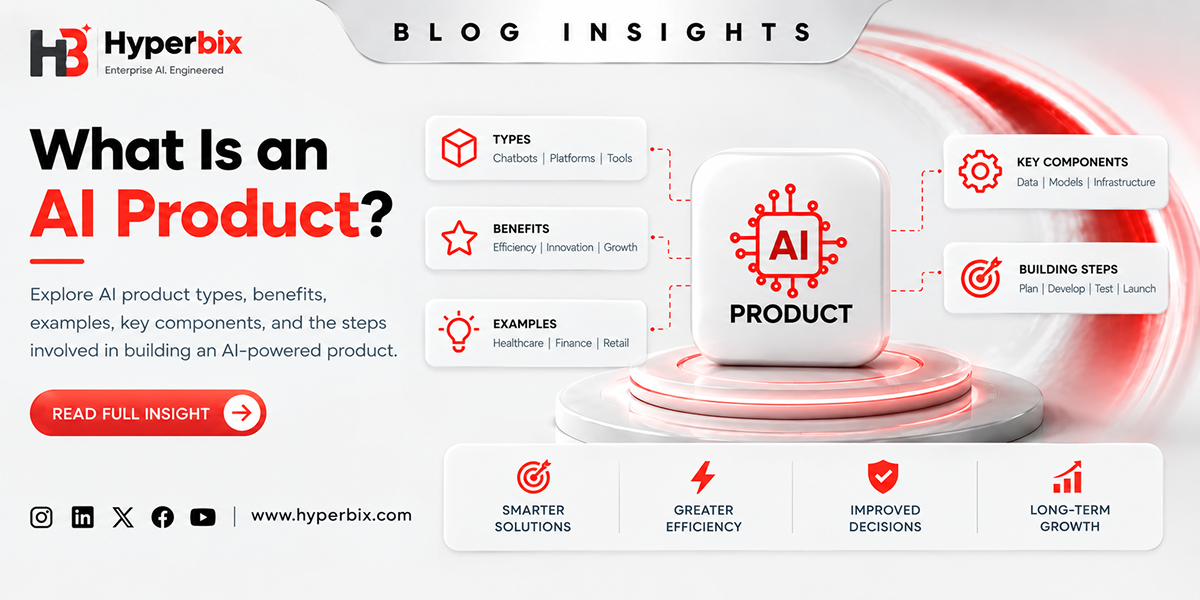
What Is an AI Product? Types, Benefits, Examples & How to Build One
Listen to this articleTap play to start listening

Introduction
AI technology has been integrated into many digital offerings used by individuals on a regular basis. AI can be utilized for assisting the customer in locating information, recommending products, detecting anomalies, summarizing information, and performing routine business functions.
An AI product is not just another application with an AI model incorporated into it. A useful AI product integrates AI, data, software, user experience, business logic, and the technology that makes it possible to provide useful outcomes.
Having knowledge about AI products will assist companies in identifying areas where AI can add value, selecting the appropriate type of AI product, and plan their AI development strategy.
What Is an AI Product?
An AI Product is a software product where AI technology is utilized to undertake tasks that involve human like skills like natural language processing, pattern recognition, prediction, classification and generation of content.
An AI product can focus on one specific task or support several business activities. If an AI system can be used by customer support software to interpret user queries and provide suggestions for responses, whereas e-commerce platforms will use AI algorithms to recommend relevant products.
The key is that the AI system must have a useful role to play in the product itself. That is to say, it must solve a problem or make some process better.
Why AI Products Are Becoming Important for Businesses?
Every day businesses have to manage vast amounts of information and repetitive activities. AI products can help teams process that information and support both employees and customers. Common business uses include:
* Answering customer questions
* Finding information from company document
* Analyzing business data
* Detecting unusual activity
* Recommending products or content
* Automating routine workflows
* Supporting employees with everyday tasks
* Generating or summarizing business content
Simply incorporating AI into a product doesn’t guarantee that this product will be useful. It still should have its purpose, right data, proper AI application, and appropriate user experience.
How Do AI Products Work?
AI solutions can be developed in various ways, but most have a fairly standardized process involving the inputting of information, processing using software and AI algorithms, generating output, and feedback when required.
Data Gathering and Preparation
AI solutions can gather information such as documents, customer data, images, transactions, business information, and other types of information. For this data to be utilized, it may require cleaning, organizing, labeling, or other preparation procedures.
AI Models and Algorithms
AI models process information and produce results based on learned patterns, instructions, or both. Different products use different approaches. For example, machine learning can be used for predictions, while generative AI can be used to create content.
User Input and Data Processing
An AI product receives information through user actions or connected systems. This could be a question, document, transaction, search, or request for a recommendation. The application processes the input and provides the relevant information to the AI system.
AI-Generated Outputs and Actions
The AI analyzes all the information that is available and provides an output dependent on the task at hand. The output can be in the form of a prediction, recommendation, classification, answer, summary, picture, or other output forms.
Improvement and Monitoring
Every single AI product must regularly be monitored to detect any errors, any changes in data, and situations where different experiences are required for the users. Using this information, the model, prompts, workflow, or data sources can be improved upon.
What Are the Key Components of an AI Product?
An AI product is made up of various components that are linked to each other. The structure will depend on the functionality of the product.
Sources of Data and Knowledge
There must be some data that the AI product processes and uses for task resolution. The sources could be documents, databases, customer data, APIs, images, and internal knowledge base. It could be useful to maintain a structure in order to enable the use of relevant and accurate data.
AI Models
AI models process information and produce results such as predictions, recommendations, classifications, or generated content. The model should be selected based on what the product needs to accomplish.
Machine Learning or AI Algorithms
Algorithms help process data and help discover the patterns in them. If an application that recommends products or content can analyze user behavior in order to make recommendations. It is important for the algorithm to be in line with the nature of the problem at hand.
User Interface and Experience
The interface should make it easy for users to provide information and understand the results they receive. Users should be able to see what the product can do and what they need to provide.
AI APIs and Integrations
AI products often need to connect with other applications and business systems through APIs and integrations. These may include CRM and ERP systems, payment platforms, communication tools, cloud storage, and databases. These connections allow the AI product to work as part of existing business processes.
Monitoring and Feedback Systems
Monitoring helps teams keep track of system performance, errors, response quality, and user activity. User feedback can also point to incorrect results, failed requests, or parts of the product that need improvement. This information can then be used to make the product better over time.
Security and Privacy Controls
The AI product might have to deal with either corporate information or individual data; thus, security and privacy should be taken into account as part of the product. Proper procedures for the protection of the data will enable a business to control the storage, processing, and use of it.
What Are the Main Types of AI Products?
AI products may be classified according to the tasks that they primarily carry out. There may also be AI products that carry out more than one function at once.
AI Chatbots and Virtual Assistants
AI chatbots and virtual assistants communicate with users using natural language. They can provide answers to user questions, to provide internal assistance, conduct search, and troubleshoot. The most advanced virtual assistants can also connect with business systems and execute certain functions.
Generative AI Products
Generative AI products generate content or change existing content depending on user instructions and the information available. They are used for the generation of text, images, code, sound, video, summaries, and business documentation.
Discriminative AI Products
Discriminative AI products specialize in the classification of information, prediction, or differentiation of certain results. Some common examples of such AI products include spam detection, fraud detection, risk assessment, image classification, and customer churn prediction.
AI Analytics and Business Intelligence Solutions
AI analytics solutions assist enterprises to handle big data and discover important patterns. The technology allows for summarization of information, discovering anomalies and helping teams analyze changes in business and customers' behaviors.
AI Recommendations Systems
AI recommendation systems offer various items, services, content, or information according to users' behavior and preferences. Such applications are widely used in order to recommend products, music, personalized offers, and courses.
AI Automation Products
AI automation products integrate AI into business processes for reduction of repetitive manual operations. The technology can process information about documents, extract it, classify the data and deliver it to other systems.
AI-Powered Search and Knowledge Solutions
AI-powered search provides users with access to relevant information taking into account meaning and context, not only keywords. This solution may be used for corporate knowledge bases, document search, research and customer support.
Computer Vision Products
Computer vision products assist computer software in comprehending data found within images or video streams. This includes using these products for inspection, object detection, document scanning, and visual monitoring.
AI Agent Products
AI agents' products are designed to perform many actions related to achieving a particular objective. It can comprehend a request, search for information, utilize linked software, take actions, and return the results. Like an AI agent might find the company information, prepare a response, and create a task.
What Are the Benefits of AI Products?
The importance of any AI-based product lies in the problem it solves. If AI is used for an appropriate application, it can help the employee, customer, and business processes in many ways.
New Digital Experiences - It enables the creation of unique ways through which one can interact with the software. Examples include conversational search, natural language interface, AI agents, and content creation. These aspects make the digital product more flexible and interactive.
Repetitive Tasks Automation - AI products are capable of doing repetitive tasks without any manual intervention. These tasks include sorting of documents, categorizing of requests, information summarization, and data extraction.
Decision-Making Improvement - The AI is capable of analyzing a lot of data and finding certain patterns which might be hard to detect by a person. The AI could help making decisions but human verification would be needed for those decisions requiring careful consideration.
Personalized Experience for Users - It is possible to personalize the experience of users through the use of their information. If an online shop is able to offer recommendations to the customers based on their activities.
Increasing Operational Efficiency - AI can connect different steps in a workflow and reduce the amount of manual work between systems. If an incoming form can be processed, categorized, and sent to the appropriate business application. This can make routine business processes easier to manage.
Handling Large Amounts of Information - An AI solution can sort out and analyze documents, messages, images, data sets, and any other kind of information. This will make it simpler for employees to find information that they need.
Facilitating Customer Support - Using AI can provide customer support with an opportunity to respond to frequent questions and find relevant information. Human assistance will still be available for complex issues.
What Are Some Examples of AI Products?
AI products are applied in many sectors to help in problem-solving and automation of certain processes. AI products are used across many areas of business and everyday software.
AI Tools for Productivity: AI tools for productivity help in activities like writing, researching, summarizing, note taking, and scheduling. They help in organizing information and performing daily activities.
AI Tools for Customer Support: AI customer support tools assist enterprises in handling recurring customer inquiries and concerns. These tools may be used in response generation, conversation summarization, reply suggestion, and forwarding inquiries to the relevant department.
AI Content and Creative Tools: AI content and creative tools assist users in generating and editing digital content. This may involve writing, imagery, video, audio, presentations, coding, and other types of content.
AI Healthcare Applications: AI healthcare applications aid in medical analysis, patient communication, research, and administration. These applications can assist in organizing healthcare information while taking into consideration privacy, accuracy, and safety.
AI Finance and Business Tools: AI finance and business tools can aid in tasks like detecting fraud, analyzing documents, forecasting, and evaluating risks.
E-commerce Using AI and Recommendation System: AI-based e-commerce systems allow product search and also recommend products according to the customer’s behavior and choices. They also help in customer service and other aspects of the shopping process.
AI Enterprise Solutions: AI enterprise solutions connect AI capabilities with internal business systems and information. They help employees find information, work with data, and handle routine business processes more efficiently.
How to Build an AI Product?
Developing the AI product begins not with selecting a model but with the analysis of the problem that needs to be solved. The process of development should involve business, users, data, AI solution, product experience, and technologies.
Identify the Problem to Solve - To begin with, define what problem your users face and how they solve it. After that, think about whether it is possible to improve this process using AI.
Target Audience Definition - Think about who will be using the product and what would be needed from it. Think of the needs of users, their activities, and level of competence. That will allow us to develop certain characteristics for the product.
Validation of the AI Concept - Find out if the concept solves any real problem and the availability of the necessary data and technologies. It will also be useful to think about the expected outcomes, alternatives, requirements, and potential threats.
Select the Proper AI Solution - Select the proper AI solution depending on the problem and result that the product is expected to provide. Based on the application scenario, this might include machine learning, Generative AI, RAG, computer vision, or AI agents.
Prepare and Structure the Data - Prepare the information needed by the AI product. It may be necessary to clean, structure, label and integrate the data from different sources. Structured data will be a more solid base for information processing.
Design the Product Experience - Develop the way that users will interact with the AI and get information from the AI. Define clearly what information is required by the product, what information can be provided by the AI, and where a human intervention might be needed.
Develop the AI Model and Application - Develop or incorporate the AI model into the product along with its frontend, backend, database, APIs, and business logic. These components must collaborate to make sure that the AI technology is integrated successfully into the entire product.
Integrate AI Into the Product - Integrate the AI system with the required data and tools as well as other business applications. It could be databases, APIs, knowledge bases, workflows, and third-party applications depending on the product being built.
Test the AI Product - Perform tests with various inputs for checking accuracy, quality of responses, security, performance, and reliability. Tests should also include unusual inputs, error scenarios, and the user experience.
Deploy and Monitor the Product - After deploying the product, perform monitoring for evaluating its real-world performance, detecting errors, unusual outcomes, performance problems, and user experience problems.
Improve the Product Based on User Feedback - User feedback might point out incorrect results, missing information, or poor workflow. This information will help improve the AI technology, the data, interface, and the entire product.
What Challenges Should You Consider When Building an AI Product?
AI products may face challenges that differ from those encountered in conventional software development.
Data Quality and Availability: AI products rely on good data to generate results. Lack of data or erroneous data may impair the functionality of the system.
AI Accuracy and Reliability: AI solutions sometimes generate inaccurate results or respond erroneously. Testing, monitoring, and human validation may help increase reliability.
Privacy and Security: AI solutions may have to deal with customer, business, or financial data. Robust security and data management must be taken into account from the very beginning.
Model and Infrastructure Requirements: AI solutions may require different processing power, storage capabilities, and model access requirements. The infrastructure design must match the real requirements of the product.
Integration With Other Systems: AI solutions may require integration with CRMs, ERPs, databases, APIs, and other software systems. This integration requires proper design and data flow management.
Scalability and Performance: AI solutions must keep their performance even under growing user base, increased number of requests, and more data. Scalability must be planned at the stage of product design.
Trust and User Adoption: The users should know about the functioning and limitations of the product. A clear interface, detailed explanations, and human review help to promote better user adoption.
AI Product Governance and Compliance Requirements: AI products must have well-defined guidelines related to the use of data, behavior, and processing of information. Such requirements may differ depending on the industry, region, product, and type of data.
Choosing the Right AI Strategy for Your Product
Selection of the appropriate AI technique depends on the objective of the product. Various objectives require different approaches, and some products might require the use of more than one technique.
When to Use Machine Learning: It is beneficial in finding patterns and making predictions or classifications based on past data. Some common applications are fraud detection, demand prediction, churn prediction, and risk analysis.
When to Use Generative AI: Generative AI is used when a product requires the creation of content such as text, code, images, and summaries. Such applications of AI benefit from the natural-language and creative capabilities.
When to Use RAG: The retrieval augmented generation technique comes handy in AI applications when information is to be retrieved from specific documents, databases, and knowledge bases. Such techniques help in providing answers based on business-domain information.
When to Use AI Agents: AI agents can be employed in cases where tasks involve various steps, tools, and actions. They can gather information, use other systems, perform tasks, and produce results.
When to Integrate Various AI Techniques Together: There may be cases where several AI techniques are required for a particular product. The combination will depend on what the product needs.
AI Product Development vs. Traditional Software Development
Comparison Area | AI Product Development | Traditional Software Development |
Development Approach | It includes software development along with AI models, data, and intelligent processes. | Primarily focuses on predefined rules, features, and application logic. |
Role of Data | Data is required for training purposes, search, prediction, or AI-based outputs. | Data is mainly used to store, process, and display application information. |
Decision-Making | It can detect patterns, predict, classify data, and produce outputs. | Usually follows predefined rules and programmed instructions. |
Testing and Quality Assurance | Tests the functioning of the software and quality of AI outputs. | Primarily concentrates on functionality, performance, security, and user experience. |
Monitoring After Launch | It includes evaluation of model performance, changes in data, accuracy, and AI outputs. | Primarily tracks application performance, errors, availability, and health. |
Product Improvement |
It may include improvement of models, prompts, data source, workflow, and application features. | Usually involves updating code, features, integrations, and system functionality. |
User Experience | It can enable NLU-based interactions, customization, recommendations, and intelligent support. | Typically relies on predefined interfaces and user actions. |
System Behavior | Its output is dependent on inputs, data, and AI models used. | Behavior is generally more predictable based on programmed logic. |
What Is the Future of AI Products?
AI products are no longer limited to basic automation and single AI features. The key point here is the development of software capable of learning from users, working with diverse data, and fitting into routine business processes.
Personalized AI Experiences
AI products will be able to offer more personalized content, recommendations, interface, and help according to the needs of users. There will be a need to find a balance between personalization and user privacy.
AI Agents Inside Business Applications
AI agents can become part of business applications and help users complete multi-step tasks through natural-language instructions. They may retrieve information, perform actions, and complete workflows across connected systems.
Multimodal AI Products
AI products may be capable of processing several different modes of data inputs such as text, pictures, sound, or video. Such flexibility can allow for increased user-friendly interactions with software applications.
AI-Powered Business Process Automation
Automation tools used in conjunction with artificial intelligence technologies can be used for workflow management involving structured and unstructured data. The process can be initiated by the AI system recognizing an incoming document.
AI Products Built Around Proprietary Data
A company's internal information can play an important role in creating AI products that match its specific business needs. Documents, customer information, product details, and operational data can support specialized AI experiences when the information is collected and handled appropriately.
Conclusion: Understanding AI Products and Their Potential
An AI product is not just an ordinary product augmented by an AI model. An AI product combines data, AI models, software, integration, UX, security, and monitoring in order to solve a particular problem. The development process needs to start with the definition of the user need or the business need.
Once that is done, one can move on to identifying the data needed, selecting the appropriate AI technology, designing the product UX, developing the software, testing the product, and optimizing the product based on user feedback. Businesses planning an AI product development project can use these steps to understand where AI can fit into the product.
Blog FAQs
Frequently Asked
Questions
An AI product is a software product that leverages artificial intelligence to carry out actions, including prediction, classification, recommendation, content creation, and natural language interaction.
An AI product gathers or accesses data, processes it through AI algorithms and software, takes an action or produces an output and monitors its performance and improves it through feedback.
Common types include AI chatbots, generative AI products, discriminative AI products, recommendation systems, AI automation tools, AI analytics platforms, computer vision products, AI search solutions, and AI agents.
Some uses of AI products include automation of routine tasks, processing vast amounts of data, helping decision making, personalization, improved workflow, and new types of interaction with software.
The examples of AI products include productivity tools, customer support platforms, content creation software, healthcare applications, finance tools, ecommerce recommendation engines, and enterprise AI solutions.
The development of an AI product begins with determining a problem and target audience. After that comes selecting the right AI method, data preparation, product design, development and implementation of AI, testing, deployment and improvement according to the feedback received.
Essential elements of an AI product include sources of data and knowledge, AI models, algorithms, user interface, API integration, backend services, monitoring tools, and security mechanisms. The combination of these elements enables the AI product to process information and yield valuable outputs.
The most frequent issues related to creating an AI product include data quality, AI accuracy, security and privacy, infrastructure, system integration, scalability, adoption, and AI governance.
Development of an AI product includes software as well as AI components such as data, monitoring, and AI testing. Regular software tends to depend more on pre-defined rules and programming logic.
The business should define the problem to solve, its target users, available data, desired results, AI methodology, how the product integrates with other systems, security aspects, and its testing methods.