What Is Enterprise AI? A Complete Guide for Businesses
Listen to this articleTap play to start listening

Introduction
Artificial Intelligence is increasingly playing a significant role in information management, employee assistance, customer interactions, and process improvement in business. As enterprises integrate AI in different functions, the emphasis is no longer on integrating different artificial intelligence tools but AI into larger business processes.
Enterprise AI is that larger integration of AI in a business enterprise. Enterprise AI integrates artificial intelligence technology, business information, applications, and processes to meet certain business requirements taking into account elements like security, integration, scalability, and human supervision.
What Is Enterprise AI?
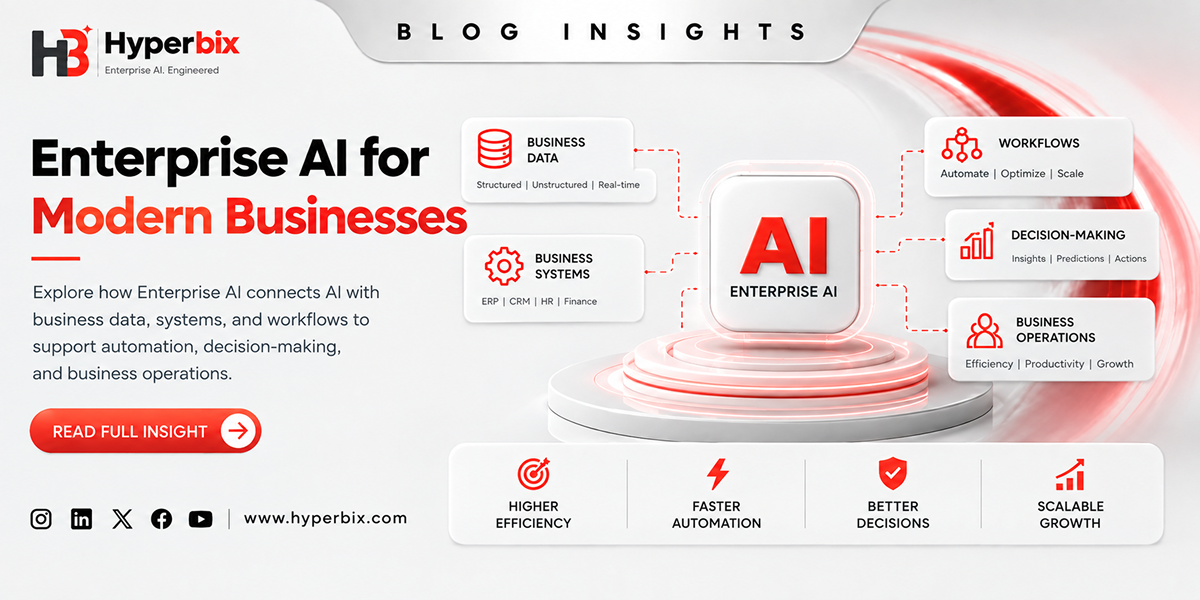
Enterprise AI is related to the use of AI technology in an organization for the improvement of processes, data analysis, help of employees, and customer experience enhancement. Enterprise AI links AI with corporate data, applications, processes, and systems to solve particular problems.
In contrast to general AI tools, which are universal, Enterprise AI is tailored according to the needs of the company, security measures, access to data, and business processes. Machine learning, generative AI, predictive analysis, NLP, and AI agents are some examples of the technology used by Enterprise AI.
How Enterprise AI Differs From General AI Tools?
General AI Tools: General AI tools are often designed for broad use. A person can use one to summarize text, generate content, answer questions, or analyze information.
Enterprise AI: It has a narrower business context. It may be connected to a company's private information and configured around specific business rules, permissions, workflows, and processes.
If a general AI tool may answer a question based on information provided by the user. An enterprise AI application could retrieve information from approved internal sources, apply access rules, and provide an answer within a business workflow.
Why Enterprise AI Matters for Modern Businesses?
AI is becoming a part of everyday business processes. Statista's 2026 reporting highlights the continued adoption of AI across businesses worldwide, based on data from McKinsey & Company's global survey. With more use of AI, businesses begin to look not at AI tools as separate from them but rather how they can combine the use of AI with their own data, software, and workflows. This is where enterprise AI comes into play, providing help in automating routine tasks, analyzing business data, assisting employees, enhancing customer experience, and making decisions.
The emphasis is not on simply using AI for a business but on using the right AI abilities for the business, while taking into account aspects like data, security, integration, and human monitoring. The key is that AI for Enterprise should relate to some business requirement. Not every business process requires AI. Rather, the question is where AI could help solve a particular problem or process.
How Does Enterprise AI Work?
Enterprise AI is the process of incorporating AI algorithms with business data, software, and processes in order to complete a certain task or make decisions. In doing so, enterprise AI can access data, analyze data, produce output, and make actions depending on predefined business requirements.
Enterprise AI Data Sources
Enterprise AI takes business data as input from various sources such as customers' information, documents, databases, financial data, and support chats. It can integrate with the data sources using API integration, databases, and enterprise systems.
AI Model and Machine Learning Technology
AI model learns from the business data and makes predictions, identifies patterns, classifies, creates content, and provides recommendations depending on the requirement of the organization.
Information Search and Retrieval
Enterprise AI can search for the related information in the documents and knowledge base and use it to generate response or provide recommendations.
Output Generated and Action Taken
The outputs of the AI system include predictions, summaries, recommendations, classifications, or automation of the action. They depend on the workflow which involves checking the output by the employees or predefined process.
Human Oversight and Decision Making
Human intervention is crucial where it deals with critical or sensitive situations. Employees check the output of AI systems, authorize actions, exceptions, and monitor performance of the system.
Benefits of Enterprise AI for Businesses
Increased Operational Efficiency: With the aid of artificial intelligence, organizations can automate many repetitive tasks and save people's time for more complicated tasks requiring human intelligence.
Improved Utilization of Business Data: With enterprise AI, teams can sort, search, and analyze huge volumes of business data in order to have more opportunities to get relevant data.
Faster Decision Making: AI technology is capable of processing information and generating summaries, forecasts, and recommendations that can be used by employees while making decisions in business.
Personalized Customer Experience: Based on customer information and interaction, AI technologies can provide more personalized responses, recommendations, and services in various channels of interaction.
Improved Productivity of Employees: Artificial intelligence can help people in searching for information, summarizing the text, drafting messages and completing various repetitive tasks.
Increased Consistency: Artificial intelligence technology can be applied to applying consistent rules and processes in relation to repetitive tasks while human intervention can still be applied when it is needed.
Types of Enterprise AI
Enterprise AI applications can be classified according to the organizational functions they support, the kinds of tasks they perform, and their methods of application within the workflow process.
* Predictive AI – Predicts future business outcomes using patterns identified from business data.
* Generative AI - Generates content such as text, summaries, reports, etc., which may be needed for business purposes.
* Conversational AI - Allows businesses to communicate with their clients and employees using chatbots and assistants.
* Automation AI – Automates repetitive business tasks using AI technology.
* Decision-supporting AI – Provides analysis and insights or recommendations to aid decision-making based on business information.
* Knowledge-base AI – Facilitates information discovery and processing from business documents, databases, and knowledge bases.
* Computer vision AI – Conducts image and video analysis for various business use cases.
Key Characteristics of Enterprise AI
Enterprise AI is built on aspects like scalability, security, data integration, customization, reliability, and governance. All these characteristics facilitate the effectiveness of AI in an organization's environment.
Scalability: Enterprise AI should be capable of supporting the organization's expected users, workloads, and data volumes. The system architecture needs to account for growth rather than only the initial use case.
Data Integration: AI becomes more useful when it can work with relevant business information. Integration with databases, CRM systems, ERP platforms, document repositories, APIs, and other systems may therefore be an important part of the solution.
Security and Access Control: Not all employees must necessarily be able to access every piece of business data. Appropriate levels of authentication, authorization, and access controls must be set for enterprise AI systems so that authorized information is provided to the users.
Reliability and Performance: Predictable behavior and appropriate performance are what is required for enterprise applications. Monitoring may aid in detecting failure, inaccurate outputs, and any other problems.
Customization: The Enterprise AI solutions can be tailored according to the processes, language, sources of data and other specifications of each individual business. It allows for alignment with the way business works.
Governance & Compliance: Policies should be developed regarding development, implementation, monitoring and upgrading of the AI systems. This includes governance of data management, models utilization, access and regulation.
Human Oversight: Introduction of AI does not exclude human oversight from processes. It can be included as a part of workflows that demand more consideration and accountability.
Enterprise AI Use Cases Across Industries
Enterprises may implement Enterprise AI for customer service, sales, finance, healthcare, manufacturing, retail, and their internal processes, depending on how those sectors function.
Customer Service and Support: AI may categorize inquiries, answer standard questions, summarize the interaction, and assist support staff.
Sales and Lead Management: AI may be used to sort and analyze lead interactions, and suggest opportunities for follow up.
Marketing and Personalization: AI may be used to analyze customer behavior and personalize the customer experience or recommendations.
Finance and Risk Management: AI may be used to analyze financial data, detect anomalies, and perform risk management processes.
Life Sciences and Healthcare: AI may be used to analyze information, process documentation, perform research and administrative functions.
Manufacturing and Logistics Management: AI can be used for demand forecasting, quality analysis, maintenance and logistics management.
AI Applications in Banking and Financial Services: It includes Fraud Detection, Customer Services, Document Processing, and Risk Management.
AI Applications in E-Commerce and Retail: It includes Product Recommendations, Customer Services, Inventory Analysis, and Demand Forecasting.
- HR and Internal Processes: AI can help employees find information within the company, document processing, and administration of selected processes.
How Enterprise AI Can Improve Business Operations?
Enterprise AI could be incorporated into the daily business process as an aid to managing information, automating processes, and making operational decisions. The effectiveness of this will depend on the level of integration of Enterprise AI in the actual business workflows and data.
Automation of Repetitive Processes
The technology could automate repetitive processes like document classification, data processing, information extraction, and routine answers.
Analysis of Information
AI could analyze big data sets to discover patterns, trends, and valuable information that teams could use to analyze business performance and customer behavior.
Aid to Business Decision-Making
Enterprise AI could provide summaries, predictions, recommendations, and other decision-support information. Employees would use this information together with their experience and expertise.
Improved Customer Experience
AI could help businesses answer customer questions and analyze customer interactions to generate relevant information. It could also help in providing consistent services via various customer communication channels (websites, applications, etc.).
Enhancing Knowledge Management
The enterprise AI system could enable knowledge management in that it will link up people to relevant documents, databases, and knowledge bases. In this way, the searching for information in various systems will be reduced.
Workflows Optimization
The use of AI could be incorporated into workflow processes such that the system is able to classify requests, pass information, produce output or invoke an action according to the set rules.
Pattern Identification and Business Opportunities
The AI system could analyze business and customer data and look for changing trends, odd patterns or things that may require attention. Such findings could provide grounds for investigation into possible opportunities.
Challenges of Implementing Enterprise AI
Quality of the Available Data: AI relies very much on the data that it uses. Outdated, duplicate, partial, or inconsistent data will influence the results that an AI system generates.
Privacy and Data Protection: Corporate systems usually include important business and customer information. It is important for the organizations to provide adequate management of storage, access, processing, and exchange of such data.
Integrations With Corporate Systems: The integration of AI into existing systems may present challenges. Such aspects as data format, APIs, permissions, and workflows should be taken into account.
Accuracy of AI: AI systems may generate inaccurate results. Business should be ready to test and monitor such outputs.
Compliance and Governance: Depending on the industry and region, there might be certain regulations that have to be complied with in order to govern the data usage and decision-making process of AI.
Infrastructure and Scalability: AI application may involve adequate IT infrastructure, monitoring, data infrastructure, and architectural design. This aspect greatly varies depending on the application itself.
AI Costs Management: AI solutions have associated costs that include those for infrastructure, data processing, use of models, integration, monitoring, and maintenance. Organizations should keep in mind the above aspects while choosing an AI solution.
Enterprise AI vs Generative AI vs AI Agents
Aspect | Enterprise AI | Generative AI | AI Agents |
What it is | A broad approach to applying AI across business systems, data, and workflows. | AI that generates new content, including text, images, code, and summaries | AI systems designed to perform tasks and manage multiple steps toward a defined goal. |
Main purpose | Solve business problems and improve organizational processes. | Generate useful content or responses from instructions and context. | Perform actions, coordinate tasks, and automate workflows. |
How it works | Capable of integrating various AI tools with business information and applications. | Processes prompts and available context to generate outputs. | Can reason through tasks, use tools or data, and take defined actions. |
Business use | From customer support to analytics, operations, knowledge management, automation, and beyond. | Content generation, document summarization, information analysis, internal knowledge support, and customer interactions | Workflow automation, task coordination, information gathering, and process execution. |
Relationship | Serves as the bigger AI platform for the business. | Can be used as part of an Enterprise AI solution. | Can also be part of an Enterprise AI system to automate multi-step business processes. |
Factors to Consider When Choosing Enterprise AI
The selection of Enterprise AI approach is done by taking into consideration aspects such as business objective, data, workflow complexity, integration requirements, and security among others.
Business Objectives: Establish the aspects of the business that are to be improved and the desired result from using the AI solution. The clarity of the objective will assist in defining the best way to implement AI.
Data Requirements: Pinpoint the required data for AI as well as sources of this information. Ensure the data is relevant, accurate, structured and accessible.
Workflow Complexity: Determine the complexity of the workflow in the business. Simple processes might only require automation whereas multiple-stage workflows might necessitate more elaborate AI features.
Integration Requirements: Identify the existing systems, applications, databases or API solutions that will need to be integrated with AI.
Security Requirements: Ascertain the level of confidentiality of business data that the AI will need to access. Determine proper controls and permissions.
Scalability Requirements: Think about how capable the AI solution is when it comes to scaling with more users, data, and workloads.
Human-in-the-loop Requirements: Identify what aspects require human interaction for reviewing and making decisions.
What Is the Future of Enterprise AI?
The future of Enterprise AI will involve closer integration with various aspects of business operations. Some of those aspects could include AI agents, intelligent automation, multi-modal systems, decision support, and governance.
AI Agents for Business Processes - AI agents have the capacity to undertake various steps within processes, including data collection, output generation, and transferring tasks to the right individual/system.
Decision Making Assisted By AI - With AI, decision making has become easier since AI is now able to analyze large amounts of data and make recommendations/predictions to help make business decisions.
Personalized Enterprise Apps - Enterprise apps can leverage information about businesses to offer individuals more personalized information, recommendations, and assistance.
Multimodal Enterprise AI - AI systems have the capability of working with various types of information that include text, images, audio, videos, etc. Such multimodal enterprise AI can open up some new opportunities for industries that rely on different types of information.
AI-Assisted Automation - There can be increased integration between business processes and AI in the sense that processes can leverage AI to understand information and perform certain predefined actions.
Increased Emphasis on Governance and Security - As AI becomes increasingly embedded into the business systems, there will be an increased emphasis on security, information governance, monitoring, and responsible AI use.
Conclusion
Enterprise AI is more than another application of AI to be used by companies. Rather, it is a way of implementing AI into a true business environment with its data, applications, processes, security concerns, and people.
The applications of enterprise AI could vary from customer care to data analytics, from knowledge management to workflow automation. In order to use enterprise AI effectively, a company needs to find the right solution to a business problem at hand, understand its data, choose the right technology and create the needed infrastructure around it.
For a company that wants to explore AI Development Services, a good start would be identifying a problem, understanding its data and choosing the right technology for this problem and creating the infrastructure around it.
Blog FAQs
Frequently Asked
Questions
Enterprise AI is the use of artificial intelligence in an organization that helps in automating the business process, analyzing data, performing workflow, helping employees, and improving customers' experience.
General purpose AI tools are used for generic purposes; on the other hand, Enterprise AI is customized according to the organization's data, workflows, security needs, and business requirement.
Common types include predictive AI, generative AI, conversational AI, AI-powered automation, decision-support AI, knowledge-based AI, and computer vision AI.
Enterprise AI can assist companies in automating repetitive work, analyzing vast amounts of data, decision making, improving customers' experience, and increasing employee productivity.
Enterprise AI may connect to business data, which may come from the sources such as database, documents, CRM platform, ERP platform, APIs, and knowledge base, to get insights or perform business activities.
Some of the challenges include data quality issues, security and privacy, integration with the existing system, accuracy of AI, governance, infrastructure requirements, scalability of AI solutions, and cost management.
Yes. Enterprise AI can be used with CRM and ERP platforms, databases, APIs, document store, and other business applications, based on use cases.
Enterprise AI is a more comprehensive implementation of AI in a business setting. In contrast to enterprise AI, generative AI is more geared towards content generation, and AI agents are geared towards performing actions and handling multiple actions to achieve an objective.
Business may think about their goals, data needs, workflow complexities, integration needs, security requirements, scalability, and human involvement.
Enterprise AI will be more integrated into the workflow of businesses using AI agents, intelligent automation, multimodal systems, decision-making assistance from AI, personalized applications, and better governance.