What Is a Large Language Model (LLM)? A Complete Guide
Listen to this articleTap play to start listening

Introduction
The application of AI is changing how businesses operate as the technology enables faster and smarter business processes. Customer support, content creation, data analysis, workflow automation – all of these and many other processes require the application of AI today. One of the main reasons for such changes is the development of Large Language Models (LLM), which can recognize, interpret, and generate human language with high accuracy.
LLMs provide new opportunities for building intelligent applications, which do not only perform automation of routine business processes but can understand user's intention and generate appropriate responses. Businesses can develop chatbots, virtual assistants, document processing systems, and knowledge management tools with the help of LLMs. All of these applications will enable businesses to increase productivity, enhance customer experience, and spend less time on routine activities.
Due to the growing popularity of generative AI, many businesses invest not only in public AI but also in creating a custom Large Language Model. The custom model can be either trained or fine-tuned with business data, which will make it more accurate and secure. In addition, such an approach will allow businesses to develop AI, which understands the company's products, services, business processes, and even customers better.
In this guide, we will discover what Large Language Models are, the process of developing LLMs, technologies used in LLM development and, its advantages. If you want to explore the world of AI for business purposes or transform your existing business digitally, you need to start with understanding LLM development.
What Is a Large Language Model and How Does It Work?
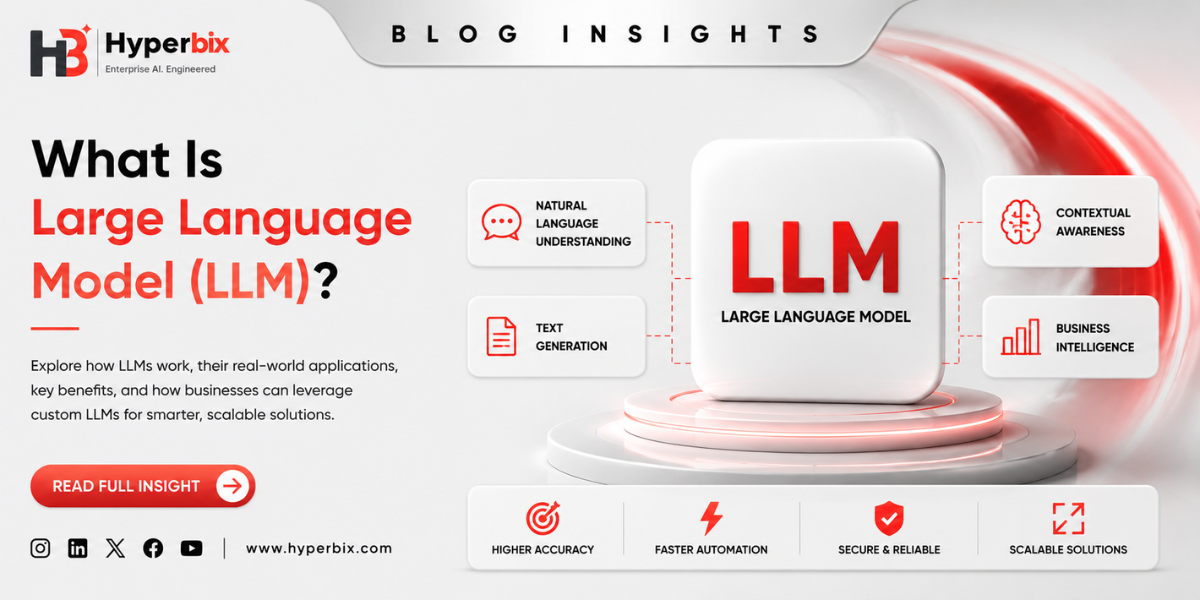
The Large Language Model (LLM) refers to a high-end artificial intelligence system meant to understand, process and generate human languages. The training data of this kind of model includes books, articles, websites, research papers and many other texts. After learning how the patterns, grammar, context and relationships among words work in different texts, the LLM can generate responses that mimic human language very well.
While standard software uses hard-wired rules for functioning, LLMs use deep learning technology to predict the next words or phrases according to the context of a user's query. Thus, LLMs are capable of answering questions, summarizing documents, producing text, translating languages, writing code, and executing a wide variety of other language-based operations. Being capable of identifying the context, LLMs are much more versatile compared to automated systems.
Among the known Large Language Models include GPT, Llama, Claude, Gemini and Mistral. These are some of the LLMs used to build conversational agents, coding, chatbot apps, enterprise search platforms, and content generation systems among others. Many businesses have adopted this technology to automate communication and decision-making processes.
LLMs have become the bedrock of intelligent apps in the current era of advancement in AI. The capability to process natural languages enables businesses to create intelligent applications that can communicate better with their customers. This is the reason behind the importance of LLMs being recognized as an essential technology for the future of AI.
What Is Large Language Model (LLM) Development?
The process of LLM development consists in the creation, customization, training, fine-tuning, and deployment of artificial intelligence language models that will help address certain business problems. Instead of integration of an already existing AI model within the application, LLM development aims at creating solutions with understanding of industry-specific data, business processes, and customers' needs in order to provide accurate and reliable answers.
The process of development includes data collection and preparation, the choice of the proper foundation model, its fine-tuning with the industry-related data, and usage of advanced technologies such as Retrieval-Augmented Generation (RAG). Besides, API development, prompt optimization, implementation of security measures, and deployment to the cloud and/or on-premises infrastructure take place during LLM development.
There are several reasons why businesses opt for custom LLM development: first, it provides better flexibility and reliability; second, developers create a model that understands corporate policies, products, interactions, documents, which results in more relevant answers. Finally, such development ensures better data protection and privacy.
In today’s world, the development of Large Language Models allows companies to create AI chatbots, virtual assistants, document analysis systems, smart search platforms, and process automation solutions. Using AI models tailored to the specific goals of the organization allows businesses to streamline processes, delight customers, and invent new products to fuel growth.
How Does an LLM Work?
Large Language Models operate based on learning patterns, grammar, context, and relationships from huge amounts of text-based data. During training, the model receives billions or even trillions of words that are taken from books, articles, websites, research papers, and any other credible sources. In contrast to memorizing information, the model learns how words interact with each other, thus predicting the right answer according to the input made by a user.
The creation process starts with data gathering and preprocessing where the raw text is processed and turned into tokens. Afterward, the model will be trained using deep learning techniques and transformer architecture. This allows the model to learn the meaning behind each sentence or word and predict the next one in the sentence. After the first phase of training, companies can use their datasets to further refine the model's knowledge of products and business terms.
LLMs for enterprise business applications often use RAG to increase the precision of responses. Rather than being dependent solely on its training dataset, the LLM finds necessary information in the databases or other resources of the business and then generates its response. Thus, the use of RAG allows reducing wrong answers and ensuring that the AI will generate current and business-related responses.
The model continues learning after its deployment by monitoring and optimizing. Developers analyze user interaction, optimize prompts, improve knowledge sources, and enhance performance in order to ensure that the AI is precise and trustworthy. Such an approach allows for making sure that Large Language Models can be applied in practice.
Types of Large Language Models
Large Language Models come in various types, all tailored to address specific business problems. Determining which LLM to use will depend on issues such as customization needs, deployment environments, security needs, and application purposes.
General-Purpose LLMs
General-Purpose LLMs are created by training on varied datasets that contain many topics. They are useful for content generation, chatbots, translation services, programming, summarization, and customer care among other uses. They are usually chosen by businesses that require flexible AI capabilities, after which they customize their domain specifics.
Domain-Specific LLMs
These LLMs are fine-tuned on industry-specific datasets that are from industries like healthcare, financial services, legal services, manufacturing, or retail. This enables them to generate responses that are accurate since they understand the specific jargon used in the particular industry.
Open-Source LLMs
These LLMs offer full flexibility in customization and security. Organizations can fine-tune them using their proprietary data sets and host them on their own infrastructure.
Proprietary LLMs
Proprietary LLMs are created and managed by AI companies offering commercial solutions. Typically, proprietary LLMs provide enterprise-level APIs, managed infrastructure, frequent updates, and great performance, making them a good option for businesses that wish to minimize the burden of managing the infrastructure.
Multimodal LLMs
Multimodal LLMs can handle various types of input data, from text to images, audio, video, and documents. Such models allow creating advanced applications, including document processing, visual search, image recognition, and voice assistants.
Key Components of LLM Development
There are several key components of Large Language Model development that interact and complement each other. All these elements determine the success of the developed solution. This means that every step of the process is important, starting from data collection and preparation and finishing with deployment and further improvements of the AI system.
The first step includes gathering of the proper data sets. High-quality clean data makes the model learn accurate language patterns and business-specific knowledge. Then, the developers choose a suitable foundation model and fine-tune it with domain-specific information so that the AI can get familiar with all the terminology and workflow of the company.
Another important part of the process is related to prompt engineering and Retrieval-Augmented Generation (RAG). The former one helps improve the ability of the model to interpret user prompts. The latter makes the AI able to use enterprise knowledge bases when providing its response. This helps make the AI more accurate and secure.
The last stage of Large Language Model development includes deployment and constant monitoring of the performance of the AI. The developers deploy the model in the required environment (web app, mobile app, etc.) and monitor its performance in terms of accuracy, latency, security, etc.
Popular Technologies Used for LLM Development
Building a scalable Large Language Model solution requires a combination of AI frameworks, cloud platforms, databases, deployment tools, and monitoring technologies. The technology stack should be selected based on the project's complexity, scalability requirements, security standards, and deployment strategy.
Programming Languages: Python, JavaScript, TypeScript
Machine Learning Frameworks: PyTorch, TensorFlow, JAX
Foundation Models: GPT, Llama, Mistral, Claude, Gemma
LLM Frameworks: LangChain, LlamaIndex, Haystack
Vector Databases: Pinecone, Weaviate, Milvus, ChromaDB, FAISS
Embedding Models: BGE, E5, OpenAI Embeddings, Sentence Transformers
Cloud Platforms: AWS, Microsoft Azure, Google Cloud Platform
Containerization & Orchestration: Docker, Kubernetes
Model Monitoring & MLOps: MLflow, Weights & Biases, Grafana
Security & Authentication: OAuth 2.0, JWT, RBAC, Vault
Benefits of Large Language Model Development for Businesses
The process of creating a Large Language Model helps enterprises to automate business operations, increase customer satisfaction and become more data-driven. By incorporating LLM-powered applications into business operations, companies are able to eliminate routine work and become more productive, at the same time offering a higher level of personalization to customers. If you are either a small business or an enterprise, investment in LLM development will bring value to your company and help to implement digital transformation projects.
Increased Business Productivity
LLM-powered applications will automate the processes of documents generation, email writing, meeting notes preparation and data processing, leaving employees to focus on more important and innovative tasks which will lead to the growth of the business.
Improved Customer Experience
LLM-powered solutions allow for creating intelligent chatbots, virtual assistants and other AI-powered systems that will respond to customers' requests immediately providing them with personalized answers. This will not only improve customer satisfaction but also decrease the time of the response and ensure its consistency at all hours of the day.
More Efficient Business Decision Making
Large Language Models are able to analyze big amounts of structured and unstructured information and provide useful information for decision making.
Cost Reduction with the Help of Automation
Automating business workflows will decrease the costs of their implementation and increase efficiency. AI-powered solutions will perform fewer manual actions and therefore, will decrease the number of human errors made during the process.
Scalability of the AI Infrastructure
Custom LLM solutions can adapt to the growth of the business and accommodate hundreds and even millions of users.
Competitive Advantage
Businesses which choose LLM development have a chance to come up with new products and services, increase operational efficiency and provide better customer experience than competitors.
Common Use Cases of Large Language Model Development Across Industries
LLM development is changing numerous industries through automation of communication, increasing productivity, and improving decision-making processes. Companies start using LLM applications for improving their performance, providing customers with personal experience, and extracting value from huge amounts of data.
Customer Support and Virtual Assistants
AI assistants based on LLM development instantly respond to questions of customers, solve typical problems, and make recommendations. Thus, companies not only increase the level of customer satisfaction but also reduce the amount of work of support teams.
Content Creation and Marketing
Marketers use LLMs to produce blogs, social media posts, descriptions of products, advertising copy, emails, SEO content, etc. It becomes faster to generate content consistently in marketing channels.
Enterprise Knowledge Management
Organizations build AI assistants to extract information from company's internal documents, policies, and databases. In this way, employees will be able to receive the needed information instantly without searching through a lot of documentation.
Healthcare and Medical Assistance
Companies use LLM for documentation of clinical events, summarizing medical records, communicating with patients, and managing healthcare knowledge. This approach helps to improve the efficiency of administrative processes for healthcare professionals.
Financial Services
LLM development is used in customer support, fraud detection, compliance assistance, financial reports preparation, and documents analysis. This way, AI not only increases the efficiency of operations but also helps to process huge amounts of financial information.
Software Development
Development teams use LLM to create coding assistants for generating code snippets, explaining the logic, finding bugs, and documenting software. It makes software development faster and more efficient.
Education and E-Learning
Educational institutions use LLM-based platforms for creating personalized education, preparing learning materials, answering students' questions, and supporting online learning environment.
Legal and Compliance
Law firms and corporate legal departments use LLMs for summarizing contracts, analyzing legal documents, conducting researches, and facilitating the compliance processes. Thus, professionals can do their routine work faster.
Custom LLM Development vs Pre-Trained Models
Organizations choosing AI usually have an option to decide either to implement a custom Large Language Model solution or to opt for some pre-trained model solution. Each of the options has its advantages and is worth consideration depending on the business goals, security issues, scalability, and budgetary aspects.
The pre-trained models represent the already trained AI systems capable of providing various functionalities within short periods of time. The technologies can be implemented easily to facilitate the work with chatbots, content generation, translation, summarization, and coding.
The development of custom LLM solutions implies the adaptation of AI solutions for specific business requirements. With a help of proprietary data, it is possible to fine-tune the model and optimize its performance according to the specifics of the industry. The process is more time-consuming but provides higher security level and increased accuracy of the results.
Many companies find a way to combine those two approaches and build customized intelligent applications by applying such techniques as prompt engineering, fine-tuning, and Retrieval-Augmented Generation (RAG).
Things to Consider Before Starting Large Language Model Development
LLM Development Starts with Strategic Planning Instead of Choosing the Model or Technology Stack Right Away. Companies need to determine what kind of problem they plan to solve with the help of artificial intelligence and what benefits they expect from this process both in terms of creating something valuable for their customers and employees.
Data Quality is One of the Key Aspects to Take into Account While Developing an LLM. The better the quality of the data used for training or customizing the model is, the more efficient the latter will work. In addition, the business should make sure it uses appropriate data governance policies that guarantee privacy and comply with all regulations.
Scaling Up and Integration of the System Should Be Planned From the Beginning. An LLM needs to integrate well with other apps and databases of the business, and it should allow scaling up and growing along with the business itself in the future.
The business needs to estimate the infrastructure needs and deployment options, check API compatibility, and think about maintenance of the system in the future.
The last but not least thing to consider is that businesses need to find an experienced and skilled partner for developing the LLM.
How Much Does Large Language Model Development Cost?
The cost of LLM development depends on a number of aspects, including the complexity of the project, specific business needs, customization of the LLM, infrastructure, and deployment options. While some companies only need a basic chatbot based on an existing foundation model, others would like to have more complex and fully customized enterprise solutions with integrations with other business systems. Every project has its own unique goals and, therefore, there is no universal pricing strategy here.
Some of the major considerations which affect the total development cost are whether to use a pretrained model or fine-tune a customized model, training data quantity and quality, integration complexities, security aspects, cloud deployment, and maintenance. The projects that need to use more advanced features of AI like RAG, multilingual or private implementations will generally need more development.
Alongside the cost of LLM development, companies also need to think about the cost of operation of the application they create. In addition to the cost of development, businesses need to be ready to cover expenses on cloud hosting, APIs, model monitoring, updates, and optimizations.
The most optimal thing to do is to consult an experienced LLM development company that will help you analyze your business needs and select the most cost-effective solution for you.
How to Choose the Right LLM Development Company?
The selection of a good development company for the Large Language Model is among the key decisions in the AI development project. An effective partner in this case must not only have sufficient expertise in complex AI technologies but also be ready to deal with business realities. The company should offer scalable, safe, and customizable solutions that are in line with your business goals.
It is essential to check how the company operates within LLM development frameworks, how it integrates models into AI solutions, what cloud platforms the company uses and how it manages vector databases, and how experienced it is in the enterprise software development. The analysis of the company's portfolio is helpful when checking whether the company will develop the solution for you successfully.
Security, scalability, and post-deployment support of the solution are among other critical criteria for selecting the right development company for LLM. It is necessary to check whether the company follows industry best practices regarding the security of the developed solution, its scalability, and further maintenance.
Lastly, it is recommended to choose a partner who will collaborate actively with you during the process of development and will provide regular updates and communication about all changes and steps.
Future Trends in Large Language Model Development
The evolution of Large Language Model development remains active with constant improvements in AI technology efficiency, accuracy, and availability. Companies are no longer limited by basic conversational AI applications, as they start to invest in intelligent systems capable of understanding complex business processes, analyzing enterprise knowledge, and making decisions in real-time. With the increased adoption rate, the importance of LLMs in digital transformation processes is only going to increase.
The development of custom AI solutions for particular domains is one of the emerging trends in LLMs. Instead of being limited to general-purpose models, businesses develop domain-specific AI models based on their specific knowledge. This allows increasing the accuracy of answers, securing the data better, and providing more relevant responses.
The emergence and increased adoption of such solutions as RAG, multimodal AI, and AI agents is another important trend in LLM development. With the help of such solutions, LLMs can access fresh data, work with various data types including text, images, and audio, and perform complex operations without any human input. In this way, companies are able to create truly intelligent solutions that can automate whole business processes, not just separate tasks.
Such advancements as model optimization, private AI deployments, and responsible AI developments will keep on shaping the future of LLM development. Companies that focus on such approaches today will definitely benefit from them in the future.
Why Choose Hyperbix for Large Language Model Development?
Hyperbix provides customized and intelligent solutions based on Large Language Models (LLMs) that assist businesses in automating their operations, increasing productivity, and offering outstanding customer experience. Our team brings extensive AI knowledge along with cutting-edge development frameworks to create custom solutions based on the LLMs.
Whatever your needs are – whether you want an AI-driven chatbot, enterprise knowledge assistant, content automation platform, or an AI solution tailored to your business – Hyperbix will create scalable applications to provide long-term benefits for your business. Hyperbix's development process involves thorough analysis of your business needs before choosing the right foundation model, architecture, and technology stack. This way, every solution is created in accordance with the specific business needs and is scalable, secure, and reliable.
Hyperbix relies on the cutting-edge technologies, including GPT, Llama, Mistral, LangChain, LlamaIndex, vector databases, cloud, and the best practices of MLOps in order to create highly-efficient LLMs.
Every application created by our team is made in accordance with the principles of scalability and security and can easily be adapted for further evolution as per changing business needs. Choosing Hyperbix means working with a professional team that builds intelligent LLMs for your business.
Conclusion
LLM Development is changing the way businesses communicate with their customers, automate operations and decision-making processes. Intelligent virtual assistants, content creation, enterprise knowledge management and workflow automation powered by LLMs are making it possible for companies to work more efficiently and discover new opportunities.
With the growing number of innovative AI technologies, companies who would choose scalable and customized LLM development services will stay ahead of competition in the digital world. It will be important not only to choose the right technology but also to find the professional developer who knows what your company is about and will be able to offer solutions which will match your business goals and objectives.
No matter whether you want to start working on your first AI project or to expand your current capabilities, LLM Development is a great place to start from.
Blog FAQs
Frequently Asked
Questions
LLM development is the process of creating, customizing, integrating, or fine-tuning language models that can understand and generate human-like text. Businesses can use these models to build intelligent applications for customer support, content processing, search, automation, data analysis, and other language-based tasks.
An LLM learns patterns and relationships within large amounts of text data. When a user provides a prompt, the model processes the context and predicts appropriate tokens to generate a relevant response. Modern LLMs can handle tasks such as summarization, question answering, classification, extraction, and conversational interactions.
Traditional software mainly follows predefined rules and programmed logic. LLM-powered applications can interpret natural language and generate responses based on patterns learned by the model. LLM development also involves areas such as prompt design, model selection, fine-tuning, retrieval systems, evaluation, and model integration.
LLMs can support AI assistants, customer service systems, enterprise search, document analysis, content generation, knowledge management, recommendation systems, data extraction, translation, and workflow automation. The right application depends on the organization's data, processes, and business objectives.
Yes. Businesses can customize LLM-powered solutions using techniques such as prompt engineering, fine-tuning, Retrieval-Augmented Generation (RAG), tool integration, and proprietary knowledge bases. This allows the system to provide responses that are more relevant to a particular industry or business context.