What Is Machine Learning? How It Works, Types, Benefits & Real-World Applications
Listen to this articleTap play to start listening

Introduction
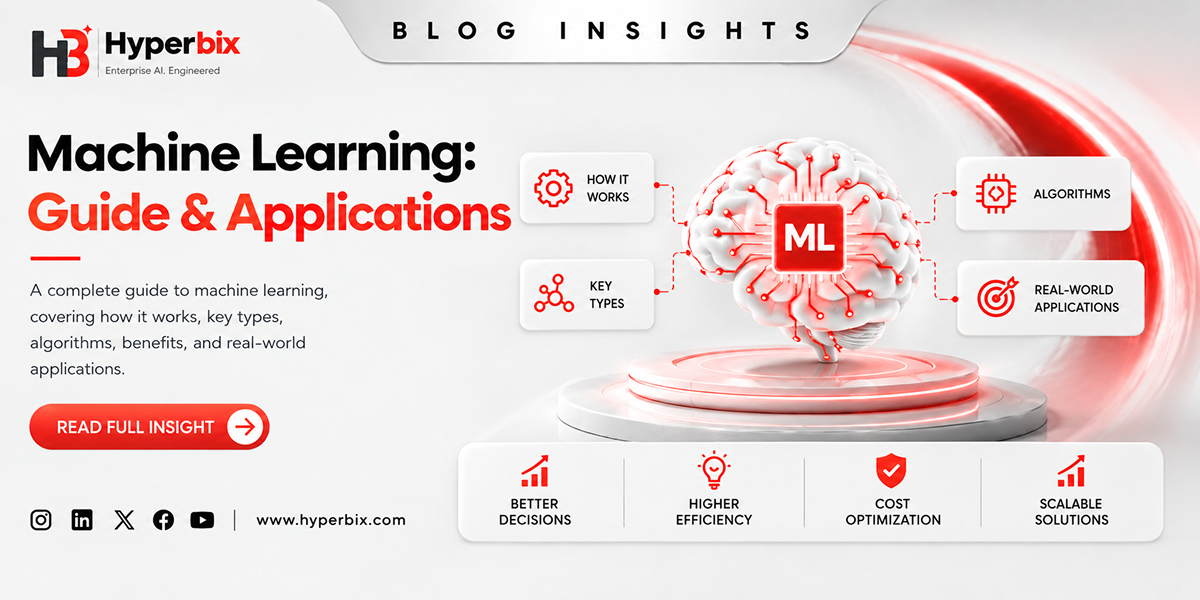
Machine learning is a major fields of artificial intelligence technology now. With machine learning, computers can learn from the data using certain patterns and then predict, detect, or decide based on these patterns without being programmed in advance for any particular case.
In many everyday-used applications like fraud prevention and personalization, machine learning is already being used. In this guide, you will learn about the fundamental aspects of machine learning, its approaches, algorithms, application areas, benefits and drawbacks, as well as important considerations in relation to machine learning implementation in the business sphere.
What Is Machine Learning?
Machine learning can be defined as a kind of artificial intelligence that enables computers to learn from data and improve performance in a specific task without explicit programming for individual situation.
As opposed to programming computers with exact instructions for a specific scenario, machine learning provides data and an appropriate method of learning for the computer to discover and apply patterns within the provided data in order to reach conclusions. This form of artificial intelligence works best when there is a vast amount of data or complex patterns.
How Does Machine Learning Work?
The machine learning algorithm learns through a systematic approach involving the following steps: preparation, training, testing, and evaluation. The trained model will use new data to generate results such as predictions or classifications.
Gather Data
The first step is gathering the necessary data relevant to the problem that the machine learning algorithm must solve. This data can include text information, pictures, transactions, customer behavior, sensor information, and many other types of information. The quality and relevancy of the gathered data influence the learning ability of the model.
Prepare the Data
Gathered data usually needs to be prepared first before using it as the input of the model. The data should be cleaned up and transformed to be used correctly by the algorithm.
Choose the Algorithm
The choice of the algorithm is determined by the type of the problem, the gathered data, and the expected output. If several algorithms are available, the one appropriate for value prediction, information classification, and pattern recognition will be chosen.
Train the Model
During the training phase, the selected algorithm works with the processed data and recognizes patterns and relations. There are changes made to the model based on the examples that it receives. The idea is to recognize patterns that can be used on new and unseen data.
Test the Model
The trained model is tested by using some data that have not been seen during the training phase. This allows testing of the performance of the model in case of receiving new data. Testing helps detect problems like over fitting or low accuracy of prediction.
Use the Model
When the model operates properly, it can be embedded into some application or business process. There it will use new data for making predictions, classification, recommendations or other types of output.
Key Components of Machine Learning
There are various elements that machine learning requires for its operation, some of which include data, algorithms, models, training, and testing.
Data: Every machine learning system starts with relevant data. Data forms the examples that the system uses in order to learn. Often, the nature of data plays a significant role in defining the final model formed.
Algorithms: An algorithm defines the method used to learn patterns from data. Different algorithms are suitable for different types of problems. If a regression algorithms can be used to predict numerical values, while classification methods can help assign data to categories.
Models: Machine learning model is the result of machine learning. Models are the result of discovering some sort of relationship from data used for training. When a model is ready, it can take input data and give output data according to the relationship it has discovered.
Training and Testing: Training is the phase in which the model learns from the available data set. Testing comes in when we evaluate the performance of a particular model on data that it has not seen before. The separation of training and testing phases is essential because a good model should generalize the learned knowledge rather than remember the training examples.
Types of Machine Learning
Machine learning includes different learning approaches based on how a model learns from data and feedback. The main types are supervised, unsupervised, semi-supervised, and reinforcement learning.
Supervised Learning
In supervised learning, there is labeled data with the output being known in advance in the training process. The model learns how the output is related to the input data. It is commonly used for classification and regression tasks.
Unsupervised Learning
Unsupervised learning deals with data without any defined output in advance. The model finds some patterns, connections, relationships, similarities, etc. It is applied to clustering, pattern recognition and data mining.
Semi-Supervised Learning
Semi-supervised learning uses a combination of a small number of labeled and large number of unlabeled data. The model learns the patterns in data using both kinds of data. This approach helps when labeling all the inputs becomes complicated.
Reinforcement Learning
In reinforcement learning, there is a feedback system which makes the process possible. The system receives some feedbacks from actions it performed and learns what actions are better for reaching the goal. Learning in this case is based on rewards and penalties.
Common Machine Learning Algorithms
Machine learning techniques offer distinct ways to discover patterns and learn from data. Some techniques that are commonly used include regression, decision trees, support vector machine, K-nearest neighbor, and neural networks.
Logistic Regression - Although logistic regression has this name, it is widely used for classification problems. It can provide an estimation of the probability that an object belongs to some category.
Decision Tree - The algorithm of the decision tree is based on the conditions that lead to a certain conclusion or decision. Its architecture looks like a flowchart and, thus, can facilitate the process of making decisions.
Random Forest - This machine learning approach uses a random forest that comprises decision trees to make predictions. Several decision trees can provide more accurate results compared to just one decision tree.
Support Vector Machine - Support vector machines classify data using the appropriate boundary between categories. This technique is efficient when it comes to the ambiguous division between classes.
k-Nearest Neighbors - The k-nearest neighbor approach relies on the information provided by the nearest neighbors in order to predict the new observation. The neighbors decide the class or the prediction of the new observation.
Neural Network - In neural networks, the computational units are connected into layers. Neural networks can be applied to learn complicated patterns and to work with images, texts, speech and other types of information.
Machine Learning vs. Artificial Intelligence vs. Deep Learning
Aspect | Artificial Intelligence (AI) | Machine Learning (ML) | Deep Learning (DL) |
Definition | Huge discipline dealing with the creation of systems that can perform tasks that need human intelligence. | A type of AI that allows for machines to learn from data and make predictions and decisions. | A subset of ML that uses multi-layered neural networks to learn complex patterns from large amounts of data. |
Main Focus | Behavior and decision making of intelligent agents. | Learning from data and improving task performance. | Learning complex representations and patterns from data. |
How It Works | Can use rules, logic, machine learning, or other techniques. | Learns patterns from training data using selected algorithms. | Uses multiple layers of neural networks to process and learn from data. |
Data Requirement | May or may not require large amounts of data, depending on the approach. | Usually requires relevant data for training. | Generally benefits from large and diverse datasets. |
Relationship | The broadest concept. | A subset of AI. | A subset of machine learning. |
Typical Applications | Assistants, automated systems, decision-support systems, and robots. | Prediction, classification, recommendation, fraud detection, and pattern analysis. | Image recognition, speech processing, natural language processing, and complex pattern recognition. |
Complexity | Varies depending on the AI system and approach used. | Depends on the algorithm used.. | Often more computationally intensive than many traditional ML approaches. |
Human Involvement | Can range from rule-based systems to systems that learn automatically. | It usually needs data preparation and selection, training and evaluation. | Typically requires substantial data preparation, training, and computational resources. |
Benefits of Machine Learning
* Automates tasks based on patterns: The systems can recognize patterns and make predictions without having to program every single decision.
* Operates with large datasets: Machine learning can handle huge amounts of data and make patterns visible.
* Helps make better decisions: Predictions and classification can give additional input for business decisions.
* Makes personalization possible: Businesses can take advantage of customers' habits and preferences for better recommendations.
* Recognizes abnormal behavior: Machine learning is capable of recognizing patterns that deviate from what should be normal, thus making it useful in such areas as fraud detection and cyber security.
* Gets better with proper data: It is possible to retrain models when new and relevant data is collected.
Challenges and Limitations of Machine Learning
Machine learning is not a universal solution to every problem. Machine learning has certain practical limitations as well.
Data quality: Learning algorithms would not work efficiently when the data that they process is incomplete, inconsistent, inaccurate, or non-representative.
Bias: Presence of any biases in the training dataset might cause the machine learning algorithms to generate biased results.
Interpretability: Certain learning algorithms are hard to interpret, especially when they are highly complex.
Overfitting: Learning algorithms may perform very well on training data, yet fail to perform well on other data since they have learned the training set too closely.
Computing power and infrastructure: Certain machine learning applications demand certain computing power and infrastructure.
Changing conditions: Learning algorithms may stop working effectively as soon as the real world stops conforming to certain patterns used for training.
Real-World Applications of Machine Learning
Applications of machine learning can be found in different industries and include data analysis, pattern recognition, automation of tasks and decision making.
Healthcare - ML could be used in medical imaging analysis, patient risk assessment, research, and pattern recognition within healthcare data.
Finance and Banking - In financial institutions, ML is used for fraud detection, risk analysis, transaction monitoring, customer segmentation, etc.
E-commerce - As far as e-commerce enterprises are concerned, machine learning is applicable in recommendation, search optimization, demand analysis, and customer experience personalization.
Marketing and Advertising - Machine learning can be applied to marketing activities such as consumer behavior analysis, segmentation, prediction, and targeting.
Transportation - Some applications of ML include route optimization, demand forecasting, traffic analysis, and vehicle operation systems.
Cybersecurity - ML could be used for detecting abnormal network activity and potential threats, as well as processing large amounts of cybersecurity data.
Manufacturing - In manufacturing, ML could be used for quality control, predictive maintenance, process monitoring, and production analysis.
Education - ML could be used in personalized learning, analyzing students' performance, making content recommendations, etc.
Entertainment - ML could be used by streaming and digital entertainment companies for content recommendation according to users' behavior.
Machine Learning in Everyday Life
Machine learning is already embedded within many digital services and technologies used in our daily lives. Some of the functions which are supported by machine learning include recommendations, spam filtering, voice recognition, text prediction, and navigation.
Spam Emails Filter: The machine learning algorithm finds patterns in the emails and then separates them into regular and spam emails.
Search Engine Output or Suggestion: Machine Learning algorithms can analyze the search to provide suitable results or suggestions.
Product Recommendations: Website platforms will analyze users' actions to recommend products related to their preferences.
Voice Recognition: Voice recognition technology could utilize machine learning to interpret one's voice into instructions or text.
Online Fraud Alerts: Machine Learning can analyze the transactions made by the user to spot anything unusual.
Navigation and Traffic Predictions: Machine Learning will help in analyzing data about locations and traffic to provide predictions.
Social Media Personalization: Machine Learning can analyze which posts or contents would be most relevant to the user.
Image Recognition: Machine Learning will analyze patterns in images to recognize various elements in them.
What Are the Requirements for Machine Learning?
For successful implementation of machine learning, there is more than the need of having a machine learning model/algorithm. Important factors to consider include data relevant to the task at hand, objective, computing facilities, skills, and evaluations.
Relevant Data: For machine learning algorithms, there must be data that relates directly to the problem at hand. The data must be appropriate in terms of accuracy, consistency, and representatives for the particular task.
Clear Objective: There must first be an objective of sorts before choosing which algorithm to use for machine learning. Setting an objective helps in deciding what to look out for in the machine learning algorithm and its evaluation.
Data Preparation: The data in machine learning is often unstructured and therefore needs to be processed and structured in a form suitable for use during training. These skills include cleaning of data, elimination of duplicates, handling missing data, and variable selection.
Appropriate Algorithm: There must be the correct algorithm for the right problem and right data. Various algorithms apply for different kinds of problems like classifications, predictions, clusters, patterns.
Computing Resources: Machine learning requires appropriate computing resources that process the data, training and predictions. The computing resources needed depend on the size of the dataset and the algorithm used.
Technical Skills: Technical skills are required by machine learning applications in areas such as data preparation, model development, testing, deployment, and monitoring. The skills required depend on the complexity and intended use of the application.
Model Evaluation: The models need to be evaluated based on performance metrics using data that is independent of the training data.
Monitoring and Maintenance: The models deployed require monitoring in order to detect any changes in their performance or data trends that necessitate retraining of the model.
The Future of Machine Learning
Future development of machine learning will be towards integration within business software and services. This will involve developing better models that are more accurate, efficient, interpretable, secure, and business-oriented.
* Machine learning would continue to integrate further within software, business processes, and digital services. As data increases, businesses would leverage machine learning for recognizing patterns and automation of decision-making and processes.
* Further advancements would not only revolve around the effectiveness of the machine learning model but also its accuracy, efficiency, interpretability, security, and responsible use. Further, businesses would have to evaluate how well the machine learning models perform with data and adapt to changes.
* Machine learning would increasingly operate in tandem with various other types of AI, which include generative AI, AI agents, NLP, computer vision, and automation.
* One of the key trends related to machine learning is making it more accessible for different business units. In that case, it does not mean applying machine learning capabilities only in highly technical environments but also embedding it into current applications.
* As for businesses, the future of machine learning depends not on implementing the technology just because of its availability but on solving practical problems through learning from data.
Conclusion
Machine learning endows the computer with the capability to learn the patterns from the data collected and utilize such learned knowledge for making predictions, classifying, giving recommendations, etc. The uses of machine learning include but are not limited to healthcare, financial sector, e-commerce, manufacturing, cybersecurity, education, and regular online services.
Machine learning also needs more than just selecting the correct algorithm. It also involves data quality, problem formulation, model evaluation, infrastructure, monitoring, and many more.
For companies exploring machine learning, starting with a clear problem, relevant data, and a suitable approach can provide a strong foundation. An AI development company can help businesses evaluate their requirements and plan an appropriate machine learning strategy.
Blog FAQs
Frequently Asked
Questions
Machine Learning is a subfield of artificial intelligence which allows computer algorithms to learn from data and make predictions, classifications and other kinds of decisions.
There are five steps in machine learning: data collection and preparation, choosing the right algorithm, training the model, testing its performance and using the learned model on new data.
The four main types of machine learning are supervised learning, unsupervised learning, semi-supervised learning, and reinforcement learning.
AI is the wider area of building intelligent systems. ML is one of AI disciplines which learns from data, DL is a specific type of ML with multi-layer neural networks.
Common machine learning algorithms include linear regression, logistic regression, decision trees, random forests, support vector machines, K-nearest neighbors, and neural networks.
Machine learning can be used for tasks such as prediction, classification, recommendation, pattern recognition, anomaly detection, and data analysis across different industries.
Machine learning needs data which is relevant to the particular issue and the one which is good for learning. It depends on the application what kind of data is used - texts, images, transactions, customers interactions, sensors and so on.
Machine learning will allow companies to deal with huge amount of data, find patterns in it, automate certain processes, make personalization better, recognize anomalies and support decision making.
ML models may be impacted by issues like low quality data, bias, overfitting, changes in the data trends, and the difficulty of understanding complicated models. The models also need to be evaluated and monitored.
A company may begin from defining the problem, analyzing data at hand, choosing an appropriate machine learning technique, developing and testing the algorithm, and implementing the algorithm into its processes.