What Is RAG in AI? A Complete Guide to Retrieval-Augmented Generation for Businesses
Listen to this articleTap play to start listening

RAG in AI: An Overview
AI can answer questions, summarize information, create content, and support many everyday business tasks. But it not always have access to the specific information a business needs.
In case a business needs an AI agent that can provide answers based on its documents, product information, policies, support data, or knowledge base, then the general AI models might lack access to this information, as it is often confidential, regularly changes, or is unique to the company. Here comes the Retrieval Augmented Generation technique into play.
This article provides the definition of RAG, its workflow, main elements, business value, examples of applications, challenges, and differences between RAG and other approaches including classical AI, fine-tuning, and AI agents.
What Is RAG in AI?
RAG stands for Retrieval-Augmented Generation is an AI methodology where the language model can retrieve information from external sources before responding to the user’s query. Unlike the existing AI models which depend only on the built-in knowledge, in case of RAG the AI model is connected to a particular knowledge base that could be company’s documents, product information, FAQs, database, etc.
If an employee poses a question to the AI assistant regarding any company policy, the RAG system searches through the respective company documents and uses the retrieved information to provide an appropriate answer to the question. The application of RAG technology is highly beneficial for companies that would like to integrate AI applications in accordance with their particular information requirements.
What Is Retrieval-Augmented Generation?
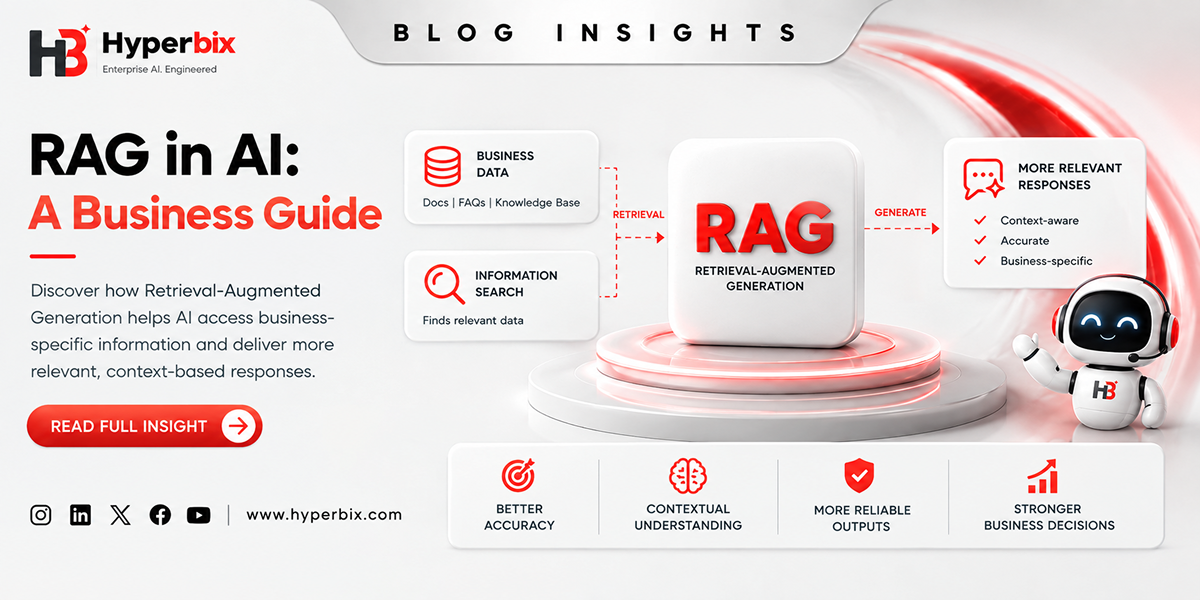
Retrieval-Augmented Generation can be understood as a simple three-part process: First, the system receives a user's question and searches a connected knowledge source. It then selects information that is relevant to the question and provides it to the AI model as additional context. The AI model uses the question and retrieved information to generate a response.
The model can then provide an answer based on those instructions. This is different from simply asking a language model to answer the question using only its existing knowledge. The main idea behind RAG is simple: connect AI generation with external information.
How Does RAG Work?
RAG operates in the way that the model retrieves relevant information from the linked knowledge base and provides it to the AI model for context and generates relevant output accordingly.
Document Ingestion
The RAG system first collects information from sources such as PDFs, websites, databases, FAQs, and internal documents. This information is processed and organized so it can be searched efficiently. The quality and accuracy of the source data directly affect the information retrieved later.
Data Chunks and Embedding
The large document gets broken down into smaller chunks that make sense to the system. Each chunk of data is represented as a mathematical model referred to as embedding. The embedding get stored in a vector database or any other system that can perform a search.
Information Search
When the user makes a query, the system does a search for suitable data. It matches the meaning of the query to the information available instead of matching the keywords only. The most suitable data gets picked for the next phase.
Context Augmentation
The retrieved information is added to the user's original question as additional context. This gives the AI model relevant information to work with when preparing its response. As a result, the model can base its answer on the retrieved business or domain-specific information.
AI Response Generation
The language model relies on the question asked by the user as well as the context that is retrieved in order to give the final output. The basic flow is: User Question → Retrieval → Relevant Context → AI Generation → Response.
Different Types of RAG Systems
The design of the RAG system depends upon the complexity of the task at hand, the data source used and the method of information retrieval and generation. There are three types of RAG systems discussed commonly – Naive RAG, Advanced RAG, and Modular RAG.
Naive RAG: The naive RAG system uses the standard flow of the RAG systems. First, it retrieves the information required from the knowledge source and then provides it to the language model which generates the answer based on that.
Advanced RAG: Advanced RAG uses advanced methods and techniques along with the basic RAG flow to improve information retrieval, processing, and response generation. Some of these methods include better chunking, improved query expansion, ranking and filtering techniques, and enhanced retrieval.
Modular RAG: Modular RAG system uses independent, flexible modules for each stage of the RAG system. Each module can be customized according to the requirement of the business, thus making the system more complex and flexible.
Graph RAG: The Graph RAG is based on information connection through relations between entities and concepts. It can be used for answering complex queries, where connections are needed between different information points.
Multimodal RAG: This type of RAG retrieves information in different formats such as text, image, tables, audio, and video. It brings together information in these formats for context for AI answers.
Key Components of a RAG System
RAG systems consist of multiple components which collaborate to extract relevant information and produce contextually appropriate responses. This involves the use of the following elements: knowledge base, embedding model, vector database, retriever, and large language model
Knowledge Base
The knowledge base contains the information the RAG system can retrieve. It may include company documents, product information, support articles, databases, websites, or other approved sources. The knowledge base should be organized and maintained so the system can retrieve useful information.
Embedding Models
Embedding models convert text or other supported information into numerical representations. These representations help the system identify content with similar meaning.
Vector Database
The function of vector databases is to store embeddings and do searches within those embeddings. As opposed to just doing a word search, with the vector method, a search will be done for information semantically similar to what the user asked for.
Retriever
The retriever looks for relevant information in the knowledge source. When a user submits a question, the retriever searches the stored information and selects content that may help answer it. The quality of retrieval has a direct effect on the quality of the final response.
Large Language Model
The large language model, or LLM, produces the output itself. It receives input from the user as well as the retrieval system as context and uses it to generate a natural language output.
Why Is RAG Important for Businesses?
Companies usually have plenty of data which is not known by generic AI models. This might include internal policies, technical documentation, customer data, support knowledge base, manuals, and various other types of business-related information.
* Works With Business-Specific Information - RAG enables AI systems to work with company documents, databases, FAQs, and other forms of company-specific information.
* Provides More Relevant Answers - The system searches for relevant information before answering the user’s query.
* Reduces Dependency on General AI Data - RAG provides more context to the model, instead of only depending upon the data that the model knows through its training phase.
* Allows Update of Frequently Changing Data Sources - Businesses can easily update their knowledge base without requiring any retraining of the model.
* Helps in Information Retrieval - Employees or customers can easily search for relevant information in vast collections of business information.
* Allows More Control Over AI Answers - Businesses can control the data sources that the AI system uses while formulating answers.
Benefits of RAG for Businesses
More Relevant AI Responses: RAG provides information directly related to the user's question. This helps the AI generate responses that better fit the business context.
Access to Business-Specific Knowledge: RAG connects AI applications with selected company information and knowledge sources. This makes AI more useful for internal tasks, customer support, and business documentation.
Reduced AI Hallucinations: RAG provides relevant source information to help reduce inaccurate or unsupported responses. However, it does not eliminate hallucinations.
Up-to-Date Information: RAG can retrieve information from updated knowledge sources when answering a query. This allows responses to reflect newer business information without retraining the entire model.
Better Data Control: Businesses can choose which information sources the RAG system can access and use. They can also manage, update, or remove information as needed.
Types of Data Can RAG Work With
RAG can work with many types of information as long as the data can be processed and made available to the retrieval system. Including:
* Documents – PDFs, Word files, reports, and manuals
* Web Content – Websites, knowledge bases, and help centers
* Text Data – FAQs, articles, policies, and support content
* Structured Data – Databases, spreadsheets, and business records
* Product Information – Catalogs, specifications, and product documentation
* Internal Business Data – Company policies, employee resources, and operational information
RAG can also be extended to applications involving other forms of data, depending on the architecture and models being used. The important factor is not simply the file format. The information needs to be accurate, relevant, accessible, and properly prepared for retrieval. Poor-quality source data can lead to poor retrieval and, ultimately, poor AI responses.
Common Business Use Cases of RAG
RAG can be used in many business situations where users need answers based on a specific collection of information.
AI Customer Support
A RAG-powered support assistant can retrieve information from product documentation, FAQs, policies, and support knowledge. Customers can ask questions naturally instead of searching through multiple pages.
Enterprise Knowledge Assistants
Large organizations often have information spread across different documents and knowledge repositories. An enterprise AI assistant can use RAG to retrieve relevant internal information and answer employee questions.
Document Search and Analysis
RAG can make large document collections easier to search. Users can ask questions about contracts, reports, manuals, research documents, or other supported files and receive answers based on relevant sections.
Internal Employee Assistants
Business could develop AI assistants which assist workers in getting their hands on internal information. Such assistants could assist workers in accessing information related to Company policies, processes, product information, technical documentation, training materials, and internal guidelines.
E-commerce and Product Recommendations
RAG can connect AI applications with product catalogs, specifications, descriptions, and other product information. If a customer could ask any questions about the product, the system could retrieve relevant product information and explain the options based on available specifications.
Legal and Compliance Research
Organizations can use RAG to search large collections of approved legal, regulatory, and compliance-related documents. Instead of manually reviewing every document, users can ask questions and retrieve relevant sections. For sensitive applications, appropriate review, access controls, and human oversight remain important.
RAG vs. Traditional AI vs. Fine-Tuning vs. AI Agents: What’s the Difference?
Comparison | RAG | Traditional AI | Fine-Tuning | AI Agents |
Main Goal | Retrieve relevant information to support AI responses | Perform prediction, classification, detection, or recommendations | Adapt a model for specific tasks or behaviors | Perform tasks and take actions toward a goal |
Uses External Knowledge | Yes, through connected knowledge sources | Usually no | Not necessarily | Yes, through tools, APIs, and knowledge sources |
Works with Updated Information | Yes, when connected sources are updated | Depends on implementation | Usually requires retraining | Yes, when connected to updated sources or tools |
Industry-Specific Knowledge | Strong when connected to relevant data | Depends on how it is designed | Strong for trained tasks | Strong when connected to relevant tools and data |
Best Use Cases | Q&A, document search, knowledge assistants | Forecasting, classification, detection, recommendations | Task-specific model adaptation | Workflow automation, multi-step tasks, and decision-making |
Main Difference from RAG | Retrieves relevant information before generating a response | Focuses mainly on specific AI tasks | Changes model behavior through training | Performs actions and executes tasks using tools and workflows |
How Can Businesses Build a RAG-Based AI Solution?
Building a RAG-based AI solution involves connecting an AI model with relevant business data so it can retrieve information and use it to generate context-based responses. Businesses typically need to select suitable data sources, prepare the information, set up retrieval, connect the language model, and apply appropriate security and access controls.
Step 1: Determine the Business Problem
Describe the problem that the AI system will solve for the user, e.g., question answering and document searching. Understanding the problem will allow for identifying the type of information and functionality needed from the system.
Step 2: Determine the Knowledge Sources
Identify where the required information is located – in documents, in databases, on websites, or through a support system. Only appropriate and relevant knowledge sources should be selected for the RAG system.
Step 3: Prepare the Data
Clean and structure the data obtained, breaking it down into appropriate chunks. Duplicate, obsolete, or irrelevant information should be considered and processed properly.
Step 4: Generate Embeddings
Generate embeddings out of the pre processed information to enable searching by semantics. Embeddings need to be stored in the vector database or a corresponding retrieval system.
Step 5: Developing the Retrieval Layer
The retrieval layer will search through all the information that has been made available based on the query by the user. The most relevant information will be selected to be fed as context to the AI model.
Step 6: Connecting the Language Model
The retrieved information will be added to the user's query and fed into the language model. The AI model will respond to the query based on the provided context.
Step 7: Adding Business Rules and Access Controls
Rules for information access and management can be defined to ensure that only authorized people have access to certain information.
Step 8: Testing and Improving the System
Realistic questions should be used to test the RAG system to determine the quality of both retrieval and response. Data and other processes will then be improved accordingly.
What Challenges Should Businesses Consider When Implementing RAG?
Inaccurate Source Data
Source data may include incorrect or out-of-date information which will cause the responses by AI to be unreliable. It is important to keep the source data up-to-date and relevant.
Inappropriate Retrieval
Information may be retrieved by the system that is not directly answering the question posed. More effective chunking, embeddings and retrieving will help resolve this problem.
Excessively Large Information Retrieval
Retrieving too much information will complicate the process of identifying the most relevant information by the model. The system is supposed to retrieve only the necessary data to answer the query.
Confidentiality and Security
Data available in businesses may be confidential or restricted. It is necessary to provide access control to prevent any data misuse.
Outdated Information
Business information changes quite frequently thus outdated information might become a problem. Therefore, the source data should be updated regularly.
AI Hallucinations
Although RAG will decrease the number of inappropriate responses, it cannot guarantee that there won’t be any. It is important to address uncertainty issues properly.
How Can Businesses Improve RAG Performance?
A RAG application can be improved by looking at the entire retrieval and generation process rather than focusing only on the language model.
Enhance Quality of Source Information - Maintain the knowledge base accurate, up to date, organized, and relevant.
Use Appropriate Chunking - Documents should be divided into meaningful sections. If chunks are too large, retrieval may return unnecessary information. If they are too small, important context may be separated.
Improve Retrieval Quality - The retrieval system should be designed to find information that actually answers the user's question. Diverse search strategies may be utilized based on applications.
Give Model Instructions - It is important that clear instructions are provided to the model on how to use the acquired data.
Add Source References Where Appropriate - Showing where an answer came from can make an AI application easier to review and give users greater visibility into the information behind a response.
Evaluate With Real Questions - Testing should use realistic questions that users are likely to ask. This helps identify retrieval problems, missing information, irrelevant results, and other weaknesses.
Is RAG Right for Your Business?
RAG can be a good fit if your business needs AI to work with specific, private, or frequently updated information. It is especially useful for document search, customer support, internal knowledge assistants, and business Q&A. It may be worth considering if your business has:
Large Document Sets – With RAG, users can access and retrieve useful information from sets of documents in large quantities without having to go through individual document manually.
Frequently Updated Information – RAG can be connected to knowledge databases that are frequently updated and provide the most recent information in its answers.
Company Knowledge for Employees – RAG can help employees easily locate any policies, procedures, guidelines, and other information internal to the company.
Product Documentation – RAG can locate all relevant information regarding the products, including documentation, specifications, manuals, and instructions.
Customer Support Information – RAG can assist in locating useful information for customer support such as product information and FAQs.
Business-Specific Knowledge – RAG can connect AI systems with business-specific information which cannot be known to general AI models.
Multiple Knowledge Sources Search Using Natural Language – Users can ask questions using natural language, and RAG will search multiple sources for information.
If your goal is to classify data, predict an outcome, recommend products based on structured data, or perform another focused machine learning task, a different AI approach may be more appropriate.
What Is the Future of RAG in AI?
RAG is becoming an important part of AI application architecture because businesses increasingly want AI systems that can work with their own information. Future RAG systems are likely to focus on more than simple document retrieval. They may combine multiple knowledge sources, different retrieval methods, structured business data, tools, and AI agents.
Real-Time Knowledge Access – RAG can connect AI systems with continuously updated information sources. This helps responses reflect the latest available business information.
Multimodal RAG – RAG can retrieve information from text, images, audio, video, and other formats. This allows AI systems to work with a wider range of business data.
Smarter Retrieval – Advances in retrieval methods can help systems identify more relevant information. Better context selection can lead to more useful and focused AI responses.
RAG with AI Agents – RAG can work with AI agents to provide relevant knowledge while they perform tasks. This combination can support more informed, multi-step workflows.
Better Business AI – Businesses can use RAG to connect AI assistants with internal documents and operational data. This can make AI applications more useful for business-specific needs.
Conclusion
RAG provides a means for AI applications to utilize external and domain-specific knowledge. This is because, unlike a purely memory-based approach where an AI application depends solely on its internal knowledge base, RAG provides a way of retrieving pertinent information and feeding it to the language model before generation of any output.
AI applications that would benefit from RAG include customer support, enterprise knowledge assistant, document search, internal assistant, product information, among others. For businesses exploring AI, understanding when to retrieve information, when to customize a model, and when to use an agent is an important part of designing an AI solution that matches the actual business need.
Blog FAQs
Frequently Asked
Questions
RAG is a kind of AI methodology which involves retrieving information related to external knowledge sources and then feeding this information into the language model.
RAG collects data, processes it, keeps the information for retrieval purposes, looks for relevant information when receiving a question from the user, and generates a response based on the information.
The key parts of RAG include a knowledge base, embedding model, vector database, retriever, and large language model.
RAG enables the AI application to work with specialized information. This characteristic of the technology makes it effective for performing such operations as customer support, document search, and accessing internal information.
RAG can work with documents, websites, FAQs, product information, databases, spreadsheets, internal business content, and other data that can be processed for retrieval.
Yes, RAG can reduce hallucinations by providing relevant source information to the language model. However, it cannot eliminate inaccurate or unsupported responses.
RAG provides external information to the model during a query, while fine-tuning changes how a model behaves through additional training. RAG is generally more suitable when the information changes frequently.
RAG mainly focuses on retrieving relevant information to support AI responses. AI agents can use RAG along with tools and workflows to perform tasks and take actions toward a goal.
Common use cases include AI customer support, enterprise knowledge assistants, document search, internal employee assistants, product information, and legal or compliance research.
No. RAG is most useful when an AI application needs access to specific or changing information. Tasks focused mainly on prediction, classification, or other specialized machine learning functions may require a different approach.