Generative AI for Business: Benefits, Risks, and Practical Implementation
Listen to this articleTap play to start listening

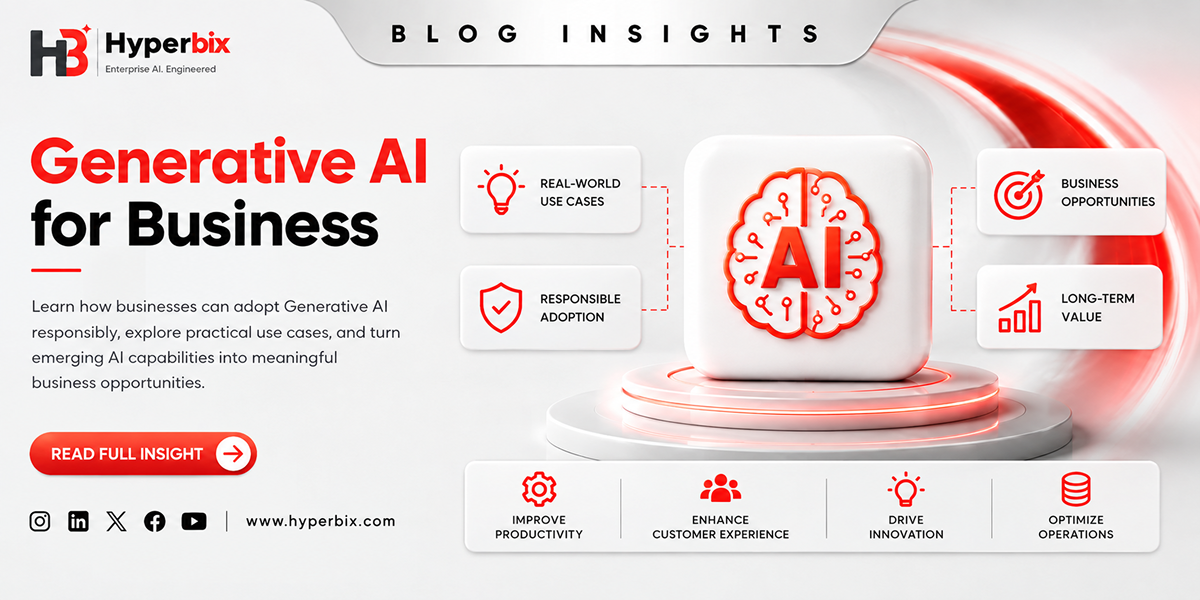
Generative AI for Business: An Overview
Generative AI is becoming a technology for modern businesses. It helps companies handle information better support customers effectively create content faster and make business processes smoother. According to the Stanford HAI’s 2026 AI Index Report, least 70% of organizations are already using Generative AI in at least one part of their business. This shows how quickly Generative AI is becoming a part of daily operations.
Many companies are now testing Generative AI in areas like customer service, software development, marketing, data analysis, employee assistance and managing company knowledge. Using Generative AI successfully isn’t just about picking the right tool. Businesses must find the use cases, for their needs. They also need to connect Generative AI to trusted and accurate data. They must set up rules and governance. They must make sure Generative AI fits well into the way they already work.
What Is Generative AI?
Generative AI is a kind of intelligence that can make new content by learning patterns from data that already exists. Generative AI can produce text, pictures, computer code, sound, moving pictures, summaries and many other kinds of content when a user gives it instructions or prompts.
For businesses, Generative AI can do more, than simple automation. Generative AI can help employees write drafts, answer questions, analyze information, support customers produce software code and use business knowledge.
How Generative AI Works?
Generative AI takes in amounts of data and learns patterns from it. It uses these patterns to generate new content. This happens based on what a user asks for or tells the AI to do. In a business environment the AI can also use company- information. That helps make the results more accurate and useful.
Generative AI Works: Step-by-Step
* Input – A user provides a question or a task to the AI.
* AI Model – The AI looks at the input. Tries to understand what is needed.
* Business Data – Some information about the company or outside facts are given to make the answer better.
* Generated Output – The AI makes the answer or the content that was asked for.
* Review – The answer is checked if needed and then put into the place, in the business process.
This process lets businesses use AI for tasks. They can write articles answer customer questions, shorten reports, analyze data or help with daily operations.
Why Businesses Are Turning to Generative AI?
Businesses are using generative AI to handle complicated information and make workflows simpler. It helps teams, with tasks that need understanding, writing, searching and working through amounts of data. Key reasons are:
Faster Access to Knowledge – Workers can easily find and understand information, from company documents and internal knowledge bases.
Personalized Experiences – AI can create responses, suggestions and content that match what each customer wants.
Better Employee Support – AI helpers can assist workers with research, writing, communication and daily questions.
Smarter Workflows – Generative AI can link parts of a process and cut down on extra manual work.
Improved Content Quality – Groups can. Improve different kinds of business content while still having people check it.
New Product Opportunities – Companies can add AI features to products or build new services that use AI.
Benefits of Generative AI for Businesses
Generative AI can create value that goes beyond automation by helping companies improve the way they handle knowledge interact with customers and come up with new ideas.
Faster Knowledge Discovery – Workers can locate information from big groups of documents without having to search through many different places manually.
Consistent Communication – AI can assist groups in keeping the same tone and message when dealing with customers when talking internally and when creating marketing content.
Improved Decision Support – AI can sort through information and show helpful summaries that help teams understand situations better.
Greater Business Agility – Groups can change content, processes and customer interactions quickly as the needs of the business change.
Employee Experience – AI helpers can take care of simple questions and offer support whenever it is needed which makes daily work easier, for employees.
Innovation Opportunities – Companies can use AI to look into new products, new services, new customer experiences and new business models that use AI.
Better Use of Business Knowledge – Linking AI with company data can turn information into a resource that is easy for workers to use.
Scalable Personalization – AI can help companies provide content, suggestions and interactions to a bigger group of customers.
Practical Business Applications of Generative AI
Generative AI can be used in different areas of business to help with daily tasks make processes better and make information easier to understand. Some of the useful uses are:
Content creation & Marketing: Create and improve blogs, product descriptions, email campaigns, social media posts and other marketing content while making sure human workers are in charge of the result.
Customer Service and AI Assistants: AI assistants can understand questions from customers give answers summarize discussions and help service teams get information quickly.
Sales and Finding New Customers: Generative AI can help sales teams look up customers send personalized messages summarize meetings and get ready for follow-ups using customer details.
Software Development: Programmers can use AI to write code explain ideas make test cases write documentation and get help with fixing problems.
Data Analysis and Business Intelligence: AI can take business data and turn it into simple summaries find trends answer questions asked in normal language and help teams understand reports.
Human Resources and Hiring: HR workers can use AI to write job postings answer employee questions summarize job applications and help with communication.
Finance and Accounting: Generative AI can help with handling documents making reports, managing invoices creating reports and answering questions, about money.
Product Development: Teams that make products can use AI to look at customer feedback find needs come up with new ideas and write product documentation.
Industry-Specific Applications of Generative AI
Generative AI is not limited to technology companies. Different industries can apply it according to their workflows and information needs.
Healthcare
Healthcare organizations can explore AI for clinical documentation assistance, patient communication, medical information retrieval, administrative workflows and research support. High-impact healthcare applications require privacy, accuracy and human oversight.
Finance & Banking
Financial organizations can use AI for customer service, document analysis, internal knowledge assistants, report summarization and employee support. Security and regulatory requirements make governance especially important, in applications.
Retail & E-commerce
Retail businesses can use AI for product descriptions recommendations, customer support, marketing content review analysis and merchandising assistance.
Manufacturing
Manufacturers can apply AI to technical documentation, maintenance knowledge, employee assistance, process documentation and operational support.
Education
Educational organizations can use AI for learning assistance, content generation, personalized explanations, administrative support and knowledge discovery.
Real Estate
Real estate businesses can use AI for property descriptions customer communication, lead qualification, document summarization and property search assistance.
Professional Services
Consulting, legal, accounting and other professional service organizations can use AI to assist with document review, research, summarization, knowledge management and client communication. Because professional services often handle information data governance is a critical consideration.
Generative AI vs. Traditional AI
Knowing the difference, between Generative AI and Traditional AI helps companies pick the technology for their own needs. The right choice can lead to results and faster progress.
Generative AI | Traditional AI |
Creates new content | Analyzes or predicts using data that's already available |
Generates text, images, code and other outputs giving you material. | Does tasks like classification, prediction, detection or recommendation |
Often works with natural-language prompts making it easy to ask for help. | Usually works with structured data and clear goals |
Useful, for content and knowledge-based workflows helping teams stay organized. | Helps with things like forecasting future trends finding fraud, scoring items and spotting patterns |
Can produce human-like outputs sounding natural and approachable. | Typically gives a clear output such, as a prediction, score or decision |
Both the traditional and generative approaches can work together. If traditional AI could detect unusual activity while generative AI explains the finding in natural language.
Also Read: Generative AI vs. Traditional AI
Generative AI Tools for Business
Generative AI tools help companies create content. They help automate tasks, analyze information, support employees, and Improve customer interactions. These tools can work on their own. This depends on what the company needs.
AI Assistants for Employee Productivity - AI assistants help employees write messages break down information manage tasks and find answers fast. They make regular business tasks simpler to handle.
AI Writing Tools for Content & Communication - AI writing tools help with blogs, emails, product details, reports and other business content. They help teams come up with ideas fix drafts and keep communication steady.
AI Coding Assistants for Software Development - AI coding assistants help developers write code find mistakes create tests and explain how things work. They act as helpers during development while letting engineers check and control the code.
AI Customer Support Platforms for Automated Service - AI customer support platforms can answer questions understand what customers need and help solve problems. They can also help workers by summarizing talks and finding important info.
AI Analytics Tools for Business Insights - AI analytics tools let users look into business data by asking questions in language and get clear insights. They can help spot trends summarize reports and back decisions with data.
AI Knowledge Assistants Connected to Internal Information - AI knowledge assistants link to company-approved documents, databases and knowledge bases to answer employee questions. They make it easier for workers to find company info without going through sources.
AI Image & Media Tools for Creative Production - AI image and media tools can make visuals, marketing materials, presentations, videos and other creative items from instructions. They help creative teams try out ideas and make content faster.
AI Development Platforms, for Customized Applications - AI development platforms offer tools and systems for making custom AI apps, agents and steps. They can help with bringing models connecting data, testing, launching and managing apps.
How to Implement Generative AI in Your Business?
Implementing Generative AI means finding the right business needs selecting the best Generative AI technology preparing the needed data and weaving it into current workflows.
Identify Business Problems
Begin by spotting processes where employees or customers face work information bottlenecks or communication challenges.
Choose the AI Use Case
Not every business problem calls for Generative AI. Pick Generative AI use cases where the improvement's clear and measurable.
Select a Generative AI Model or Platform
Pick a model or platform that fits the application’s requirements, data sensitivity, integration needs, output quality and level of customization.
Prepare Data and Infrastructure
Business information must be gathered and accessible to AI. Before providing it, set up storage, permissions, security and infrastructure for data, and also for AI's operational setup.
Connect data with AI
Integrate AI into current operations. AI should seamlessly plug into applications that the staff use. For this, an connection to the company’s system might be created-or more specifically, to ERP, CRM, analytics, helpdesk, or document management systems.
Test, Monitor, and Optimize
Evaluate Generative AI outputs before and, after deployment. Keep an eye on accuracy user feedback, security, system performance and business outcomes. Continuous improvement is important because business requirements, data, models and user expectations can change.
How to Identify the Right Generative AI Use Cases?
Businesses should pick Generative AI use cases that give value to the business are practical to implement and carry manageable risk instead of using Generative AI simply because Generative AI is easy to try.
Assess Business Needs: Look for processes where Generative AI can fix problems make people work faster or make customers feel better.
Evaluate Potential ROI: Think about how Generative AI will change productivity reduce operating costs increase revenue or raise customer happiness.
Analyze Risk and Rewards: Weigh the good outcomes of Generative AI against the dangers of data privacy loss mistakes, in accuracy security holes, bias and legal compliance.
Prioritize High-Impact, Low-Risk Opportunities: Look for situations where the business benefits are obvious and the chances of problems, with technology or how things work are small
Decide Whether to Build or Buy: Check if a current AI product works for what you need or if making something new gives more control and fits better with what you already have.
Challenges and Risks of Generative AI
Generative AI opens up many opportunities for organizations, although the challenges may need to be managed. It refers to possible issues and constraints that companies or individuals may encounter while utilizing AI software that produces text, graphics, programming codes, or other forms of data.
Data privacy and security
The AI application might process sensitive customer, employee, financial, or company data. Companies would need adequate access controls and security policies.
Accuracy and Hallucinations
The output from the AI may be accurate but sound plausible. In business use-cases where accuracy is required, validation and trusted sources should be employed along with human oversight.
Bias and Responsible AI
AI could produce an output which reflect bias. Companies would be required to inspect it to verify its fairness and also promote responsible AI usage.
Intellectual property rights
Companies would need to comprehend the way in which AI-created content and third party data are related to existing copyright, ownership and other IP laws.
Costs and Scalability
Application of the AI doesn't involve solely the use of the model but other issues like infrastructure, data processing, integrations, security, monitoring and maintenance are also of consequence.
Over-dependence on AI
AI should never be used in scenarios where human judgment, responsibility, and knowledge of the context required.
Generative AI Governance & Responsible Adoption
Generative AI governance helps businesses set rules about how AI is made accessed and used in the whole company. A responsible approach balances ideas with safety, correctness, privacy and responsibility.
Define AI Usage Policies – Provide rules about which AI tools are allowed what tasks they can do and what employees must do.
Protect Business Data – Keep information locked and stop confidential data from leaking via AI systems.
Maintain Human Oversight – Keep people in charge of decisions when AI results can have impacts, on customers, employees or business operations.
Evaluate AI Outputs – Frequently review AI responses to make sure they are accurate, fair, dependable and relevant.
Ensure Transparency – tell customers and employees when they are dealing with content made by AI or systems powered by AI.
Monitor AI Systems – Watch performance, security, usage and any problems after AI is put into service.
Review and Improve – Keep AI rules. Controls fresh, as business needs, technology and laws change.
Businesses should also decide which tasks AI can do on its own and which tasks still need a human to approve them. Using AI responsibly does not mean stopping employees from using it. It means setting limits so that employees can use AI in a productive and safe way.
How Businesses Can Measure Generative AI ROI?
Businesses can measure Generative AI return on investment by comparing the value that an AI solution creates with the resources needed to set it up and run it.
Productivity Gains - Measure how AI helps employees finish tasks faster and concentrate on valuable work. Compare how fast tasks are finished how work there is and how much employees produce before and after AI is adopted.
Operational Efficiency - Evaluate how processes like document handling, customer support and content creation get better. Look for manual work fewer bottlenecks in processes and smoother workflow.
Customer Experience - Track if AI makes responses better increases customer satisfaction boosts engagement and makes service easier to reach. Customer feedback and service metrics can show if AI is creating an experience.
Revenue Impact - Identify if AI brings in leads more conversions, more sales chances or keeps customers longer. Connect AI-supported activities to changes in business revenue.
Cost Optimization - Assess if AI cuts manual work or improves how existing resources are used. Focus on operational savings instead of measuring AI success only by how much it is used.
AI Performance - Monitor accuracy, response quality how much it is. How many tasks are completed successfully. Strong AI performance, with measurable business improvements gives a clearer picture of overall ROI.
If an AI support assistant reduces repetitive questions handled manually while maintaining customer satisfaction, the business can evaluate the resulting operational improvement. The right metrics should be connected to the original business objective.
Future of Generative AI in Business
Generative AI is becoming more smart, connected and focused on business uses. Of just being used for making content or giving answers AI will help with full processes and business activities more and more.
AI Agents and Automatic Workflows – AI agents can do tasks that have steps use business tools and manage workflows with very little help from people.
Multimodal AI – Companies can mix text, pictures, sound, videos and data to make AI experiences.
AI Help for Making Decisions – Generative AI can take business details and turn them into summaries, ideas and suggestions to help with better choices.
More Personal Experiences – AI can offer products, content, ideas and customer help that are more suitable, for each person.
AI Built Into Business Programs – Generative AI will be more and more included in CRM, ERP data analysis, customer support and other company software.
AI Made Just for the Company – Businesses can create AI systems that work with their data, their own ways of doing things their own rules and their own industry needs instead of just using tools that are not specific.
Why Choose HyperBix to Turn Generative AI Into Business Value?
Choosing the right Generative AI development partner can make a big difference when turning an AI idea into a real business solution. HyperBix helps businesses look at AI applications that match their own operational needs, customer demands and overall business goals.
The focus should be on building solutions that work well with workflows. This means creating AI-powered assistants, knowledge systems or custom generative AI tools that actually help people do their jobs better. It’s not about adding technology just because it’s new. It’s about using it where it makes sense.
It can also involve using RAG-based knowledge solutions building AI assistants and agents putting in place security and access controls and always watching and improving AI performance to make sure the solution gives business value. The goal is simple: take AI abilities and turn them into useful business results.
Conclusion
Generative AI has moved beyond experiments. It Is now a practical technology for businesses in many industries. It is valuable because it solves problems. It can help employees find information improve customer support, automate repetitive tasks, support content creation and make business data easier to understand. They should think about data privacy, accuracy, intellectual property, bias, security and governance well as the benefits.
The best way is to start with a business problem pick the right Generative AI use case link the technology to reliable business data weave it into current workflows and keep checking the results. When used carefully Generative AI can be more, than a productivity tool. It can become a part of how a business works serves customers and creates value.
Blog FAQs
Frequently Asked
Questions
Generative AI for business involves leveraging AI systems to produce content, handle information, support workers, customer service, and optimize business processes as per the needs of specific business organizations.
Businesses can leverage Generative AI to generate content, customer service, sales, software development, data analysis, HR, finance, product development, knowledge management, and other business processes.
Information is accessed quickly, productivity is improved, customers are provided with more personalized experiences, decision support is enhanced, workflows are streamlined, personalization is scalable and there are new opportunities for innovation.
Traditional AI is typically used for prediction, classification, detection, recommendation, pattern recognition and more whereas Generative AI is dedicated to generating content and flexible responses.
Potential issues include data privacy and security inaccurate or hallucinated results, bias, intellectual property rights, operational needs and reliance, on AI.
Businesses should start by finding a problem to solve choosing the right AI use case and model getting data ready setting up infrastructure blending AI into current workflows and keeping a tight watch on the solution with continuous testing and monitoring.
Yes Generative AI applications can link to approved business data sources such as documents, databases, CRM systems and knowledge bases. Technologies such as RAG can help AI pull useful information while it creates answers.
Businesses can measure ROI of AI adoption by productivity increase, operational efficiency improvement, customer satisfaction improvement, increase in revenue, optimization in costs, user adoption, etc. They can use relevant AI metrics also to measure the benefit.
Not always. Human oversight matters a lot for high-impact or business-critical tasks where accuracy, professional judgment, accountability and regulatory rules must be met.
HyperBix supports businesses in creating Generative AI solutions that fit their goals and workflows. We offer custom AI applications, AI assistants, RAG-based solutions, AI agents, business integrations and secure AI implementation.